
- Session length
- 2 to 5 minutes, several times a day, spread across normal routines
- Skill
- Settle and calmness
- Suits
- Puppy
What you need
- A crate sized correctly for your puppy's current size, with comfortable washable bedding
- Small pieces of soft food, and something longer-lasting such as a stuffed chew for quiet time inside
- A quiet corner of the home, away from a radiator, direct sun or a draughty doorway
A crate only works as a management tool if it already means something good to your puppy before you ever need to rely on it. Rushed introductions, where the door closes on the first day for the sake of a quiet evening, tend to create exactly the anxiety that makes a crate look like a bad idea in the first place. Done properly, the process is slow at the start and fast towards the end, because a puppy who chooses to walk in for food will accept a closed door far sooner than one who has been pushed inside.
Purpose
To build a genuine positive association with the crate, so your puppy enters it freely and settles calmly, before the door is closed for even a few seconds. The finished behaviour for this lesson is a puppy who walks into an open crate on their own to eat, lies down inside without fuss, and tolerates the door being shut for short periods while remaining relaxed rather than merely quiet.
Prerequisites
Your puppy can already settle briefly on a mat with you nearby, from the previous lesson, and you have a crate sized so they can stand up, turn around fully and lie flat without touching the sides. A crate that is too large will not feel den-like and one that is too small is uncomfortable, so check the sizing before you start rather than partway through.
Equipment
The crate itself, fitted with washable bedding that feels comfortable rather than thin or slippery. Small, soft food for the early stages, and a longer-lasting chew or stuffed food toy for once your puppy is settling inside for a minute or two. Place the crate in a quiet corner of a room the household actually uses, away from a radiator, a draught from an outside door or direct sun through a window, so the space itself is comfortable regardless of the training.
Method
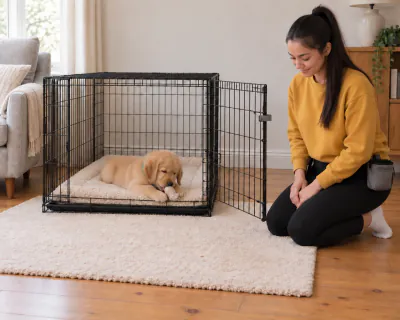
- Prop the crate door fully open so it cannot swing and startle the puppy, and leave it set up permanently as ordinary furniture rather than only appearing at bedtime.
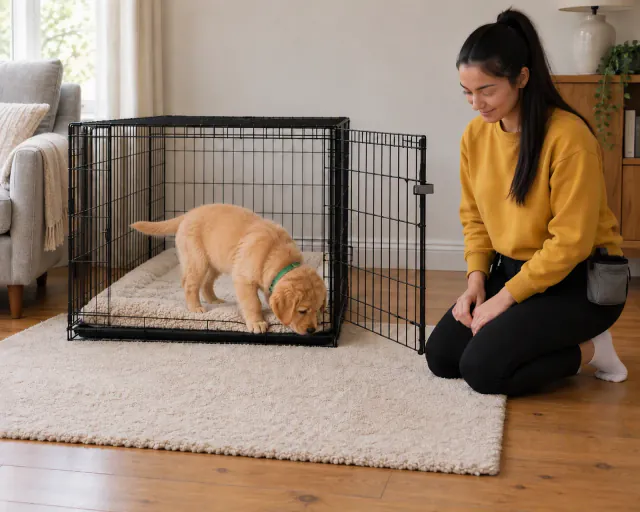
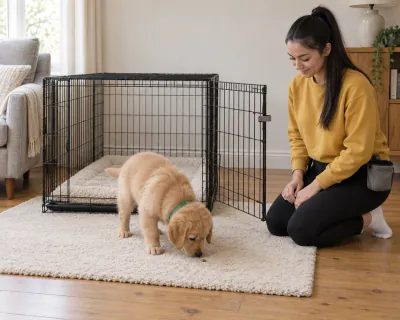
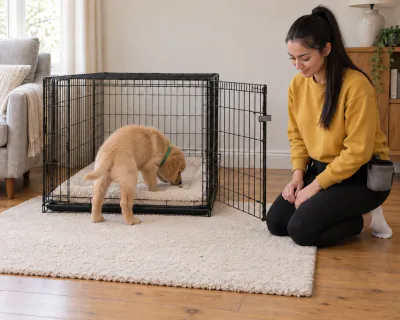
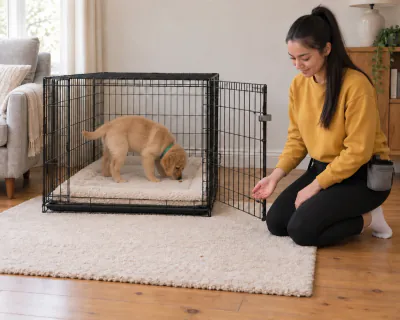
- For the first few days, feed all meals near the crate, then just inside the doorway, then further inside as your puppy becomes comfortable following the bowl.
- Through the day, toss small pieces of food into the back of the crate at random moments so your puppy learns that good things appear there even when no meal is happening, and let them come and go freely.
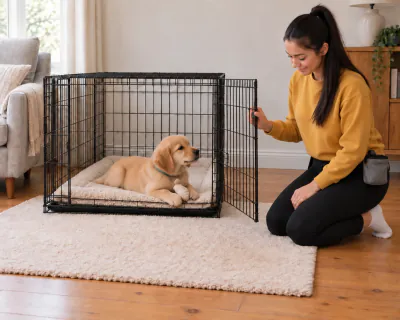
- Once your puppy is choosing to wander in and out on their own and will lie down inside with the door open, start offering a stuffed chew inside the crate for a minute or two while you stay in the room.
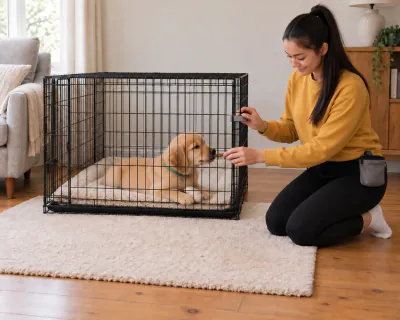
- Only once your puppy is genuinely relaxed lying down inside, not just tolerating it, begin very short door-closed intervals: close the door for two or three seconds, feed a piece through the bars, then open it again before any reaction builds.
- Extend the closed time gradually, a few seconds at a time, staying in the room throughout the early sessions so your puppy is not learning to cope with the door and your absence at the same time.
- If your puppy whines or scratches at the door, avoid opening it while they are actively protesting, since that teaches the door opens on demand. Wait for even a brief pause, then open immediately and go back to a shorter duration next time.
- Once your puppy will settle for a few calm minutes with the door shut and you in the room, begin stepping a short distance away before returning, still keeping total time brief.
Session length
Two to five minutes at a time, but spread across several points in the normal day rather than treated as one formal session, since feeding and casual food drops throughout the day do most of the work here.
Progression criteria
Move on from free-choice entry when your puppy walks into the open crate for food without hesitation on eight out of ten offers, across three separate days. Move on from the door-closed stage when your puppy remains visibly relaxed, lying down rather than standing alert at the door, for a full minute with the door shut and you present, on eight out of ten attempts. Then add difficulty one variable at a time: extend the closed duration first, then add distance by leaving the room briefly while still within earshot, and only once both of those are solid should you introduce a normal household distraction, such as television noise or another person moving about nearby.
Common mistakes
Closing the door on the very first session, before any positive association exists, is the single biggest reason crates go wrong. Using the crate to end unwanted behaviour, such as putting an overexcited puppy away to calm down, quietly turns it into a place associated with being removed from the fun rather than a place of rest. Leaving a puppy crated for long stretches as soon as the door closes without success, before duration has been built gradually, undoes the earlier work. Covering the entire crate to block sound and light can help some puppies settle, but doing this before they are comfortable can make an unfamiliar space feel more enclosed rather than safer.
Troubleshooting
If your puppy refuses to go anywhere near the crate even for food, move the food a little further from the entrance and build up gradually over several sessions rather than luring them fully inside on day one. If barking or scratching appears the moment the door closes, you have moved too fast; go back to a duration where your puppy was previously calm and rebuild more slowly from there. A puppy who is generally anxious when briefly separated from people, rather than specifically unsettled about the crate, needs that separation-related distress addressed with a qualified behaviourist working alongside your vet, since a short introduction lesson like this one is not designed to resolve broader anxiety on its own.
Safety and when to stop
Stop and open the door immediately if your puppy shows genuine panic rather than ordinary protest: frantic scrabbling, attempts to chew or claw through the bars, or sustained distress that does not settle within a few seconds of quiet. Never use the crate as a punishment, and never close the door on a puppy who is already upset, since this teaches the crate predicts distress rather than rest. Keep confinement times short at this age; a puppy’s bladder control develops gradually, and the next lesson builds the toileting routine that tells you how long is reasonable at your puppy’s current stage.
Next lesson
With a crate your puppy chooses to use, move on to building a toilet-training routine, which uses the same confinement space as part of a wider schedule.
Related reading
This lesson covers the behavioural side of crate introduction. For choosing the right size, material and placement before your puppy arrives, see our guide on how to crate train a puppy.