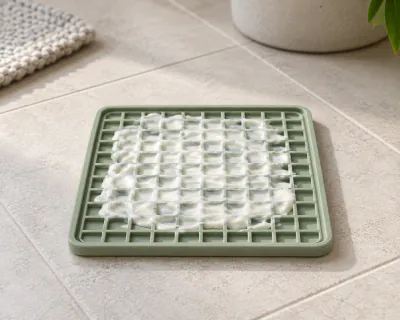
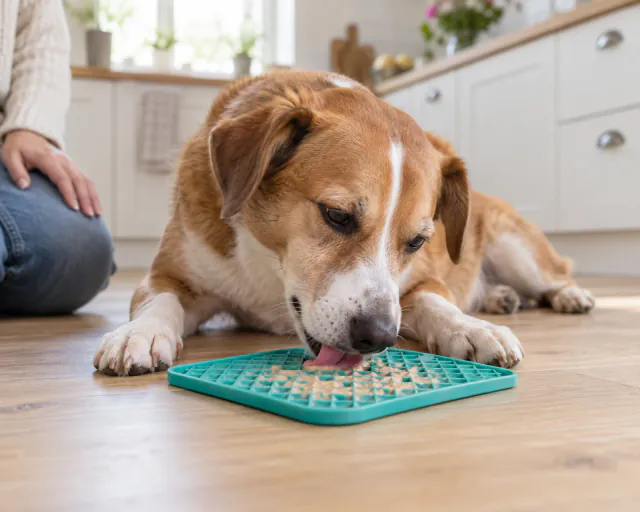
A lick mat is a sheet of textured rubber, or a shallow textured bowl, spread with soft food so a dog licks it off a little at a time. It suits dogs that would rather lick than chew, and owners who want to give a dog something quiet to do during a bath, a nail trim or a busy half hour in the kitchen. This guide answers which lick mat suits your dog, and how to use one safely. It covers mats and lick bowls only: stuffable toys and toys that release kibble as they roll are compared in our food-dispensing dog toys guide, and bowls that break up a whole meal of kibble in the slow feeder bowl guide.
How products are chosen
Canine Origin has not tested these mats hands-on. Each one was chosen from the maker’s published details and a UK stockist’s listing, and every specification on the product cards names its source. The criteria were the material and any rigid base, the surface texture and the food the maker designs it to hold, the published sizes and the dogs they are meant for, how the mat is held still (suction cups, straps or a bowl shape), freezer and dishwasher instructions, the maker’s supervision advice, and a current UK listing. Makers’ statements about what licking does for a dog’s mood or health played no part in the choice and are not repeated here. How long a particular dog stays interested, how a texture wears after months of washing, and how well suction cups grip your own tiles can only be judged in use, so no claim is made about them.
What a lick mat is for, and what it is not
Licking food out of a textured surface takes far longer than eating it from a bowl, so many owners use a mat to give a dog a quiet, absorbing activity: in the bath, on the grooming table, or on a wet afternoon when walks are short. The RSPCA reminds owners that dogs get bored and need suitable things to chew and play with, and a lick mat is one small option alongside walks, play, training and sniffing. Our guide to enrichment and boredom shows how they fit together.
A mat does not change how a dog feels about being left alone or handled. A dog that panics when alone, or is frightened of handling, needs a vet check and then a qualified behaviourist, and should never be left with a mat unwatched. For routine brushing and nail work, the grooming handling lesson builds handling up step by step.
Texture and groove depth
The surface pattern decides which foods stay put and how long they take to lick off. Most mats use one of three broad textures.
- Criss-cross grooves or square pockets hold spreads, wet food and small soft chunks. Shallow grooves suit a beginner; deeper pockets hold more and take longer to clear.
- Raised nubs or fine bristle-like tips hold thin spreads, yoghurt and runny food between them, and make a small amount last.
- Honeycomb cells sit between the two, with each cell holding a small dab of food.
Start with a texture and a food that let the dog succeed quickly, because a dog that licks for a minute and gets almost nothing tends to give up. Once it is keen, a finer texture, a thinner layer or a frozen mat makes the same food last longer. Flat-faced dogs such as Pugs and French Bulldogs may find a flat mat easier than a deep bowl, as there is no rim to press their face against.
Rubber, silicone and rigid bases
Most lick mats are made from thermoplastic rubber (TPR) or silicone. Both are soft and flexible, which is what lets a tongue work food out of the grooves, and neither is designed to be chewed. A soft mat left with a dog that likes to chew can be torn, and the pieces can be swallowed.
Care instructions vary, even between soft mats: some are hand wash only, some go in the dishwasher on the top rack, and one silicone mat sold in the UK is labelled as unsuitable for the dishwasher altogether.
For dogs that chew, some makers bond the rubber surface to a rigid plastic base, so the dog cannot fold the mat or get its teeth round an edge so easily. That makes a mat harder to damage, not impossible to damage, so a tougher mat is a better choice for a chewer rather than a reason to leave the room. If the dog chews many things around the home, our guide to chewing explains what drives it.
Keeping it still: suction cups, straps and bowls
A mat that slides across the floor frustrates the dog and spreads food around the kitchen. There are four common answers.
- Suction cups hold a mat to a smooth surface such as glazed tiles, glass or the side of a bath. They grip poorly on textured or dusty surfaces, and a dog that paws at the mat can pull one free, so check the grip first. A mat on the side of the bath gives the dog something to do while it is washed; our guide to bathing a dog covers the rest of the routine.
- Straps fix a mat to crate bars or a grooming table leg. Use them only while you are there, and remove the mat and straps afterwards.
- A bowl shape keeps runnier food behind a rim. Some lick bowls rock as the dog licks, which can unsettle a dog that dislikes things moving under its nose.
- A rigid holder, sold separately by some makers, grips a flat mat and covers its edges.
Choosing the right size
Choose a mat big enough that the dog can lick it without chasing it across the floor, and far too big to fit in its mouth. For a toy breed or a young puppy, a small mat keeps the portion small and easy to finish. A large dog on a small mat tends to push it along with its nose and clear it in moments, so a larger mat, or a smaller one in a holder, suits it better. Read the maker’s guidance on dog size: one UK stockist lists a standard mat as unsuitable for dogs over 50 kg unless it sits in the maker’s holder.
Size also sets how much food goes down, because a bigger mat invites a bigger smear. Decide the portion first, then spread it thinly rather than filling every groove.
How the five compare
The LickiMat Classic Buddy is the plain starting point, made in three sizes, but it is hand wash only and not for chewers. The SodaPup Honeycomb eMat is the soft flat mat to choose if you want to use the dishwasher, and it is not for chewers either. The LickiMat Tuff Pro Soother adds a rigid base for chewers and teething puppies, with a fine texture that suits thin spreads more than chunks. The LickiMat Wobble swaps the flat surface for a rimmed bowl that holds wetter food and moves as the dog licks. The LickiMat CrateMate is the one to fix to a crate, bath or grooming table, and it holds only a small portion.
Four of the five come from one maker. That reflects which lick mats could be confirmed with published specifications and a current UK listing, not a judgement that other makers’ mats are worse.
What to spread, and what to leave out
Keep fillings simple and soft. Good options are part of the dog’s usual wet food, its usual kibble soaked until soft and mashed, or a little plain, unsweetened yoghurt if it agrees with the dog. Avoid thick, sticky spreads that dry hard in the grooves; one UK stockist’s listing advises against undiluted peanut butter and foods that dry out.
Never use anything that contains xylitol, a sweetener in some sugar-free foods. The US Food and Drug Administration warns that it can cause a dangerous drop in a dog’s blood sugar, and lists some peanut and nut butters among the products that may contain it. Read the ingredients of any spread, especially one sold as sugar-free or low in sugar. If a dog eats xylitol, contact a vet straight away: the FDA notes that signs such as vomiting, weakness, seizures and collapse can take up to a day to appear.
Whatever goes on the mat is part of the day’s food. The PDSA suggests treats make up no more than 10% of a dog’s daily food allowance, with meals reduced to match, and suggests setting part of the day’s food aside as the treat allowance. A lick mat makes that easy: spread some of the dog’s usual food and take the same amount out of its bowl. Our guide to treats and daily energy intake explains how to keep track.
Freezing, cleaning and replacing
Freezing a spread mat makes it last longer. Lay it flat in the freezer, and save frozen mats for a dog that already knows how to use one unfrozen.
Wash the mat after every use, because wet food and yoghurt left in the grooves spoil quickly. Soak it in warm, soapy water, then work the grooves with a stiff brush or an old toothbrush, which reach between nubs better than a sponge. Use the dishwasher only if the maker says the mat is dishwasher safe, on the top rack where stated, and dry the mat fully before storing it.
Replace a mat once it has tears, splits or missing pieces, once nubs have been bitten off, once a rigid base has cracked or begun to separate from the rubber, or once the grooves no longer come clean.
Safety and supervision
Treat every session as supervised. The makers here advise it, at least while a mat is new, and a soft mat can be damaged quickly by a bored dog.
- Take the mat away once it is licked clean. An empty mat is the point at which many dogs start to chew.
- Remove it at once if the dog starts chewing, tearing or folding it, or if any piece comes off. Swallowed rubber can cause choking or a blockage in the gut. If a dog has swallowed part of a mat, or starts retching, vomiting or seems uncomfortable, call a vet.
- Move a chewer to a rigid-based mat or a holder, and still stay with it.
- Check suction cups and straps before each use: a suction cup pulled free is small enough to swallow.
- In a home with more than one dog, give mats in separate rooms or behind a baby gate, because food can cause tension even between dogs that normally get on. A dog that stiffens, growls or guards its mat should have its sessions alone, and guarding that persists needs a qualified behaviourist.
Before you buy: six questions
- Does my dog lick, or does it chew? A chewer needs a rigid-based mat or a holder, and close supervision either way.
- Is the mat big enough that my dog cannot fit it in its mouth, and small enough to hold a sensible portion?
- Which texture suits the food I plan to use: grooves or pockets for wet food, fine nubs for thin spreads?
- Where will I use it: on the floor, in the bath, on the grooming table or clipped to a crate?
- How will I clean it, and does the maker allow the dishwasher?
- Have I checked every spread for xylitol, and planned the portion as part of the day’s food?