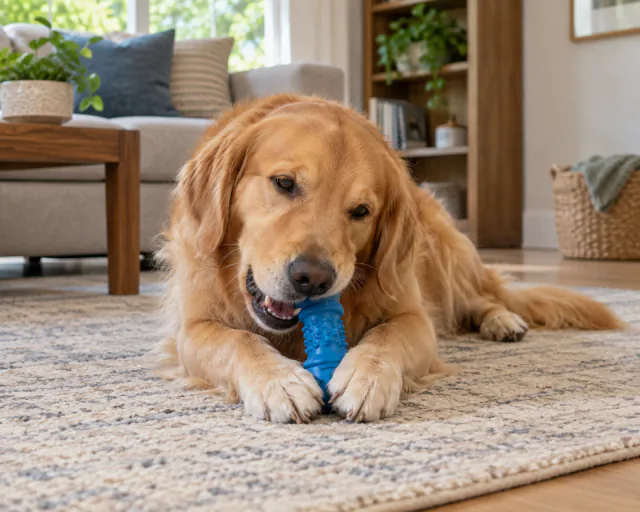
Chewing gets treated as a puppy problem that a dog should grow out of, and that framing causes more damaged shoes and more frustrated owners than almost anything else in this category. Chewing is a normal behaviour throughout a dog’s life, not a phase confined to teething. It serves real purposes: it exercises the jaw, it relieves stress, it occupies an otherwise idle mouth, and it is one of the main ways dogs explore texture and object.
Because chewing is not going away, the realistic goal is redirecting it towards appropriate things rather than eliminating it altogether. This guide covers matching chew items to the individual dog, keeping valuable and dangerous items out of reach in the first place, what to do when a dog already has something they should not, and how to tell ordinary chewing apart from a pattern that needs a closer look.
Chewing is normal at every stage, not just in puppies
Puppies chew heavily while their adult teeth come through, roughly between three and six months, and sore gums make chewing genuinely soothing during that window. But chewing does not stop once the adult teeth are in. Adolescent dogs, adult dogs and senior dogs all chew, for reasons that have nothing to do with teething: settling after a busy day, occupying time alone, working through mild stress, or simply because gnawing on something is enjoyable in its own right.
Treating adult chewing as abnormal or as a training failure misses what is actually going on for most dogs. The more useful question is not “why is my adult dog still chewing” but “does this dog have an appropriate, safe outlet for a behaviour they are always going to want to do.”
Matching chew items to the individual dog
Not every chew item suits every dog, and the wrong match causes real harm, from broken teeth on something too hard to a dog swallowing pieces of something too soft or destructible. A dog’s chewing strength, jaw size, age and any dental history all affect what is appropriate, and this varies more between individual dogs than breed alone would suggest.
As a general guide, avoid anything hard enough that you would not want it swept across your own knuckles, since that level of hardness can fracture teeth. Avoid anything that breaks into pieces small enough to swallow whole or splinter into shards, and avoid cooked bones specifically, which splinter more readily than raw. Supervise any chew item that is new to a dog until you know how they handle it, and remove worn-down items before they become a size that could be swallowed. If you are unsure what is appropriate for a particular dog’s age, size or dental history, ask your vet, since they can factor in anything specific to that dog rather than a generic recommendation.
Puppy-proofing rather than relying on restraint
A puppy, and to a lesser extent an adolescent dog, has no innate sense of which household objects are acceptable to chew and which are not. Shoes, remote controls, skirting boards, electrical cables and children’s toys all look identical to a chew stick from the dog’s point of view. Expecting a young dog to learn this distinction through correction alone is unrealistic and puts both the dog and valuable or dangerous items at ongoing risk.
Puppy-proofing the space the dog has access to, putting valuables out of reach, using stair gates or a pen to limit unsupervised access to certain rooms, and keeping appropriate chew items readily available in the areas the dog spends time in, does far more than any amount of telling a puppy off after the fact. Electrical cables deserve particular attention, since a chewed cable is a genuine safety hazard rather than only a cost. As the dog matures and demonstrates reliable choices, supervised access to more of the house can be extended gradually.
Swap, don’t snatch
If a dog already has something inappropriate in their mouth, resist the instinct to grab it or wrestle it away. A sudden grab can startle a dog into gulping the item down faster, and it also teaches the dog that a person approaching their mouth means something is about to be taken, which can make a dog more inclined to run off with items or, in some cases, more protective of what they are holding.
A calm trade for something better, a piece of food or a more appealing chew item, is both safer and more effective, and it is the basis of the reliable “drop it” skill covered step by step in the training lessons at puppy drop and release and beginner drop it reliably. Those lessons build the swap into a trained, reliable cue; this guide covers only the underlying reasoning and the immediate safety point. If a dog has swallowed something that could be dangerous, or if an item was toxic, contact your vet promptly rather than waiting to see what happens.
When chewing is more than normal behaviour
Occasional chewing of an inappropriate item, a puppy testing a chair leg, an adult dog working through a favourite toy until it falls apart, is unremarkable. A pattern of chewing that is frequent, destructive on a scale well beyond ordinary wear, focused on exit points such as door frames and window sills, or that appears specifically when a dog is left alone, points towards something underlying that a chew toy alone will not solve.
Boredom is one common driver, particularly in dogs with more energy and mental capacity than their daily routine currently uses. Increasing physical exercise suited to the individual dog, along with mental enrichment such as food puzzles, scent games and training sessions, often reduces chewing that stems from an under-stimulated dog. Anxiety is another driver, and destructive chewing that is concentrated around departures, doors and windows can be a sign of distress at being left alone rather than simple boredom. This pattern is covered in more detail in the barking guide’s section on anxiety-related barking, since the two often occur together, and it is worth an individual assessment from a qualified behaviourist alongside a vet check, since medical discomfort can also drive excessive chewing and is worth ruling out first.
Building good long-term habits
Rotate a small selection of chew items rather than leaving everything out permanently, since novelty makes a familiar item interesting again. Offer a chew item during predictable higher-arousal moments, such as when visitors are due to arrive or before a period the dog will spend settling, since chewing has a genuinely calming physiological effect that can be put to good use rather than only managed after the fact. Keep supervising new items until you are confident in how a particular dog handles them, and replace anything that has become small enough to be a choking risk, rather than waiting until it visibly breaks.