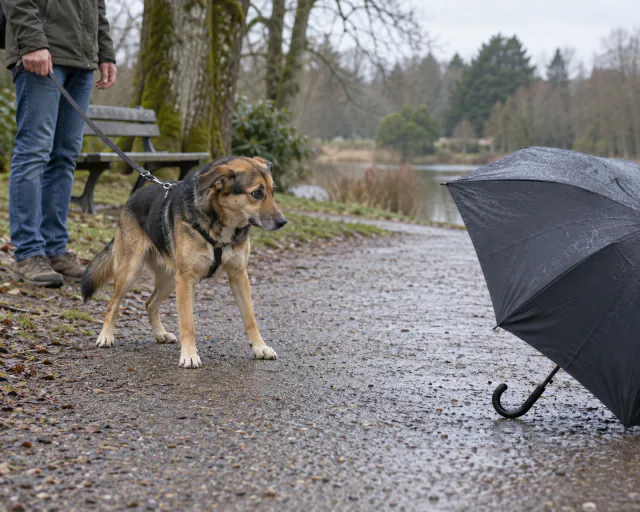
Nearly every dog reacts with a moment of wariness to something new at some point, a sudden noise, an unfamiliar object, a stranger appearing suddenly, and this on its own is a normal, healthy response rather than a problem to be solved. The difficulty comes in telling that everyday caution apart from more significant fear, and in knowing how to support a dog through either one without accidentally making things worse.
This guide covers how to distinguish mild, resolving wariness from fear that is more significant, the general principles that help a fearful dog cope, and why trying to force exposure to a frightening trigger tends to entrench fear rather than reduce it. Fear that is persistent, intense or not improving with sensible support is a matter for a qualified behaviourist, and it is also worth ruling out a medical contribution with a vet, since pain, sensory decline and other health issues can produce or worsen fearful behaviour.
Mild wariness versus significant fear
Everyday wariness looks like a brief pause, a moment of watching or sniffing towards the new thing, perhaps a step back, followed by the dog relaxing and moving on within a short space of time, often on their own initiative. A dog encountering a new type of bin on a walk, briefly startling at an unfamiliar sound, or watching a stranger cautiously before approaching for a sniff is showing a completely ordinary response to novelty.
Significant fear looks different in both scale and persistence. Signs include freezing in place and refusing to move, trembling or shaking, trying to escape or actively bolting, hiding behind furniture or a person, refusing food the dog would normally take readily, excessive drooling, dilated pupils, panting when not hot or exerted, and a failure to settle even once the trigger has been removed or the dog has had time to recover. A dog who shows this pattern repeatedly around the same trigger, or whose fear does not reduce with calm, repeated, low-intensity exposure over time, is showing something more significant than ordinary caution.
The distinction matters because the right response differs. Mild wariness usually needs nothing beyond patience and allowing the dog to approach in their own time. Significant fear needs a considered plan, and pushing a dog experiencing significant fear to “get used to it” through repeated confrontation tends to make the fear worse rather than better.
General principles for supporting a fearful dog
Never force a fearful dog physically or verbally towards what frightens them. Picking a dog up and carrying them towards a trigger, dragging them on a lead, or repeatedly encouraging them forward removes the one thing that helps most, which is the dog’s own sense of control over the distance between themselves and whatever is worrying them.
Allow retreat and choice wherever it is safe to do so. A dog who can move away from a trigger, and finds that moving away is respected rather than blocked or reversed, learns that they have some agency in the situation, which itself reduces overall anxiety over time. Where retreat is not practical, such as at a vet practice or in a lift, increasing distance from the trigger as much as the situation allows, and keeping the encounter as brief as reasonably possible, achieves something similar.
Pair calm distance from the trigger with something positive, such as food the dog particularly enjoys, delivered while the dog is aware of the trigger but not so close that they cannot eat or engage with it. This general principle, sometimes called counter-conditioning, works by building a different association with the trigger over repeated, well-managed exposures, but it needs to happen at a distance and intensity the dog can actually cope with, which is often much further away and much milder than people initially assume. For significant fear, a qualified behaviour professional should set that distance and pace for the individual dog.
Move at the dog’s pace rather than a schedule that suits the household. Fear responses do not resolve on a fixed timeline, and trying to hurry progress by increasing exposure faster than the dog is ready for typically causes a setback rather than faster improvement.
Why flooding usually makes fear worse
Flooding means exposing a fearful dog to a frightening trigger at full intensity and preventing escape, on the theory that the dog will eventually stop reacting once they realise nothing bad happens. In practice, this approach carries a serious risk of making fear worse rather than better, and it can also make a dog more likely to bite, since a dog who cannot escape a situation they find frightening has fewer options left besides aggression.
Even where a dog appears to “shut down” and stop showing obvious signs of distress during flooding, this is frequently a sign of a dog who has learned that showing fear does not change the outcome, not a sign that the underlying fear has resolved. This is sometimes mistaken for progress because the visible signs reduce, when the more likely explanation is that the dog has given up trying to communicate distress, which is a worse outcome, not a better one. Genuine graded exposure at a distance and pace the dog can cope with is a fundamentally different approach from flooding, even though both involve exposure to a trigger, and mixing them up is one of the most common and damaging mistakes in this area.
When to involve a vet
Fear that appears suddenly in a previously confident dog, fear that is worsening over time, or fear accompanied by other changes such as reduced appetite, changes in sleep, reluctance to move, or signs of pain, deserves a vet visit before anything else. Pain is a common and frequently overlooked contributor to fearful behaviour, since a dog in discomfort has less tolerance for handling, noise, and unpredictable situations generally, and addressing pain can meaningfully improve fear-based responses on its own. Sensory decline in older dogs, particularly hearing and vision loss, can also produce fear responses that look behavioural but have a physical root, so this is worth raising with a vet specifically for older dogs showing new wariness or fear.
When to involve a behaviourist
Fear that is significant, persistent, affecting the dog’s daily life, or involving any risk of aggression towards people or other animals needs an individual assessment from a qualified, reward-based behaviourist, ideally working alongside the dog’s vet. A behaviourist can identify the specific triggers and their intensity, assess how ready the dog is for graded exposure work, and build a plan paced correctly for that particular dog, which general guidance cannot safely replace. Fear that involves a dog who has snapped or bitten, or who is showing severe or escalating distress, needs professional input promptly rather than continued attempts at home management, both for the dog’s welfare and for the safety of everyone around them.