Some dogs are naturally more cautious than others. They hang back at a new gate, take a moment before stepping onto an unfamiliar surface, or watch a new object from a distance before deciding whether to approach. This is a temperament tendency rather than a problem to be fixed, and it responds well to a proactive, general approach that builds confidence gradually over time rather than waiting for a specific fear to develop and then trying to address it.
This guide covers how to build confidence in a naturally cautious or under-confident dog through everyday choices rather than dramatic interventions. It is a different angle from the guide on supporting a fearful dog, which covers what to do once fear is already present and established. This guide is about the groundwork that reduces the likelihood of fear developing in the first place, and about steadily growing a cautious dog’s comfort with novelty as a general life skill.
Let the dog choose to approach
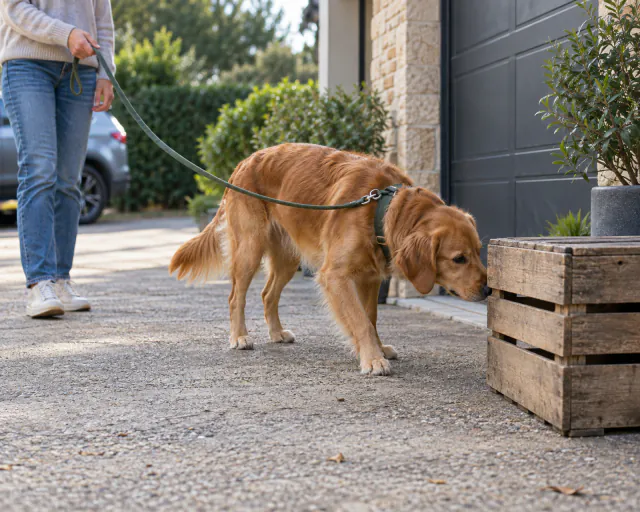
The single most important principle in building confidence is that the dog decides when and whether to investigate something new. Carrying a dog towards an unfamiliar object, dragging them closer on the lead, lifting them onto a new surface, or physically placing them near something they are uncertain about removes the one thing that actually builds confidence, which is the dog’s own experience of approaching something on their own terms and finding it manageable.
A dog who is allowed to stand back, watch, sniff from a distance, and approach in their own time, if they choose to approach at all, is having a genuinely different experience from a dog who is moved there by someone else. The first dog learns something about their own ability to assess and handle new things. The second dog learns nothing except that novel situations involve losing control over their own movement, which does not build confidence even when the outcome turns out to be harmless.
Reward curiosity and voluntary approach, not just calm
It is easy to focus only on rewarding the absence of a reaction, essentially waiting for a cautious dog to not react to something and then praising the quiet. This has its place, but a more effective long-term approach also actively rewards curiosity itself: a step towards a new object, a sniff, ears coming forward with interest rather than pinned back, any voluntary movement towards investigating something new.
Marking and rewarding these moments, with food, praise or whatever the individual dog finds motivating, reinforces the behaviour of investigating novelty rather than only reinforcing tolerance of it. Over time this shifts a cautious dog’s default response to new things from wary avoidance towards active, confident investigation, which is a meaningfully different outcome from a dog that has simply learned to put up with things without reacting.
Build a track record through calm, varied, everyday experience
Confidence is built cumulatively, through a large number of ordinary, low-stakes experiences that go well, rather than through one dramatic exposure that is supposed to settle the matter. A dog that repeatedly experiences the world as broadly predictable, manageable and safe, across a wide variety of everyday situations, builds a general expectation that new things are probably fine, which then generalises to situations the dog has never specifically encountered before.
This means variety matters as much as repetition. A dog that has calm, positive experiences with different surfaces, different quiet outdoor environments, different everyday sounds and different mild novelties, builds a broader and more resilient sense that the world is generally manageable, compared to a dog whose experience is narrow even if it is calm within that narrow range.
Use low-stakes novelty as confidence-building repetitions
A useful way to think about this is treating small, low-stakes new experiences the same way you would treat repetitions in building a physical skill: each one is a rep, and confidence builds through an accumulation of successful reps rather than through a single large effort. A new but unremarkable surface to walk across at home, a new safe object left out in a familiar room for the dog to investigate in their own time, a short walk along a slightly different but still quiet route, all count as reps.
None of these need to be dramatic or effortful to be useful. The value comes from the dog encountering something mildly novel, having the freedom to investigate or ignore it, and the experience resolving without incident. Doing this regularly, in an unpressured way, across a wide range of small novelties, builds a genuinely different dog over months than a single big exposure ever could.
A secure home base and routine as the foundation
Confidence-building work outside the home is more effective when it is built on top of a secure, predictable home environment. A dog with a consistent routine, a reliable place to retreat to, and household members who behave predictably towards them has a stable emotional baseline to work from. Trying to build confidence in novel outdoor situations while the dog’s home life is itself unpredictable or stressful is much harder, since the dog has no calm baseline to return to and recover from between challenges.
This does not mean a rigid, unchanging schedule is required. It means the dog can generally predict roughly what to expect from their own home and the people in it, which frees up their coping resources for genuinely novel things outside it, rather than spending those resources managing an unpredictable environment at home as well.
Why forcing exposure to “get it over with” backfires
A common but mistaken approach is deciding that the fastest way to build confidence is to expose a cautious dog to a mildly worrying situation in full, quickly, on the theory that getting through it once will prove there was nothing to worry about. This does not tend to work, and it often produces the opposite of the intended effect.
What a dog actually learns from being forced into a situation regardless of their own signals is that bad things, or at least uncomfortable things, happen to them regardless of what they do. This removes the sense of agency and predictability that confidence actually depends on, and behaviour professionals widely describe it as one way fear can develop and later turn into reactivity. A dog who has learned that their own attempts to retreat, hesitate or ask for space do not change what happens to them has learned something considerably more damaging than a dog who was simply left to be cautious a while longer.
This is a difficult instinct to resist, particularly when a situation looks entirely harmless from a human perspective and it seems obvious that a quick push through will resolve things faster. It is worth holding the line anyway. Slower, dog-led progress that preserves the dog’s sense of control produces a more confident dog over time than a faster approach that removes it.
When this general approach is not enough
This guide describes a general-tendency approach suited to a dog that is naturally cautious or a little under-confident but not showing significant existing fear. A dog already showing significant fear, meaning freezing, trembling, attempting to escape, or a failure to recover once a trigger has passed, needs the more specific approach covered in supporting a fearful dog, and if that fear persists or is not improving with sensible support, individual professional input is the appropriate next step. See when to contact a behaviour professional for what that process involves. A dog whose fear appears suddenly or keeps getting worse should also see a vet, since pain and changes in sight or hearing can cause or worsen fear. Building general confidence and treating established fear are related but distinct pieces of work, and it is worth being clear which one applies to a particular dog before choosing an approach.