Most people picture a stressed or frightened dog as one that is growling, snapping or trying to bolt. By the time a dog reaches that point, though, it has usually been communicating discomfort for some time through much quieter signals that are easy to miss unless you know to look for them. A lip lick with no food nearby, a yawn when the dog is not tired, a half-turned head, these are not random quirks. They are early points on a recognisable escalation ladder that runs from subtle unease through to a dog that is close to or past its coping limit.
This guide sets out that ladder in order, from the earliest and most easily missed signs through to the clearest warning signs of all. The aim is not to turn every yawn into an emergency, since dogs also yawn and lick their lips for ordinary reasons unconnected to stress. The aim is to notice the pattern and the context, and to understand that acting on the early, subtle signs, usually by creating distance or ending an interaction calmly, is what prevents a situation reaching the later, higher-risk stages at all. For the underlying reasons a dog might be nervous, fearful, reactive or aggressive in the first place, see the guide on understanding the differences between these states.
Why context matters before anything else
Every signal described below can also happen for entirely unconnected reasons. A dog yawns because it is genuinely sleepy. A dog licks its lips because there is food nearby. A dog shakes off because its coat is actually wet or it has just got up from lying down. None of these signals means anything reliably on their own.
What makes a signal worth paying attention to is context: it appearing at a moment when nothing about the situation calls for it. A yawn during a calm, drowsy moment at home means nothing. A yawn the instant an unfamiliar dog approaches, when your own dog was alert and not remotely sleepy a second before, is a different matter. Reading body language well is about noticing signals that do not fit the moment, not about treating a checklist of behaviours as automatic proof of stress.
The early, subtle signs
These are the signals worth learning to spot first, because they appear before a dog is in any real difficulty and give you the most useful opportunity to act.
- Lip licking out of context. A quick tongue flick when there is no food around, often repeated.
- Yawning when not tired. A wide yawn appearing suddenly in an alert, awake dog, often at a moment of mild social or environmental pressure.
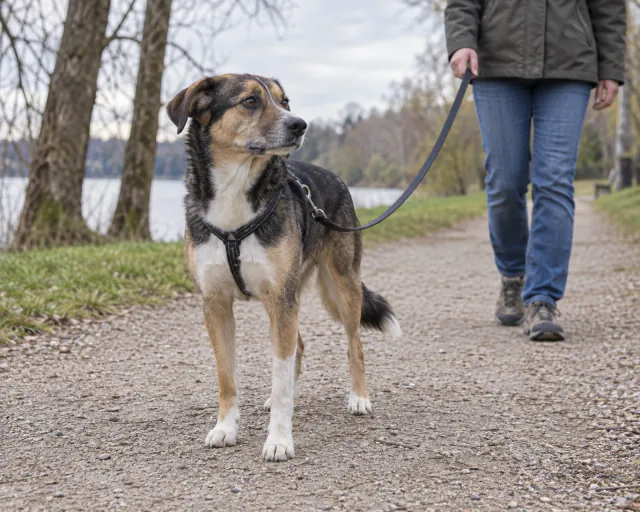
- Turning the head or body away. A dog angling away from a person, dog or object rather than facing it directly, sometimes called a look-away or a turn-away.
- A lowered tail carriage. The tail sitting lower than the dog’s normal resting position, not necessarily tucked, just held lower and often with less movement.
- Whale eye. The dog’s head stays turned away from something while the eyes swivel back towards it, showing a crescent of white around the iris.
- Panting when not hot or exercised. Fast, shallow panting appearing suddenly in a cool environment or after no exertion.
- Shaking off as if wet. A full-body shake identical to drying off, appearing when the dog is completely dry, often straight after a mildly tense moment has passed.
Any one of these on its own, in an otherwise relaxed dog, is not cause for concern. Several appearing together, or appearing repeatedly around the same person, dog or situation, is worth taking seriously as a sign the dog is finding something difficult.
The clearer signs
If early signals are missed, ignored, or the situation continues regardless, a dog’s body language typically becomes more obvious.
- Pinned ears. Ears held flat and back against the head, rather than in their normal relaxed position.
- Crouching. The body lowered, weight shifted backwards and down, often with the head kept low too.
- Trembling. Visible shaking that is not explained by cold or excitement.
- Trying to retreat or hide. Actively moving away, pulling back on the lead, or seeking cover behind a person, furniture or a vehicle.
- Freezing. The dog goes completely still, stops moving, and may stop responding to cues it would normally follow easily.
These signals are harder to miss than the earlier ones, but they still fall short of aggression. A dog showing these signs is asking, fairly clearly, for the situation to change: for space, for the trigger to move away, or for the interaction to stop. Responding at this stage by giving distance and calmly ending the encounter is still the right response, and it is still preferable to reaching the next stage.
Signs the dog is very close to or past coping
The final stage on the ladder includes a hard, fixed stare, a stiffened body with weight shifted forward or frozen in place, growling, and snapping (a fast forward movement of the mouth that does not necessarily make contact). These are the clearest warnings a dog can give, and they need to be understood correctly: as the end of a sequence of communication, not the start of a problem.
A growl or a snap is information. It tells you the dog has already tried other, quieter ways of asking for space or asking for something to stop, and this is what is left once those earlier signals were not noticed or did not work. Punishing a growl or a snap, by scolding, physically correcting the dog, or otherwise suppressing the behaviour, does not address whatever caused it and removes a warning signal the dog is entitled to give. A dog that has learned that growling leads to punishment does not necessarily become calmer around whatever it was growling at. It may simply stop growling and move straight to a more serious response next time, with no warning at all. Behaviour professionals consistently warn about this, and it is why a growl should never be punished, whatever the underlying cause turns out to be.
It is also worth being clear that a dog reaching this stage is not necessarily “aggressive” in some fixed sense, and outwardly similar behaviour at this stage can come from genuinely different causes: fear, frustration, over-arousal, resource guarding, pain, territoriality, learned behaviour, or a defensive or offensive response to a specific situation. Working out which of these applies to an individual dog is a job for a qualified behaviour professional, not something to guess from a single incident. See the guide on when to contact a behaviour professional for what that process looks like.
Why catching the early signs matters
The practical value of learning this ladder is that it gives you far more options the earlier you act on it. A dog showing a lip lick and a head turn can usually be helped with a small amount of extra distance, a change of direction, or simply pausing for a moment, none of which disrupts a walk or an outing very much. A dog that has already reached stiffening, growling or snapping needs immediate distance and a calm exit, and by that point the options are narrower and the moment is more stressful for everyone involved, including the dog.
Responding early is not about being oversensitive or treating every yawn as a crisis. It is about noticing the pattern in context, and using the small, easy interventions available at the early stage, more distance, a slower approach, ending an interaction, rather than waiting until the dog has to escalate to get the same result. Over time, a dog that reliably finds that its early, subtle signals are noticed and respected tends to need to escalate less often, because escalation stops being the only way to get a difficult situation to change.
Building a fuller picture
This guide focuses specifically on the stress and fear escalation ladder. For a broader primer covering calming signals, play signals and the wider range of canine communication, see understanding canine body language. For how these signals fit into the bigger picture of nervousness, fear, reactivity and aggression as distinct but overlapping states, the guide on understanding the differences between these states is the right place to go next. If a dog is showing these signals often, in a widening range of situations, or the signals are escalating over time despite sensible management, that is a reasonable point to seek individual professional support rather than continuing to manage it alone. If these signals appear suddenly or more often than before, ask a vet to check for pain or illness, since discomfort commonly lowers a dog’s tolerance.