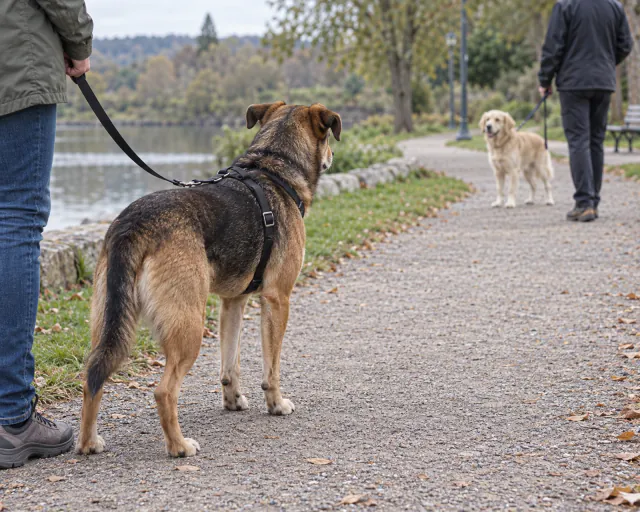
Two dogs can produce almost identical barking and lunging on a lead, teeth visible, body weight forward, and be experiencing genuinely different things. One might be terrified and trying to increase distance from a threat. Another might be desperate to reach another dog to play. A third might be in pain from an old injury and reacting to being approached at all. From the outside these look the same. What is happening inside the dog, and what would help, are not.
This guide helps you describe what you see accurately, to yourself and to a professional, rather than diagnose your own dog. It cannot tell you which of these is happening in your case: that needs an individual assessment, ideally involving both a vet and a qualified behaviourist. It can separate terms used loosely and interchangeably, so that when you seek help, you can describe the behaviour, context and pattern precisely enough to make that assessment faster and more accurate.
Nervousness
Nervousness is a general, low-level wariness, mild and often situational, that usually resolves quickly on its own. A dog that hangs back briefly from an unfamiliar object, watches a stranger before approaching for a sniff, or startles at a noise and settles within moments is showing ordinary nervousness, a normal response even in confident dogs.
Fear
Fear is a stronger, more specific response to a perceived threat, involving avoidance, freezing, or active escape-seeking rather than a brief pause. A fearful dog might refuse to move, tremble, hide behind a person or piece of furniture, or attempt to bolt. It is more intense, more specific to a particular trigger, and slower to resolve than ordinary nervousness. See fearful behaviour in dogs for how to recognise and support it.
Frustration
Frustration arises when a dog is prevented from reaching something it wants, and can look remarkably similar to aggression from a distance: barking, lunging, a tense body. The internal cause is different. A dog straining because it wants to greet another dog, but is held back on a lead, is experiencing frustrated motivation towards something appealing, not hostility. Confusing frustration with fear or aggression leads to the wrong response, since what helps a frustrated dog, usually structured opportunities to access what it wants, is not what helps a frightened one.
Over-arousal
Over-arousal is a general state of heightened excitement, not itself fear or aggression, that reduces a dog’s ability to respond to cues it normally knows well. A dog over-aroused after an exciting play session can appear to “ignore” a familiar cue not because it has forgotten anything, but because its nervous system is not in a state to process and act on it the way it would when calmer.
Reactivity
Reactivity describes an exaggerated response to a specific trigger, most often barking and lunging, and is a description of a behaviour pattern rather than a cause in its own right. It is usually rooted in fear, frustration or over-arousal, or some combination, rather than a separate explanation on its own. Two reactive dogs can be reactive for entirely different reasons, which is why “my dog is reactive” describes what a dog does without explaining why. Reactivity: what it is and what to do covers this pattern further.
Defensive aggression
Defensive aggression is aimed at increasing distance from a perceived threat. A growl, a snap, or a bite when a dog feels cornered, threatened, or unable to retreat falls into this category. The dog’s goal, functionally, is to make the threat go away, not to gain or keep anything.
Offensive aggression
Offensive aggression is aimed at controlling access to something rather than escaping, and functions differently from defensive aggression even though both can involve a growl, a lunge or a bite. A dog guarding access to a doorway, a person, or territory against another approaching dog, where the intent is to control access rather than create distance, sits closer to this category. Distinguishing the two in a real situation is genuinely difficult and needs a professional watching the whole context, not a label applied from a single incident.
Resource guarding
Resource guarding is a specific, common behaviour in which a dog protects a valued item, food, a chew, a toy, a resting place, occasionally a person, from an approaching person or animal. It sits on a spectrum from a barely noticeable stiffening to a serious bite, and its intensity and triggers vary between dogs. Resource guarding: what it looks like and what to do covers this pattern in detail, including why home experimentation carries real risk.
Predatory behaviour
Predatory behaviour is a distinct motivational system, not driven by fear, frustration or any perceived threat. A dog fixating on, chasing, or attempting to catch a small fast-moving animal is engaging a different set of instincts, with an evolutionary origin unrelated to threat response, so techniques aimed at reducing fear or building confidence do not address it. See recall and prey drive: realistic expectations for managing this motivational system in practice.
Pain-related behaviour
A dog in pain can show any of the presentations above: nervousness, fear of being touched a particular way, frustration at reduced mobility, lowered tolerance producing reactivity, or defensive aggression when a painful area is handled. This is why ruling out a medical cause is a sensible starting point, not a box ticked after behavioural work has failed. Recognising pain and discomfort in dogs covers signs accompanying a pain-related change.
Territorial behaviour
Territorial behaviour protects a specific space, a home, a garden, a car, a familiar walking route, from an approaching person or animal, and tends to be more intense within that space, reducing once the dog is away from it. A dog barking fiercely at the garden gate but relaxed meeting the same person elsewhere shows a pattern consistent with territorial behaviour, though a confident conclusion needs more than one observation.
Learned behaviour
Learned behaviour persists because it has worked before, regardless of what originally caused it. A dog that first barked at visitors out of nervousness, and found barking made the visitor keep their distance or leave, can go on barking for years after the original nervousness has faded, because the behaviour has become self-sustaining through its own history of success. A behaviour’s current trigger and its original cause are not always the same thing, which is why a full history matters as much as the current presentation.
Why this article cannot diagnose your dog
Everything above is a set of distinctions, not a diagnostic tool. The same barking-and-lunging picture can be produced by fear, frustration, over-arousal, aggression of either kind, territorial or learned behaviour, or several together, and telling them apart reliably needs a professional observing the dog directly and taking a full history. Matching your dog to whichever description sounds closest is not an assessment. This guide’s purpose is giving you the vocabulary to describe what you see, when, what preceded it, and what changes it, so a professional can work faster and more accurately.
Stopping a behaviour is not the same as understanding it
Interrupting barking, lunging or growling in the moment, calling a dog away, increasing distance, or ending an interaction, restores immediate control, and there are moments where that is exactly right. It does not, by itself, reveal or resolve why the behaviour happened. A dog that has stopped barking at a trigger because the owner has become skilled at avoiding it has not had the underlying fear, frustration or pain addressed, only avoided. This is useful for everyday safety, but a different task from a considered behaviour-change plan.
Growling deserves specific mention. It is communication, a dog’s way of signalling discomfort before anything more serious happens. Suppressing a growl through punishment does not address the state that produced it, and a dog that learns growling leads to punishment may simply stop warning while the discomfort remains, removing information a handler needs and making the dog more dangerous, not less.
Physical control versus a behaviour-change plan
Physical control genuinely matters in the moment and can be necessary to keep everyone safe: a secure, well-fitted harness and lead, increasing distance from the trigger, and calmly leaving a situation rather than persisting in it. This is management, appropriate and often essential regardless of the underlying cause. It differs from a training or behaviour-change plan, which takes longer, needs an accurate understanding of the cause, and for anything beyond mild wariness, needs professional guidance to build and carry out safely.
Why offering food often fails, and what that actually means
A dog already highly focused on a trigger, or over its threshold, commonly will not take food it would normally accept without hesitation. This is a common, predictable pattern, not a sign the treat was insufficiently appealing or that the owner has failed. Its attention is on the trigger, and no realistic reward competes with that in the moment. The correct response is to change the situation itself, more distance, a calmer exit, rather than try a higher-value treat at the same distance and intensity.
When to involve a vet and a behaviourist
A vet visit is a sensible starting point whenever a behaviour has changed, worsened, or appeared suddenly, particularly in an older dog, since pain and illness are common, frequently overlooked contributors to the presentations here, even when the behaviour looks purely reactive or fear-based. Anything beyond mild, occasional wariness, any growling, snapping or biting, any resource guarding directed at people or animals, and any worsening reactivity needs an individual assessment from a qualified behaviourist, ideally alongside your vet. See when to contact a behaviour professional and when to involve a trainer, behaviourist or vet for how to find the right help. A professional assessment, not a closer match to a description here, is the genuine next step beyond the mildest, most occasional presentation.