Dogs did not evolve to advertise weakness. In the wild, an animal that visibly limps or cries out attracts predators and loses status within a group, and that instinct has not disappeared just because a dog now sleeps on a sofa. The result is that many dogs carry on eating, greeting visitors and even wagging their tail while genuinely uncomfortable, and owners are often the last to notice because the change happens gradually and the dog is doing its best to mask it.
This guide is not a way to work out what is wrong with a dog at home. It cannot be, because the same sign can point to dozens of different causes, some minor and some serious, and only a vet examining the dog can tell them apart. What it can do is describe the kinds of behavioural and physical changes that are worth treating as a signal, so that a dog gets checked promptly rather than being watched for weeks while something continues quietly in the background.
Changes in posture and movement
Watch how a dog holds itself when standing still and when walking. A hunched back, a lowered head carried stiffly, weight shifted off one leg, or a tucked abdomen can all indicate discomfort somewhere in the body. So can a shortened stride, a stiff or stilted gait, or a reluctance to fully extend a limb.
Reluctance to do things the dog previously did without hesitation is one of the more reliable signals. Hesitating before jumping into the car, refusing to go up or down stairs, pausing at the top of a step it used to take in one movement, or struggling to get up from lying down after a nap are all worth noting, particularly if they appear alongside other changes. A single hesitant moment means little on its own; a pattern across several days is more informative.
Changes in breathing and general demeanour
Panting at rest, when the room is not warm and the dog has not been exercising, can be a sign of pain or distress rather than heat. Restlessness, an inability to settle, repeatedly getting up and lying back down, or pacing at night are all worth noting for the same reason. Some dogs show the opposite pattern instead: unusual quietness, reduced interest in toys or walks, or sleeping far more than normal.
A dog that suddenly avoids being picked up, flinches away from a stroke in a specific area, or growls or snaps when touched somewhere it previously tolerated handling is showing a clear and specific signal. This is never a training problem to correct through repetition. It is a reason to stop handling that area and get the dog checked, because forcing contact with a painful spot teaches the dog that people cannot be trusted around it, on top of whatever the underlying issue turns out to be.
Changes in appetite, grooming and mood
A dog that suddenly eats more slowly, turns its head away from food, or loses interest in treats it normally accepts eagerly may be uncomfortable, particularly around the mouth, jaw or stomach. The reverse pattern, eating normally but seeming unsettled afterwards, is also worth mentioning to a vet.
Excessive licking or chewing directed at one specific area of the body, well beyond normal grooming, often points to localised discomfort rather than a habit. Watch where the behaviour is focused rather than treating it as a general nuisance to be stopped with a cone alone. A previously sociable dog that becomes withdrawn, or a placid dog that becomes uncharacteristically grumpy, irritable or snappy with familiar people or other household pets, is showing a behavioural change that deserves the same attention as a physical one. Personality does shift with pain far more often than owners expect.
Sleep and rest pattern changes
Watch how a dog settles for the night and through the day. Difficulty getting comfortable, repeated repositioning, whining or restlessness once lying down, or waking during the night when the dog previously slept through can all indicate discomfort, particularly in joints or the back. A dog choosing to sleep in unusual places, such as a cold floor rather than its normal bed, sometimes reflects a search for a position that feels better rather than a preference change.
Do not use this list to diagnose
None of the signs above point to a single condition, and combining several of them still does not amount to a diagnosis that can be made at home. A limp can come from a thorn in a paw pad or from something affecting a joint higher up the leg. Reduced appetite can reflect dozens of unrelated causes, only some of which involve pain at all. Trying to work backwards from a symptom list to a cause, using search results or comparisons with another dog’s experience, routinely leads owners in the wrong direction and can delay a straightforward diagnosis.
The purpose of noticing these signs is to prompt a vet visit, not to skip one. Before the appointment, it helps to write down what you have observed: which behaviours changed, roughly when they started, whether anything makes them better or worse, and whether the pattern is constant or comes and goes. That description is genuinely useful to a vet during the examination, far more useful than a guess at what might be causing it.
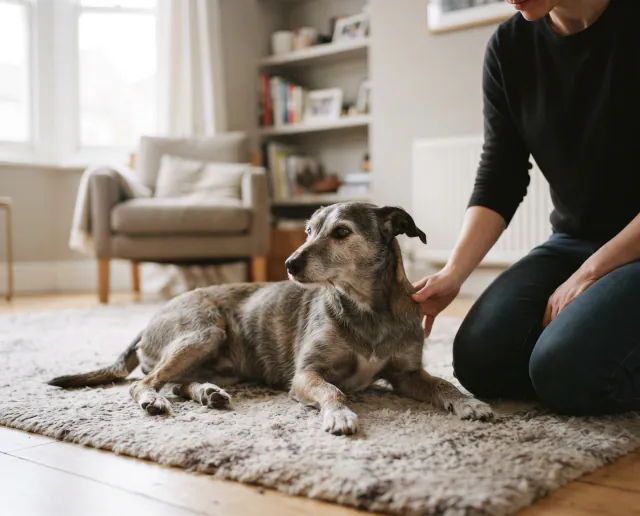
Older dogs are not simply “slowing down”
One of the most common and most costly assumptions is that an older dog’s reduced activity, stiffness or reluctance to play is a normal and inevitable part of ageing that does not need attention. Age itself does not cause pain, and plenty of conditions that produce these signs in older dogs are manageable once identified, with many dogs regaining a noticeably better quality of life after assessment and appropriate veterinary management. Writing off a genuine change as “just getting old” can mean months or years of unnecessary discomfort for a dog that could have been more comfortable much sooner.
The same caution applies at the other end of life. A young, otherwise healthy dog that suddenly shows any of the signs above has not simply had an off day, and a single instance is still worth watching closely and mentioning to a vet if it recurs or does not resolve quickly on its own.
When to book an appointment
Any of the signs described here justifies a call to your vet, and several appearing together justifies it more urgently. Sudden onset, a sign that is severe even briefly, or a dog that seems distressed rather than merely subdued should be treated as more urgent than a slow, mild change, but neither should be ignored indefinitely. Vets would rather examine a dog that turns out to have nothing seriously wrong than see one that was brought in only after weeks of a family assuming it would pass. Trust the observation, describe it clearly, and let a professional examination do the work of finding out why.