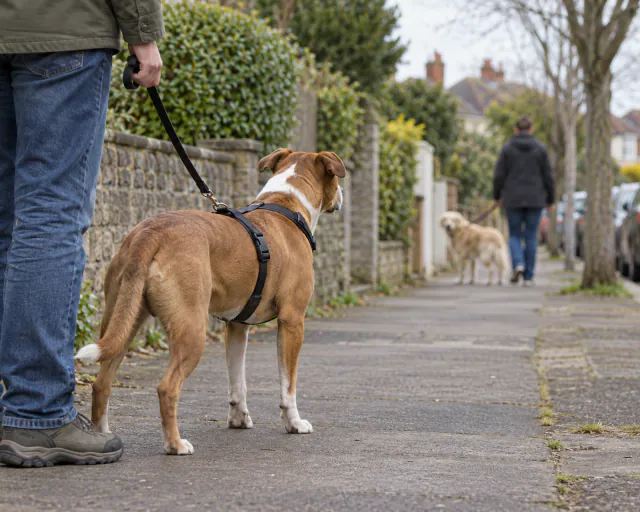
A dog that has been calm all week can suddenly erupt at the sight of another dog across the road: barking, lunging forward on the lead, spinning, sometimes screaming. To a passer-by it looks like aggression. To the owner holding the lead it is often frightening, embarrassing and confusing, especially when the same dog is friendly and relaxed everywhere else. This pattern has a name, and understanding it changes how you respond to it.
Reactivity describes an intense, repeated response to a specific type of trigger, most commonly other dogs but also people, cyclists, joggers, vehicles, or other moving things. It is not a diagnosis and it is not a fixed personality trait. It is a description of behaviour, and behind that behaviour there is usually fear, frustration, over-arousal or some mixture of the three. This guide explains what reactivity is, how it differs from aggression, what you can do day to day to manage it safely, and why real progress is a job for a qualified behaviourist rather than a general guide.
What reactivity actually looks like
Reactive behaviour usually includes barking, lunging, growling, spinning on the lead, and pulling hard towards or away from the trigger. It tends to be sudden and disproportionate to what is actually happening: a dog thirty metres away, glimpsed briefly, can produce the same intensity of reaction as one standing directly in front of the dog. The reaction usually stops once the trigger is out of sight or far enough away, and the dog can return to normal fairly quickly afterwards, though some dogs stay wound up for a while.
The picture varies a great deal between individuals. Some dogs are reactive to unfamiliar dogs but fine with dogs they know. Some react to anything fast-moving, including bicycles, skateboards and running children. Some are worse on the lead than off it, because a lead removes the option to retreat and can make a worried dog feel trapped. Some are worse in tight spaces such as narrow pavements or doorways than in open fields.
Reactivity is not the same as aggression
Reactivity and aggression overlap in what they look and sound like, which is exactly why the distinction matters and why it should not be assumed either way without proper assessment. Aggression, in the behavioural sense, refers to behaviour intended to increase distance from a threat or to gain access to something valuable, and it exists on a spectrum from a stiff stare through to a bite. Reactivity is often driven by the same underlying emotion, usually fear or frustration, but the dog is asking for distance rather than intending contact, and many reactive dogs never bite even when allowed to get close to what upsets them.
That said, reactivity can escalate. A dog that is repeatedly put into situations beyond what it can cope with, or that has a frightening experience with a trigger, can develop a stronger and more dangerous response over time. Treating reactivity as a nuisance to be pushed through rather than a genuine welfare and safety issue increases that risk. If a dog has ever made contact with another dog or a person, or you are worried it might, treat that as a safety matter requiring professional input immediately rather than something to manage informally.
Why punishment tends to make it worse
A common instinct is to correct the barking and lunging with a sharp lead pop, a raised voice, or a spray bottle, on the reasoning that the noise and drama need to stop. This usually backfires. If the underlying cause is fear, punishing the dog at the exact moment it sees another dog teaches it that other dogs predict something unpleasant happening to them, which strengthens the very association driving the reaction. If the cause is frustration, such as a friendly dog desperate to greet others but never allowed to, punishment adds a second layer of conflict without addressing why the dog is so aroused in the first place.
Suppressing the visible signs of reactivity, growling and barking included, without changing how the dog actually feels about the trigger, can also remove an early warning system. A dog that has learned that showing warning signs leads to punishment may stop giving them and move straight to a stronger response instead. None of this means a reactive dog should be allowed to drag you towards its trigger either. It means the goal is changing the underlying response, not just silencing it.
Everyday management while you get help
Management is about keeping everyone safe and reducing rehearsal of the reactive response while you arrange proper support, not a substitute for that support. The single most useful tool is distance. Reactive dogs have a threshold, a point at which they notice a trigger and can still stay under control, and a point beyond which they tip into the full reaction. Watch for the early signs of noticing a trigger, such as a fixed stare, raised head, stiffening or ears pricking forward, and add distance before the dog goes over that threshold rather than after.
Practical distance options include crossing the road, turning into a driveway or gateway, doing a U-turn, or stepping behind a parked car or hedge to break the dog’s line of sight. Choosing quieter routes and quieter times of day reduces the number of encounters you need to manage in the first place. A well-fitted, secure harness, ideally one your dog cannot back out of, combined with a sturdy lead, gives you better control and reduces the risk of a slipped collar during a sudden lunge; see the guide on choosing the correct harness size for fitting details. Avoid flexi-leads for a reactive dog, since they offer little control at the moment it matters most.
Try to keep your own body relaxed and your voice calm rather than tensing the lead or shouting, since dogs pick up on handler tension and it can add to their own arousal. Carrying food to reward calm noticing of a trigger from a safe distance can help in the moment, though building this into a genuine training plan is a job for a professional who can assess your dog’s actual thresholds.
Recognising the warning signs before a reaction
Dogs rarely go from relaxed to reacting with no warning at all, even though it can feel that way when it happens fast. Learning to read the subtler signals, a closed mouth, a sudden freeze, weight shifting backward, lip licking, yawning out of context, or a tail that has stopped moving, gives you a chance to act before the dog is committed to a full reaction. The guide to understanding canine body language covers these signals in more depth and is worth reading alongside this one, since spotting the early stages is often more useful day to day than reacting to the loud, obvious stage.
Why this needs a qualified behaviourist
Meaningful, lasting improvement in reactivity depends on an individual assessment: what specifically triggers this dog, at what distance, in what contexts, and why. Two dogs that both bark and lunge at other dogs on the lead can have completely different underlying causes and need different plans, and a plan built for one can do nothing for the other or even make things worse. A qualified behaviourist can observe your dog, take a full history, help identify the actual triggers and thresholds, and build a graded plan suited to that dog, ideally working alongside your vet to rule out pain or other medical contributors that can lower a dog’s tolerance for stress.
Ask your vet for a referral, since many practices have working relationships with behaviourists and can also check for physical contributors first. Look for someone who explains their methods clearly, uses reward-based approaches, and holds a recognised accreditation appropriate to your country, since accreditation schemes and titles vary between countries. Be wary of anyone who guarantees a fast fix or who wants to use fear, pain or intimidation to suppress the behaviour, since none of that addresses what is actually driving it. See the guide on when to contact a qualified dog behaviour professional for more on finding the right help and what a sensible referral pathway looks like.