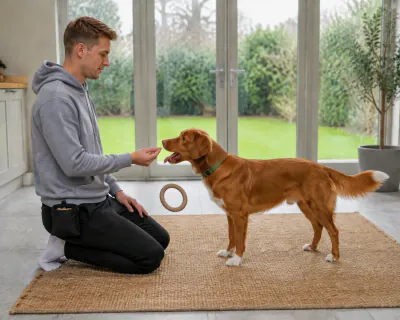
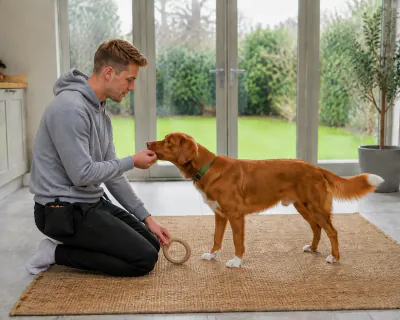
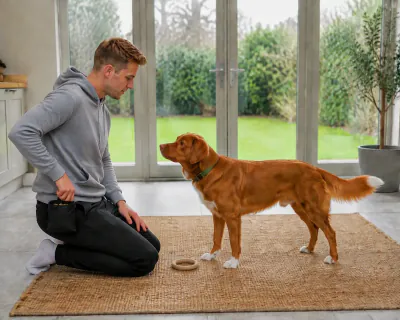
- Session length
- 5 minutes, once or twice a day
- Skill
- Impulse control
- Suits
- Any age
What you need
- Two or three low value toys the dog is happy to pick up and mouth
- One toy the dog rates as a genuine favourite, kept in reserve for later stages
- Small, soft food rewards the dog can eat quickly without chewing
- A lead for the outdoor stage, so a found item can be managed safely
Leave it stops a dog reaching for something in the first place. Drop it does the opposite job: it asks a dog to give up something already in their mouth, calmly and without a contest. Most dogs pick up a rough version of this by accident, as an occasional trade for food that only really holds with items they barely care about. This lesson turns that unreliable habit into a genuine cue, one that keeps working when the item is a favourite toy or something interesting found on a walk.
Purpose
By the end of this lesson the dog should drop an item into your hand or onto the floor within a couple of seconds of the cue, across a range of item values, without the exchange turning into a chase or a tug. That matters because the moments a drop cue earns its keep are rarely convenient ones: a chewed sock, a wrapper from a bin, something unidentified in long grass. A dog who has only ever traded a boring toy for food at the kitchen table will not automatically extend that habit to something they actually want to keep.
Prerequisites
- The dog leaves a covered item on request, from the previous lesson.
- You have a couple of low value toys the dog readily picks up and carries.
- You can set aside short, calm sessions without an audience of excited children or other dogs.
Equipment
Start with toys the dog finds only mildly interesting, so the early trades are easy wins rather than tests of willpower. Keep a genuine favourite back for later stages, once the basic pattern is solid. Rewards should be small, soft and quick to eat, so the dog’s attention returns to you rather than to chewing. A lead is useful once you move outdoors, since it lets you close the gap to a found item calmly rather than jogging over.
Method
- Pick one release word and commit to it for every repetition. Common choices are drop or give, either is fine, but do not alternate between two words or mix it with the cue for leave it, which asks for something different.
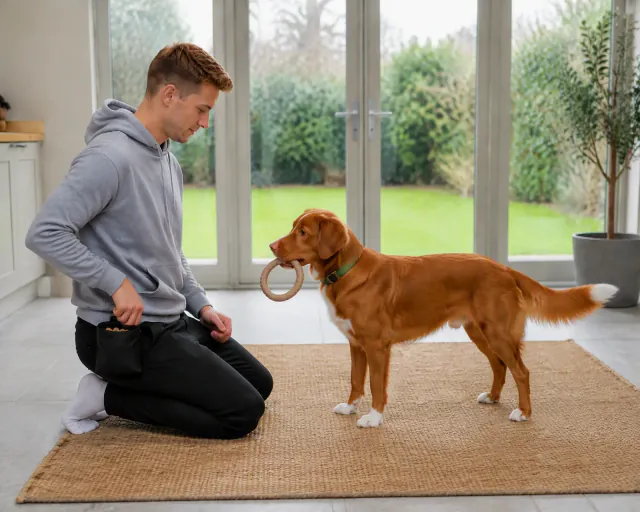
- Let the dog pick up a low value toy. Kneel nearby without reaching towards it.
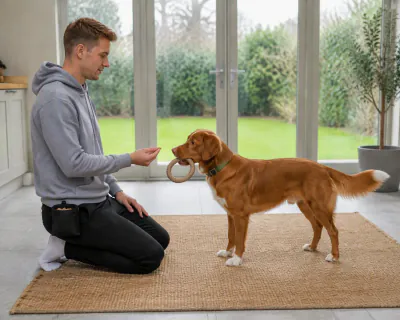
- Bring a treat to the dog’s nose, close enough to smell but not touching the toy. Say the cue as you present it.
- As the dog opens their mouth for the treat, the toy falls. Mark the moment it leaves their mouth, then feed. Pick the toy up afterwards, not before.
- Repeat with the same toy until the dog releases as soon as they hear the cue, before the treat is fully in view.
- Start delaying the treat’s appearance. Say the cue with your reward hand still by your side or in a pocket, producing the treat only once the item has dropped.
- Once this is solid with a boring toy, move to a toy the dog rates more highly. Expect the first few repetitions to be slower, and go back a step if the dog turns away from you rather than dropping.
- Add a second, better toy as the reward instead of food for some repetitions, so the dog learns that dropping one thing can also produce another good thing, not only food.
- Take the exercise outdoors on a lead, starting again with a low value toy planted in an open space, then working up to a genuine favourite.
- Practise the specific case the lesson is really aimed at: something found rather than offered. Drop a safe, uninteresting object on a walk, let the dog investigate, then cue the drop and pay generously.
- Vary who delivers the reward, which hand it comes from, and the distance between you and the dog, so the cue is not tied to one exact picture.
- Increase item value only once the previous level gets a drop within two seconds in at least nine repetitions out of ten.
Session length
Five minutes, once or twice a day, with six to ten repetitions per session. Trading is a small mental effort each time, and a dog who is tired of the game will start ignoring the cue rather than genuinely failing to understand it, so stop while it is still working.
Progression criteria
Move on when the dog drops an item within two seconds of the cue, in nine repetitions out of ten, at the current item value. Raise duration first: build a very brief pause between the cue and the treat’s appearance so the dog is dropping for the word rather than the sight of food. Add distance next, tossing the reward a short way off so the dog moves away from the dropped item rather than hovering over it. Add distraction last, working in a busier room, then outdoors, then with a genuinely valued item, one change at a time.
Common mistakes
Teaching two release words in quick succession, one for indoors and one that slips out under pressure outdoors, leaves the dog unsure which sound means what. Pick one word and use it everywhere. Offering a lower value treat for a higher value item is a bad deal from the dog’s point of view, and dogs notice bad deals quickly, so keep the trade at least as good as what you are asking them to give up. Reaching for the item before the dog has fully let go, or grabbing at their collar mid-drop, teaches a dog to hold on tighter next time.
Troubleshooting
If the dog will not release a low value toy even for food, the treat is not motivating enough for that moment, so use something better or work at a quieter time of day. If the dog drops the item then snatches it back before you can pick it up, you are moving too slowly. Cover the item with your foot or a flat hand the instant it drops, then hand over the reward. If a dog runs off with something rather than approaching you, do not chase. Walk away, encourage them to follow with your voice, and reward any movement towards you, dealing with the specific item once they are close.
Safety and when to stop
Stop immediately if the dog stiffens, freezes, hardens their stare or growls when you approach something in their mouth. That is resource guarding, not stubbornness, and it needs assessment from a qualified behaviourist working with your vet rather than more repetitions of this exercise. Never prise a dog’s jaw open, and never chase a dog holding an item, since both respond to a training problem with the exact pressure that makes guarding worse. If a dog swallows something you believe could be harmful, contact your vet straight away rather than continuing to cue a drop.
Next lesson
Continue with doorway manners, which asks for the same calm restraint at the one place in the house where excitement usually wins.
Useful tool
The dog food calculator is worth checking alongside this lesson, since trading for toys and found items uses a steady stream of small treats that are easiest to manage when they come out of the daily ration rather than on top of it.