Managing a dog’s response to a trigger, increasing distance, changing route, calmly leaving a situation, keeps everyone safe in the moment, but it does not on its own teach the dog anything new to do instead. An alternative behaviour closes that gap: a specific, well-practised action the dog performs when a trigger appears, one that is physically incompatible with or a clear replacement for the unwanted response, giving the dog a job to do rather than leaving them to default to barking, lunging or fixating.
This guide covers choosing a genuinely suitable alternative behaviour, why it must be taught to full fluency in a completely trigger-free environment before it is ever attempted near the real thing, how to introduce it near the trigger at a distance the dog can actually manage, keeping reinforcement high and consistent in the early stages, and what to do when the plan breaks down. It assumes the dog already has a solid foundation in a relevant skill, such as focus and attention or a reliable release of an item, taught step by step elsewhere on this site.
Choose a behaviour that genuinely replaces the unwanted one
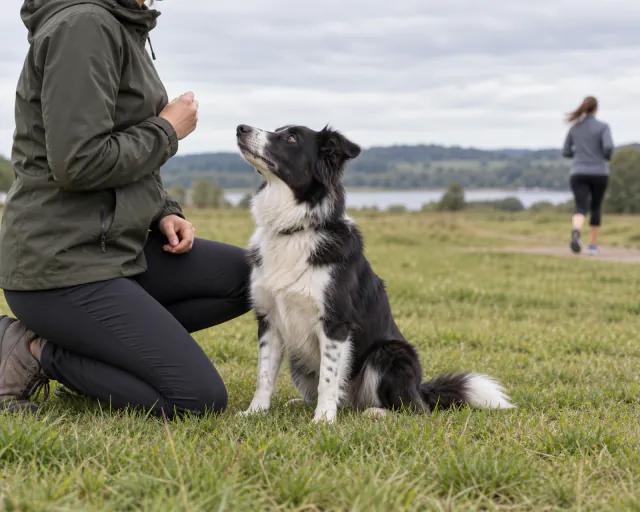
The most useful alternative behaviours are ones the dog physically cannot do at the same time as the unwanted response, or that reliably occupy their attention instead of it. Looking at the handler’s face is a common and effective choice, since a dog focused on a person’s face is not simultaneously fixating on a trigger in the distance. Moving to sit calmly at the handler’s side works well for a dog who tends to lunge forward, since sitting beside the handler is a clear, visible alternative to pulling ahead. Targeting the handler’s open hand with their nose, a simple skill many dogs learn quickly, gives a dog something concrete and rewarding to do that draws attention away from a trigger and back to the handler.
The right choice depends on the individual dog and the specific unwanted response. A dog who tends to freeze and stare fixedly benefits from something that actively redirects their attention, such as a hand target, more than something that asks for stillness, since stillness is already part of the problem. A dog who lunges forward on the lead benefits more from a positional behaviour, moving to the handler’s side, than from eye contact alone, since it changes where the dog’s body is, not just where they are looking.
Teach it to full fluency away from the trigger first
A common and understandable mistake is trying to teach a new alternative behaviour for the first time in the presence of the very thing that causes the problem. This rarely works, because a dog cannot learn a new skill properly while also managing a strong emotional response to a trigger. The two demands compete for the same attention, and the trigger usually wins.
Teach the chosen behaviour somewhere calm and completely free of the trigger, such as a quiet room at home, until it is genuinely fluent: the dog performs it promptly and reliably on a single cue, with no hesitation, in a range of ordinary everyday settings and with normal household distractions present. The lessons on focus and attention around mild distractions and drop it, reliably both show, step by step, how a specific skill is built to this level of reliability before it is asked to hold up anywhere harder, and the same principle applies whatever alternative behaviour you choose here. Only once the behaviour is solid in easy, familiar settings does it make sense to introduce it anywhere near the actual trigger.
Start near the trigger at a distance well below threshold
Once the alternative behaviour is fluent away from the trigger, the next stage is introducing it near the trigger itself, starting at a distance well below the dog’s threshold, meaning far enough away that the trigger barely registers as significant and the alternative behaviour is still easy for the dog to perform. This distance is often considerably further than people initially expect, particularly for a dog whose response to the trigger is intense.
Cue the alternative behaviour as the trigger appears, or just before, and reward generously the moment the dog performs it. If the dog cannot perform the behaviour at all, or performs it slowly and reluctantly compared with how they do at home, the distance is too close for this stage and needs increasing before continuing. There is no fixed schedule for how quickly to reduce this distance, and progress should be paced by how reliably the dog performs the behaviour, not by a plan drawn up in advance without reference to how the dog is actually doing on the day.
Reinforce highly and consistently in the early stages
In the early stages of this work, reinforce the alternative behaviour every single time it happens near a trigger, and reinforce it well, using food the dog finds genuinely worth working for rather than whatever happens to be to hand. This is not the moment to test whether the dog will perform the behaviour without a reward, or to reinforce inconsistently to make it more “resilient.” Consistent, high-value reinforcement in these early repetitions is what builds the association between the trigger appearing and the alternative behaviour being the rewarding thing to do, and thinning out reinforcement too early tends to weaken that association before it has properly formed.
Troubleshooting when it breaks down
If the alternative behaviour that was working reliably suddenly falls apart, the most common explanation is that the distance was reduced too quickly, or the trigger’s intensity increased unexpectedly, such as a dog appearing faster, closer, or more suddenly than usual, or several triggers appearing close together. Both push the dog over a threshold the behaviour was never built to hold up against.
The correct response is to increase distance again and rebuild from a point where the dog can succeed, not to push through and repeat the cue at the same distance in the hope the dog will eventually comply. Repeating a cue the dog cannot currently perform, or raising your voice to get a response, does not fix the underlying problem and risks weakening the dog’s trust in the cue itself. Treat a breakdown as useful information about where the dog’s current limit actually is, rather than as a failure of the dog or the method, and adjust the plan accordingly.
Before you start
This approach works as a practical skill-building layer on top of solid foundational training, not as a substitute for it. If the dog’s response to the trigger involves significant fear, resource guarding, or any risk of aggression towards a person or another animal, an alternative behaviour on its own is unlikely to be a safe or sufficient plan, and the guide on when to contact a qualified dog behaviour professional covers when that level of individual assessment is the right next step. For everyday triggers below that threshold, working alongside the approach in preventing trigger stacking helps keep a dog from encountering more than they can handle while this skill is still being built.