- Session length
- 5 minutes of staged practice, plus a plan for every real arrival
- Skill
- Impulse control
- Suits
- Any age
What you need
- Small, soft food rewards kept in a pot near the door
- A lead or house line to prevent rehearsal of rushing during real arrivals
- A helper who can ring a bell or knock and wait outside without walking in uninvited
- A gate or second door where the front door opens onto a road or a shared entrance
An internal door is a controlled rehearsal. A front door is the real performance, complete with a doorbell, a stranger’s voice, a rush of cold air and a wave of new smells arriving all at once. A dog who waits calmly at a quiet hallway door often abandons that wait entirely the first time the real thing happens, not because the earlier training failed but because nobody built up to the actual distraction. This lesson closes that gap, and treats the practical safety risk of a front door as seriously as the manners.
Purpose
By the end of this lesson the dog should hold a wait at the front door through a knock or a bell, while it opens, and while a visitor steps inside, released only on your word. This is not a party trick. A dog who cannot be trusted at the front door is a dog who eventually gets out through it, past a delivery driver’s legs, into a front garden that opens onto a road, or into a greeting that goes badly with someone who is nervous of dogs.
Prerequisites
- A wait the dog can already hold for a few seconds at an internal doorway.
- A front door, or another external door, where you can arrange practice arrivals.
- A helper willing to follow a plan rather than rushing in or making a fuss of the dog too soon.
Equipment
Keep rewards by the door itself, since walking away to fetch treats loses the moment. A lead or house line, held loosely rather than gripped, gives you a physical backstop while the training is new without needing to grab at the dog. If the front door opens onto a road, a shared hallway or a driveway with vehicle access, add a gate or use a second door as a fixed layer of safety that does not depend on anyone’s timing being perfect.
Method
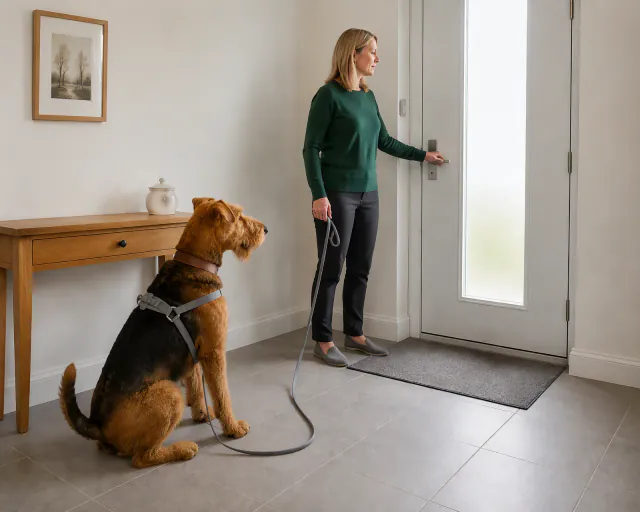
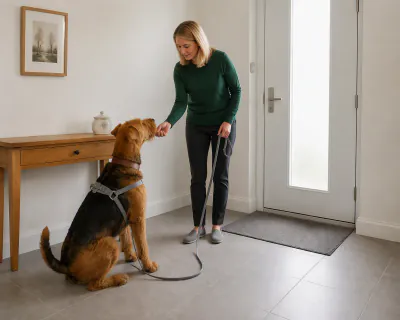
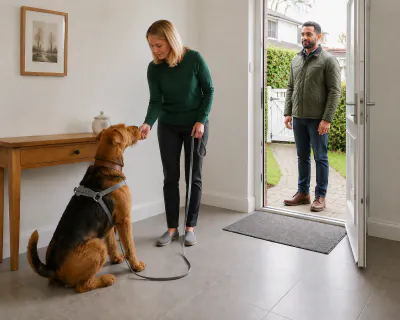
- Begin with no visitor and no sound. Ask the dog to sit a short distance from the door, walk to it, touch the handle, then return and reward in position.
- Build duration with your hand still on the handle, from one second up to five or six, feeding in position before every release.
- Change the picture rather than the time: open the door a crack, then wider, then fully, resetting to a smaller opening whenever the dog breaks position.
- Introduce sound on its own. Knock quietly on a wall, then the door itself, then use the doorbell, treating each new sound as a fresh distraction that needs a shorter duration again at first.
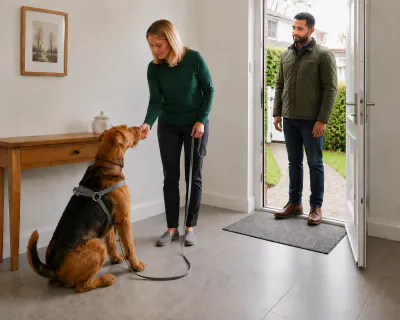
- Bring in your helper. Have them knock or ring, then wait outside for a count of ten while you reward the dog for staying, without opening the door yet.
- Open the door with the helper standing still outside, not entering. Reward the dog for holding position while they see a person in the doorway.
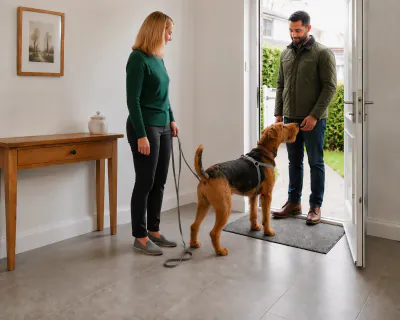
- Only once that is solid, let the helper step inside and stand quietly, hands down, not speaking to the dog. Reward generously, then release the dog to approach if the helper is happy to greet them calmly.
- If the dog breaks position at any stage, do not repeat the cue. Close the door or step back with the helper, reset at the previous easier step, and rebuild from there.
- Once the sequence holds indoors, extend distance: practise from further down the hallway, so the dog holds the wait while you walk further to answer the door.
- Add distraction gradually and separately: a helper who speaks, a helper carrying bags or a delivery box, a second helper, before trying a visitor the dog is genuinely excited to see.
- For every real arrival that is not staged practice, manage rather than train. Use the gate, put the dog in another room, or hold the lead, so an unplanned delivery does not undo the pattern you are building.
Session length
Five minutes of staged practice most days, plus a plan for handling whatever arrives unplanned. Two or three staged rehearsals per session is usually enough, since a dog gets more excited with each simulated arrival, not less.
Progression criteria
Move on when the dog holds a wait through a knock or bell, a fully open door and a visitor entering, in nine repetitions out of ten across at least two different helpers. Extend duration first, holding position for longer once the door is open. Add distance next, increasing how far you walk from the dog to reach the door. Add distraction last, working through busier or more exciting visitors only once the quieter versions are solid. Count any dash towards the door or any bark-and-lunge combination as a failure and rebuild from the previous step.
Common mistakes
Practising only with one calm helper builds a dog who behaves well for that one person and nobody else. Treating a single successful greeting as proof the work is finished skips the distraction layer entirely, since a doorbell heard for the twentieth time behaves very differently from the first. Letting an over-excited visitor make a fuss of the dog before all four feet are settled rewards exactly the arousal you are trying to lower.
Troubleshooting
If the dog cannot hold position once the bell sounds, the sound itself is still too exciting, so go back to knocking quietly and rebuild the doorbell in smaller steps, perhaps starting with a recording played at low volume. If the wait holds at the door but collapses the moment the visitor speaks, treat a visitor’s voice as its own distraction layer and introduce it separately from their entrance. Dogs who have previously been allowed to charge the door for years, rather than puppies starting fresh, often need more repetitions at each step, not a different method.
Safety and when to stop
Stop staged practice and rely on management alone if the front door opens onto a road, a car park or a shared entrance where a slipped wait has real consequences, until a gate or second door is fitted as backup. Fear at the door looks different from excitement: a stiff body, backing away, growling or persistent barking from a distance means the dog is worried, not overstimulated, and pushing through it with more exposure tends to make things worse. That pattern needs a qualified behaviourist working with your vet. Never shout, grab a collar hard enough to choke, or drag a dog away from a door, since all three add stress to a moment that already has plenty.
Next lesson
Continue with calm greetings with people, which takes the same held wait through to the greeting itself, teaching four feet on the floor once the door work is solid.
Useful tool
The dog exercise planner is worth a look here, since a dog who arrives at the door with unspent energy from a day indoors finds any wait far harder than one who has already had a proper walk and some sniffing time.