
- Session length
- 2 to 3 minutes, once or twice a day
- Skill
- Settle and calmness
- Suits
- Puppy
What you need
- Small soft food, kept separate from the daily ration if the puppy is very food motivated
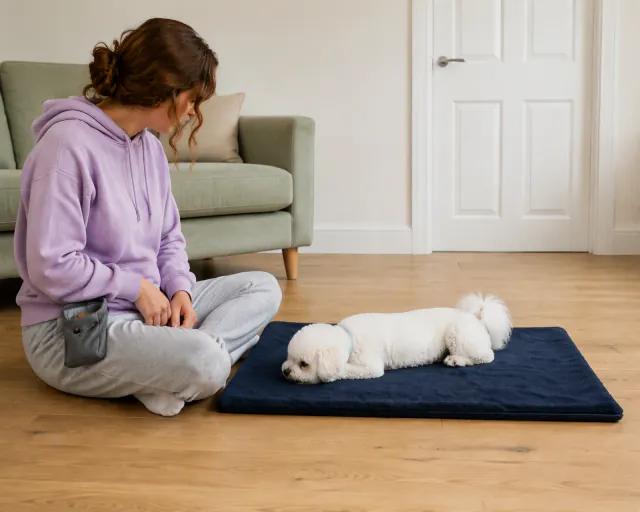
- A mat or bed the puppy already settles on
- A phone or speaker for played sounds, or access to the real sound at a safe distance
Puppies are not born knowing that a vacuum cleaner, a doorbell or a passing lorry is harmless. Left to work it out alone, some puppies decide the opposite, and a startled reaction repeated a few times can settle into a lasting fear. This lesson builds the habit of introducing ordinary noise gradually and pleasantly, starting well below the level where the puppy reacts and staying there until the sound becomes background. It sits alongside settling on a mat, since a puppy who is already comfortable resting near you is easier to keep calm as sound is added.
Purpose
To teach your puppy that everyday sounds predict something good, or at worst predict nothing at all, rather than something to brace for. The finished skill is a puppy who notices a common household or outdoor sound, glances towards it, and carries on with what they were doing, rather than freezing, fleeing or barking.
Prerequisites
Your puppy should already settle on a mat with you nearby and be generally relaxed at home, without pre-existing signs of noise sensitivity. If your puppy already flinches hard, tries to hide, or refuses food whenever a specific sound occurs, this lesson is too advanced to start with alone; that pattern needs individual assessment from a qualified behaviourist working with your vet, since undoing an existing fear takes a different pace and plan than building tolerance from scratch.
Equipment
Use a mat or bed your puppy already settles on happily, and small, soft food they can eat quickly without losing focus on the session. For sounds you can control, such as a vacuum cleaner or a doorbell, use the real item at a distance or a volume so low the puppy barely registers it. For sounds harder to control at will, such as traffic or a neighbouring dog barking, choose a moment when the real thing naturally occurs at a distance, or use a recording played quietly from another room rather than close to the puppy.
Method
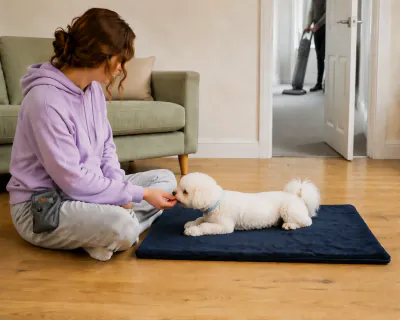
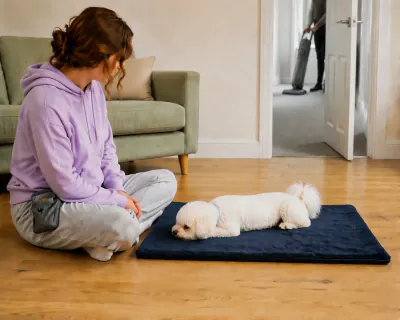
- Settle your puppy on their mat in a familiar room, with food ready and the puppy already calm.
- Introduce the sound at the lowest level you can manage, such as a doorbell rung from outside with the front door shut, or a vacuum cleaner running in a different room with the door closed.
- The moment the sound starts, feed a piece of food or offer calm praise, whichever the puppy responds to more readily.
- Watch for a puppy who notices, glances towards the sound, and returns their attention to you or to the food; that is the response you want, and it is worth ending the session on.
- Repeat the same sound at the same low level across several short sessions until the puppy stops reacting at all, then increase the volume or reduce the distance by a small amount.
- Move through each sound in stages this way: quieter or further away first, then gradually closer to normal volume and distance, never skipping a stage because progress seems slow.
- Work through one sound at a time rather than introducing several new sounds in the same session, so you can tell clearly which one, if any, caused a reaction.
- Once a sound is thoroughly boring to the puppy at close to normal volume, move on to the next one on your list.
Session length
Two to three minutes, once or twice a day, covering a handful of repetitions of one sound. Shorter and more frequent works better than one long session, and a puppy who seems tired or has had a demanding day is better left until tomorrow.
Progression criteria
Move on to a louder or closer version of a sound only once your puppy shows no reaction to the current level, meaning they do not startle, freeze or stop taking food, across three separate sessions on different days. Raise difficulty one variable at a time: reduce distance first, or increase volume, but not both together, and never introduce a new sound at the same time as increasing an established one.
Common mistakes
Playing a sound at full volume to see how the puppy copes treats exposure as a test rather than as training, and a bad reaction at that stage can set the puppy back further than not exposing them at all. Repeating a loud, sudden version of a sound in the hope the puppy will get used to it is flooding, and it tends to produce a puppy who either shuts down or reacts more strongly over time. Ignoring small signs of discomfort because the puppy has not fully panicked misses the point where the exposure was already too much. Treating this lesson as a replacement for wider socialisation leaves other important experiences, such as meeting people and other dogs, unaddressed.
Troubleshooting
If your puppy stops taking food when a sound occurs, you have moved too fast; increase the distance, lower the volume, or both, and rebuild from a level where they stayed relaxed. If a sound that seemed fine yesterday causes a reaction today, treat the puppy as more sensitive that day rather than assuming the previous progress was wasted, and step back a stage for that session. Some puppies generalise quickly from one loud noise to a broader wariness of noise in general; if that happens, slow the whole programme down and consider involving a qualified behaviourist early rather than waiting to see if it resolves alone.
Safety and when to stop
Stop the session at the first sign that your puppy is struggling: freezing, trying to leave the room, tucking the tail, or refusing food they would normally take. These are not signs to push through, and continuing past them is more likely to build a lasting fear than to cure one. This lesson covers sound specifically and is not a substitute for a full socialisation programme; for the wider plan covering people, other dogs and new environments, see the puppy socialisation checklist. If your puppy shows a strong fear reaction to any sound, or the reaction is getting worse rather than better with gentle exposure, speak to your vet and a qualified behaviourist rather than continuing the exercise alone.
Next lesson
Once everyday sounds no longer trouble your puppy at home, move on to preparing for car travel, which uses the same gradual approach for a new environment with its own sounds and motion.
Related reading
For the fuller picture of introducing a puppy to people, other dogs, surfaces, handling and new places on a sensible weekly schedule, see the puppy socialisation checklist, which this lesson complements rather than replaces.