
- Session length
- 2 to 5 minutes, once or twice a day
- Skill
- Handling
- Suits
- Puppy
What you need
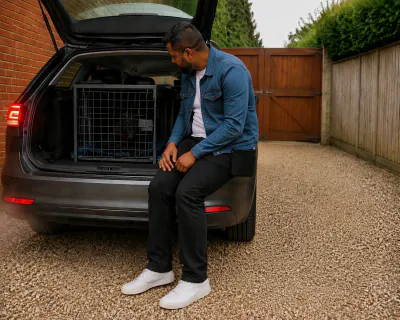
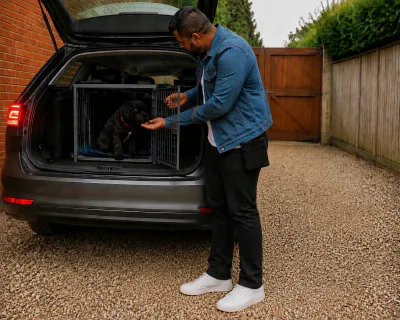
- A secure crate, travel harness or fitted carrier sized correctly for your puppy, never loose in the footwell or on a lap
- Small soft food for rewarding calm behaviour in and around the car
- A settled mat or bedding the puppy already associates with resting, placed inside the crate or carrier
A puppy’s opinion of the car is usually decided long before the engine starts, based on how the first few experiences felt. A puppy whose only car trips have been long, wobbly journeys to the vet often grows into an adult who drools, paces or panics at the sight of the car keys, and that association is far easier to prevent than to undo later. This lesson builds car travel the same way as every other skill in the pathway, in small stages, starting from stationary and adding motion only once the puppy is settled.
Purpose
To teach your puppy that the car is a calm, unremarkable place, using short, positive stages that build up gradually rather than starting with a real journey. The finished skill is a puppy who walks or is lifted into their crate or harness without fuss and settles for the length of an ordinary local trip.
Prerequisites
Your puppy should already be comfortable with handling, since getting in and out of a crate or harness in a car involves being lifted, guided or fastened in. They should also cope calmly with everyday household sounds, since a car engine, indicators and passing traffic are simply more sounds to have already built some tolerance for.
Equipment
Decide on a secure crate, travel harness or fitted carrier appropriate to your puppy’s current size before you begin, since this is not optional safety equipment to add later. A puppy loose in the footwell or sitting on a lap is a serious hazard in an accident or even a sudden stop, for the puppy and for anyone else in the car. Bring bedding the puppy already settles on at home, and small, soft food for rewarding calm behaviour at each stage.
Method
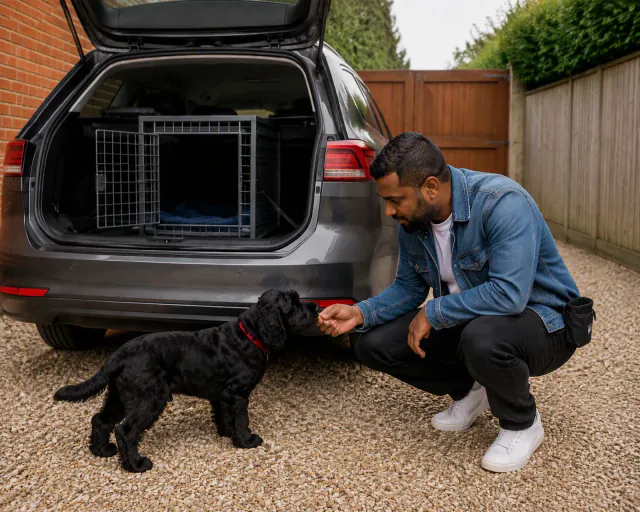
- With the car parked and the engine off, open a door and let your puppy explore the area around it and climb in and out freely, rewarding curiosity and calm sniffing.
- Fasten the puppy into their crate, harness or carrier inside the stationary car, and sit with them for a minute or two, feeding occasionally and talking normally.
- Repeat this stationary session on separate days until the puppy settles quickly and shows no sign of stress at being fastened in.
- With the puppy fastened in, start the engine but do not drive, and let the puppy get used to the sound and vibration for a minute before turning it off again.
- Once the puppy is settled with the engine running, drive a very short distance, such as once around the block, then park and reward calmly before getting the puppy out.
- Gradually extend the length of these short local drives over several sessions, always ending while the puppy is still settled rather than pushing until they are restless.
- Choose a pleasant destination for early real journeys where possible, such as a quiet spot for a short walk, so the car itself becomes associated with something the puppy enjoys.
- Keep the crate, harness or carrier as a fixed rule for every journey from the very first trip, so the puppy never learns any other way of travelling.
Session length
Two to five minutes for stationary sessions, once or twice a day, extending gradually as you introduce the engine and then short drives. There is no need to rush; a few calm minutes several times a week beats one long session that ends badly.
Progression criteria
Move on to the next stage only once your puppy settles within a minute at the current one, showing loose body language, taking food normally and not whining or scrabbling at the crate or harness, across several separate short sessions. Raise the difficulty one variable at a time: engine noise before movement, a very short drive before a longer one, and duration in the car before adding a genuinely new destination.
Common mistakes
Making the first car experience a long trip to the vet or a groomer, especially for a first vaccination visit, risks pairing the car itself with something unpleasant before any positive association exists. Skipping the stationary stages and going straight to a drive removes the groundwork that makes the drive tolerable. Allowing a puppy loose in the car, even briefly or for a short trip, undoes the safety point of using a crate or harness and creates a habit that is harder to change later. Ending every car journey at the vet, and nowhere else, teaches a puppy that the car predicts only one outcome.
Troubleshooting
If your puppy whines, drools or is sick on short drives, this is often genuine motion sickness rather than fear, and it frequently improves as the puppy grows and their balance system matures; keep sessions very short and speak to your vet if it persists, since some puppies benefit from a short-term anti-sickness medication while the association is rebuilt. If a puppy resists getting into the crate or harness at all, go back to rewarding simply approaching and standing near it with the car doors open, and rebuild from there rather than lifting a reluctant puppy in by force. If a puppy is fine in a stationary car but distressed as soon as it moves, spend longer on the engine-running stage before attempting any distance at all.
Safety and when to stop
Always use a crate, travel harness or fitted carrier sized correctly for your puppy’s current weight and shape, refitted as they grow; never travel with a puppy loose in the car or held on a lap. Stop a session if your puppy is drooling heavily, vomiting, or showing clear distress, and go back to an earlier, easier stage next time rather than persisting through it. If sickness or anxiety around car travel does not ease as your puppy matures, or seems to be getting worse, talk to your vet, since there are medical and behavioural options beyond what gradual exposure alone can achieve.
Next lesson
That completes the puppy pathway. Continue into beginner training, which takes these same foundations into longer durations, greater distances and real-world distraction.
Related reading
Car travel is often just one part of a wider plan to introduce a puppy to the world calmly and safely; the puppy socialisation checklist sets out a fuller weekly schedule that this lesson fits neatly alongside.