An unrestrained dog in a moving car is a risk to itself, to any passengers and to the driver, and this is true even on a short, familiar journey. A dog thrown forward in a sudden stop can be seriously injured by the impact itself, and a dog that becomes a projectile inside the cabin can injure or kill a passenger or interfere with the driver at exactly the moment full control is needed. This guide is about the equipment and legal side of that problem: choosing an appropriate restraint, understanding what “crash-tested” claims actually mean, and setting up a car so a restrained dog travels safely.
This is a separate topic from teaching a dog to feel calm and settled about car travel, which is a behavioural process covered in puppy car travel preparation. A dog can be perfectly relaxed in the car and still be dangerously unrestrained, and a dog that is properly restrained still benefits from the calm association that behavioural preparation builds. The two are complementary, not substitutes for each other.
Why restraint matters
In a collision or even a hard emergency stop, an unrestrained dog continues moving at the vehicle’s prior speed until something stops it, whether that is the windscreen, a seat, another passenger or the road itself if a door opens. The forces involved at ordinary road speeds are large enough to cause severe injury to the dog and to anyone the dog strikes. A loose dog can also distract a driver by climbing between seats, blocking the view or moving unpredictably at a critical moment, which is a road safety issue independent of the risk to the dog itself.
None of this depends on the length of the journey. Most road incidents happen close to home on routes drivers know well, so treating restraint as something only needed for long trips misses most of the actual risk.
Common restraint options
A few broad categories of restraint cover most situations, and the right choice depends on the dog’s size, the vehicle and how the dog copes with each option.
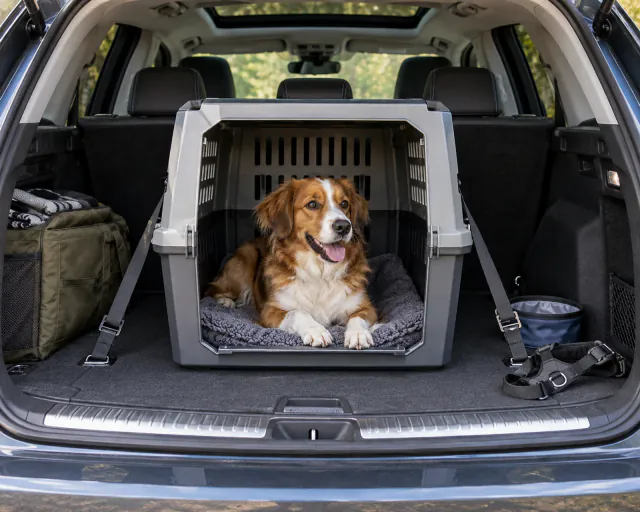
- A travel crate secured in the boot or a footwell. A rigid or well-built crate, fixed so it cannot slide or tip during a stop or collision, contains the dog fully and can offer strong protection when it is genuinely secured and sized correctly for the dog. A crate that is simply placed in the boot without being fastened down offers far less protection, since the crate itself can become a projectile.
- A properly fitted harness with a seatbelt attachment. A car-specific harness clips into the vehicle’s existing seatbelt system or a dedicated anchor point, restraining the dog in a seat much as a seatbelt restrains a person. The harness needs to fit correctly, in the same way a walking harness does, since a loose harness can allow the dog to be thrown forward within it or to slip out entirely under load.
- A dog guard combined with a crate or harness. A guard fitted behind the rear seats or across a boot area stops a dog moving forward into the passenger compartment, but a guard alone does not stop a dog being thrown around within the boot space itself. Pairing a guard with a crate or a harness gives more complete protection than either alone.
The best choice depends on the dog, the vehicle’s layout and how each dog tolerates the equipment, and trialling an option calmly, with the behavioural groundwork from car travel preparation in place, gives a better result than forcing a struggling dog into unfamiliar restraint for the first time on a real journey.
What “crash-tested” actually means
Marketing language on travel restraint products varies enormously in how much it reflects genuine, independent testing. A phrase like “crash-tested” or “safety tested” on packaging does not, by itself, tell you what standard was used, what impact speed and direction were simulated, what size or weight of dog the test used, or whether the test was conducted by an independent body or by the manufacturer itself.
Where independent, published crash-test standards for pet travel equipment exist in your country or region, look for a restraint that has been assessed against one of those specific standards, and check what the rating actually covers rather than trusting the word “tested” alone. Testing standards and available certifications differ between countries, so a product’s claims should be checked against a recognised standard relevant to where it was purchased and where it will be used, not assumed to meet a standard from a different market.
Legal requirements vary by country
Many countries have some form of legal requirement or guidance around securing an animal in a moving vehicle, but the detail, the enforcement and the specific wording differ significantly between jurisdictions, and some regions have no specific requirement at all beyond general rules about safe driving and not endangering other road users. Rather than assume any one country’s rule applies universally, check the specific legal requirements for restraining a dog in a vehicle that apply in the country, and where relevant the region, in which you are driving.
Practical setup considerations
A few further points affect how safely a restraint actually functions once it is in place.
- Airbag positioning. Never place a dog, in a crate, on a harness or loose, in a front passenger seat where an active airbag could deploy against it. Airbags deploy with enough force to cause serious injury to a dog of almost any size, and the rear of the vehicle is the appropriate place for restrained travel in almost all circumstances.
- Seat covers and hammocks are not restraints. They keep mud, hair and claws off the upholstery but do not hold a dog in place when the car stops quickly. Fit one so it never covers a buckle or gets in the way of the restraint; the seat cover guide compares the options.
- Ventilation. Whatever restraint is used, make sure air can circulate around the dog, particularly inside a crate, and that the dog is not pressed against a hot surface such as a sun-warmed window or a boot area near the exhaust system.
- Never leave a dog alone in a parked vehicle in warm weather. Temperatures inside a parked car can rise to dangerous levels within minutes, even with windows partly open and even on a day that does not feel particularly hot outside. This risk exists independently of how the dog is restrained while the car is moving, and it deserves separate attention: the guide on temperature and heat risk awareness covers how quickly this happens and the signs of heat-related harm to watch for.
- Check the setup with the engine off first. Before ever driving with a new restraint system, fasten the dog in with the car stationary and observe how they settle, whether the equipment holds its position and whether anything needs adjusting, rather than discovering a problem for the first time on the road.
Restraint is not a single purchase that solves the problem permanently. Recheck straps, buckles, crate fixings and harness fit periodically, in the same way you would recheck any other piece of dog equipment, and replace anything showing wear before it is asked to do its job in a genuine emergency.