Socialisation is the process of teaching a puppy that ordinary life is nothing to worry about. It has a time limit, because the weeks in which puppies accept new things most readily do not last, and it has a quality standard, because a frightening experience teaches the wrong lesson faster than a pleasant one teaches the right one.
The plan below works outwards from the quietest setting to the busiest. Treat it as an order of work rather than a race, and expect to spend several weeks on it.
Judge the puppy, not the list
Before adding anything new, learn what a comfortable puppy looks like. A puppy who is coping moves loosely, sniffs, takes food, looks at the new thing and then looks away again. A puppy who is struggling goes still, tucks the tail, yawns or licks their lips out of context, refuses food they would normally take, tries to get behind you, or barks in short bursts while backing off.
Refusing food is the clearest single signal. When it happens, you are too close, too loud or too long. Increase the distance, reduce the intensity or end the session, and repeat the same exposure another day from further away.
Never carry a frightened puppy into the middle of something so they can see it is harmless. Flooding a puppy in that way tends to produce a dog who shuts down at the time and reacts badly to the same thing months later.
Start inside the house
The household is the first environment and the easiest one to control. Over the first fortnight, work through the noises and events that occur in every home, pairing each with food or a game at a level the puppy barely notices.
- Vacuum cleaner, hairdryer, washing machine spin cycle and food processor
- Doorbell, knocking, letterbox, telephone and television
- Wheelie bins, hoover cord snapping back, dropped saucepan lids
- Umbrellas opening, carrier bags, cardboard boxes, ironing board
Start each at a distance or at low volume with the puppy occupied with something pleasant. The aim is that the puppy notices, carries on, and gradually stops noticing. Household preparation is covered in more detail in the first days at home.
Handling, surfaces and equipment
Handling is the part owners most often skip and vets most often wish they had not. Several times a week, with food to hand, touch and briefly hold each ear, look at the teeth, lift each paw, spread the toes, run a hand down the tail and along the belly. Keep every repetition short and stop before the puppy pulls away.
Introduce the grooming kit in the same way, brush on the floor first, then one stroke, then two. Puppies who will need regular professional grooming, including a Cockapoo or any other coat that mats, should be comfortable with a brush, a comb, clipper noise and standing on a raised surface long before the first salon appointment.
Add surfaces at home and in the garden: grass, gravel, wet paving, a metal drain cover, a doormat, a wobbly board, a puddle and the boot of the car. Let the puppy choose to step on each one rather than lifting them onto it.
Take the world to the puppy first
Ask your vet when your puppy can go on the ground in public places. Until then, socialisation continues in your arms, in the car or in a secure garden, which is often the better introduction anyway because you can leave at any moment.
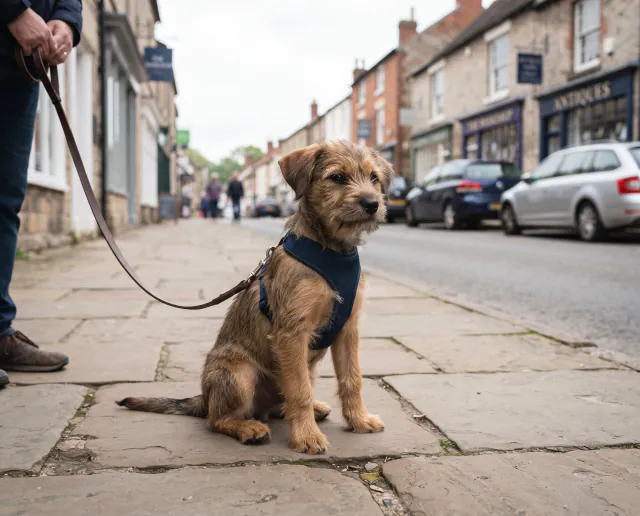
Sit on a bench a good distance from a school gate, a bus stop or a supermarket entrance and simply watch. Ten minutes of quiet observation is worth more than a walk through a crowd. Park where you can see traffic without being beside it, open a window and feed the puppy while lorries and motorbikes pass.
Build a list of the categories a dog in Britain meets: traffic and its noise, prams and pushchairs, bicycles, wheelchairs and mobility scooters, high visibility jackets, people in hats and hoods, umbrellas, joggers and skateboards, livestock behind a fence, horses, and the weather itself, including rain, wind and thunder.
People and other dogs
Visitors should be calm and few. One person who ignores the puppy on arrival and lets the puppy approach in their own time teaches more than a room full of people passing the puppy around. Ask everyone to stroke the chest or shoulder rather than reaching over the head, and to let the puppy walk away.
Cover the variety deliberately: men with beards and deep voices, children of different ages, older people with sticks or frames, and people in uniform. Children should be sitting down, with an adult supervising every interaction.
For dogs, quality beats quantity by a wide margin. Two or three known, healthy, well-mannered adult dogs who tolerate a puppy politely are the right teachers. A busy park full of unknown dogs is not. Keep greetings brief, call your puppy away after a few seconds, and end the meeting while it is still going well.
Keep a record and adjust
Write the categories on a sheet and note the date and how the puppy responded, using a simple mark for relaxed, coped, or found it hard. After a fortnight the gaps are obvious, and so is any pattern, such as a puppy fine with people but wary of anything moving fast.
Repeat the ones marked as difficult at a lower intensity rather than avoiding them. Three easy repetitions beat one hard one. Two or three short outings a week, each under fifteen minutes, cover more ground than a daily slog, and a puppy needs a great deal of sleep between them.
When to get help
Socialisation reduces the chance of fear problems, it does not guarantee their absence. If a puppy is repeatedly panicking, freezing, refusing to leave the house, growling at approaching people, or is worse at ten weeks of exposure than at two, stop the programme and get help early.
Ask your vet to check for pain or illness first, since discomfort changes how a puppy responds to everything. Then work with a qualified reward-based trainer or a clinical animal behaviourist. Fear addressed at four months is a much smaller job than fear addressed at eighteen.