
At a glance
Key facts
The essentials to compare before deciding whether this breed fits your home and routine.
- Size
- Small
- Lifespan
- 12 to 15 years
- Energy
- Medium to high
- Temperament
- Sociable, bright and people-focused
- Good with children
- Often good with calm, respectful children
- Exercise
- 60 to 90 minutes a day
- Trainability
- Beginner friendly
- Grooming
- Brush several times weekly with regular professional grooming
- Estimated monthly cost, GBP
- £80 to £150 per month
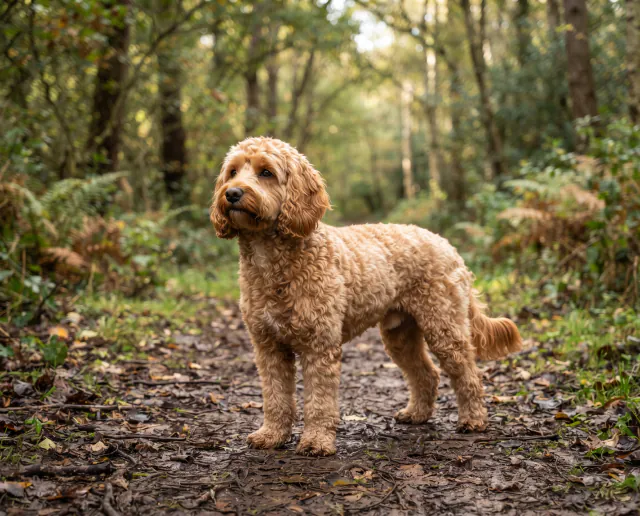
A Cockapoo is a cross between a Cocker Spaniel and a Poodle, most often a Miniature or Toy Poodle. Crossbreeding does not produce a fixed set of traits. Adult size, coat texture, shedding and temperament can differ between littermates. Prospective owners should learn about both parent breeds and meet the mother. A well-raised Cockapoo is often bright, affectionate and enthusiastic, but the same dog may struggle if left alone or given too little to do.
Origin and purpose
The Cockapoo brings together the Cocker Spaniel, a flushing and retrieving gundog with a long working history, and the Poodle, itself a water retriever before it became mainly a companion and show dog. The cross has been made in the United States since around the middle of the twentieth century and became common elsewhere from the 1990s, promoted largely on the promise of a friendly family dog that sheds less. No breed standard exists, no registry closes the pedigree and breeders work to no agreed type, so size, coat and character vary widely and littermates may differ from one another. Both parent breeds were developed to work with a handler through long days outdoors, which explains why a Cockapoo is usually quick to learn, keen to be involved and easily bored when a household underestimates how much activity it needs.
Suitability
Cockapoos can fit family homes, active retired households and committed first-time owners. They usually want close contact with people and may not suit a routine built around long absences. Children should learn to leave a dog alone while it eats, sleeps or moves away. The smaller individuals can be injured by rough handling. Most get on well with other dogs given ordinary socialisation, and a resident cat is usually accepted, though spaniel inheritance can show as chasing outdoors. Their alertness sometimes develops into persistent barking, so reward calm responses to visitors and outside noises early. A garden is useful but does not replace walks, training and new places to explore.
Exercise
Most healthy adults need 60 to 90 minutes of daily exercise, split into manageable outings. Spaniel traits may bring a strong interest in scent and wildlife, while Poodle traits often support quick learning. Recall training should begin in quiet enclosed spaces and progress gradually. Sniffing games, simple retrieves and food searches provide productive mental work. Puppies need shorter sessions and plenty of sleep. Repeated high jumps and forced running are poor choices for a growing dog. Match activity to the individual rather than assuming a small Cockapoo needs little exercise.
Grooming
Coat care is a significant commitment. Curly and wavy coats can mat close to the skin even when the surface looks tidy. Brush to the roots several times a week, paying attention behind the ears, under the collar, in the armpits and around the legs. Many Cockapoos need professional grooming every six to eight weeks. Discuss the desired practical length with the groomer. Check ears regularly because hair, warmth and moisture can contribute to irritation. Introduce handling, nail care and tooth brushing with short, rewarded sessions.
Health
Ask what health tests were completed for each parent, based on the relevant Cocker Spaniel and Poodle variety. A vague claim that crossbreeds are automatically healthier is not evidence of screening. Eyes, joints and inherited conditions may be relevant depending on the parents. Request written results and confirm identities match. Keep the dog lean, use a balanced complete diet and arrange routine veterinary care. Repeated ear trouble, skin irritation, limping or changes in drinking and urination should be assessed by a vet rather than managed through online advice.
Choosing and training
Choose a breeder who explains the parent dogs’ temperaments, likely adult sizes and coat-care needs without promises of a guaranteed non-shedding puppy. Meet the litter at home and check that puppies are confident without being forced to interact. Rescue organisations may have adolescent or adult Cockapoos whose size and coat are already clear. Reward-based training works well. Focus on calm separation practice, loose-lead walking, recall, grooming cooperation and settling while household life continues around the dog.
Size and lifespan
Adults typically stand 25 to 38 cm (10 to 15 in) at the withers and weigh 5 to 11 kg (11 to 24 lb), and individuals fall outside that range in both directions. Adult size depends heavily on which Poodle was used, with Toy Poodle parents producing the smallest dogs and Miniature Poodle parents producing something closer to the Cocker Spaniel in build. Later generation crosses are less predictable again. Ask for both parents’ actual measurements and treat any confident forecast of adult weight with caution. A typical lifespan is 12 to 15 years. As noted in the health section above, screening should cover the conditions recognised in the Cocker Spaniel and in the relevant Poodle variety, under the schemes used for each, with written results for the specific parents. Discuss anything unclear with your own vet rather than relying on the seller’s interpretation.
Verdict
Cockapoos can be engaging companions for people who enjoy training and can budget for lifelong coat care. Their popularity does not make every puppy predictable or easy. The best homes accept variation, provide daily company and give the dog both physical and mental outlets. Anyone seeking a reliably low-maintenance coat or a dog content to be alone all day should look elsewhere. Careful sourcing and early grooming practice make a substantial difference to life with this crossbreed.
Meet several mature Cockapoos if possible, as puppy photographs reveal little about adult coat or energy. Plan for the more demanding outcome rather than the easiest one. Enough time, insurance and grooming funds provide a safer basis for the decision.