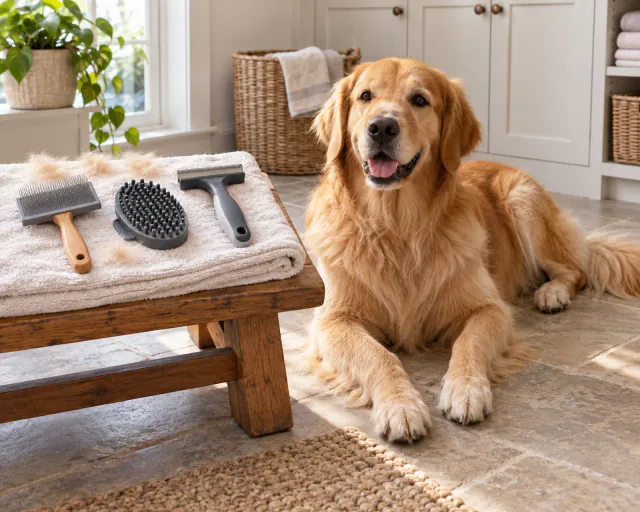
The right brush depends almost entirely on the coat. A tool that works beautifully on a Golden Retriever’s double coat does nothing for a Whippet, and a deshedding tool that suits a Labrador can irritate a dog with a single, fine coat. Buying by the coat rather than by the shelf is the single most useful thing an owner can do. This guide explains how to match a brush to a coat and compares four common kinds of tool. Our guides to grooming tool basics and grooming by coat type go into more detail on each tool and each coat.
How products are chosen
Canine Origin has not tested these brushes hands-on. Each one was chosen from the maker’s published details and a UK stockist’s listing, checked against the criteria below, and every specification on the product cards names its source. The criteria are the coat types the maker says the tool suits and does not suit, its sizes, how it clears collected hair, the maker’s guidance on how often and how to use it, any stated warnings, and UK availability. How comfortable a brush is for a particular dog, and how well it holds up, can only be judged in use, so no claim is made about either.
Start with the coat
Most dogs fall into one of a few coat groups. Smooth, short coats, such as a Boxer or a Whippet, need little more than a rubber brush or grooming mitt to lift loose hair. Double coats, with a dense undercoat beneath longer guard hairs, such as a Labrador, Husky or German Shepherd, shed heavily and benefit from a tool that reaches the undercoat. Long or silky coats, such as a Cavalier, tangle easily and need a slicker and a comb. Curly and wool coats, such as a Poodle or many Doodles, mat close to the skin and need thorough brushing with a slicker and a comb right down to the skin. Wiry coats, such as many terriers, need a slicker and, for some, hand stripping. Corded coats need specialist care, and ordinary slicker brushes are not suitable. If you are not sure which group your dog is in, a groomer can tell you; see choosing a groomer.
Slicker brushes
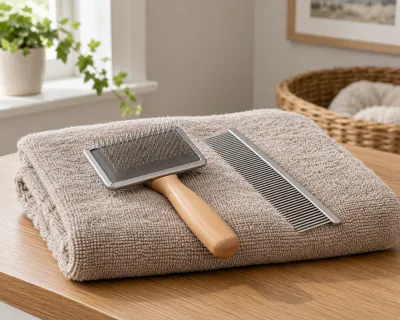
A slicker brush has fine, bent wire pins set close together, and it is the workhorse for medium, long, curly and wiry coats. Use it with a light hand, in small sections, lifting the coat and brushing outwards from the skin. Pressing hard is the most common mistake: the pins can scratch and cause a sore called brush burn, particularly on thin-skinned dogs. A slicker that clears easily saves time, because a brush full of hair stops working. The slicker on this page retracts its pins at the press of a button to release the hair, and its maker lists the coat types it suits and states that it is not for corded coats.
Rubber brushes
A rubber brush or curry has soft, flexible fingers rather than pins. It lifts loose hair and dead skin from short coats and is comfortable for most dogs, which makes it a good first brush for a puppy or a dog that is wary of grooming. Many can be used with shampoo in the bath. A rubber brush does not reach through a long coat or remove tangles, so for longer coats it is a finishing tool rather than the main one. Our guide to bathing a dog covers the rest of bath time.
Deshedding tools
A deshedding tool has a fine-toothed edge that reaches through the topcoat to pull out loose undercoat. For heavy shedders it can remove a large amount of hair in a short session, which is why so many owners of double-coated dogs use one. It is also the tool most easily overused. Its maker says it is not for non-shedding breeds or dogs with sensitive skin, that it should not be used over mats, sores or skin conditions, and that it should be used for 10 to 20 minutes a week, more during heavy shedding. Choose the size and the coat-length version carefully, work gently, and stop if the skin looks red. Our guide to shedding and seasonal coat changes explains what to expect through the year.
Combs and mats
Whatever brush you use, a metal comb is the check that the job is done: if the comb glides from skin to tip, the coat is clear; if it catches, there is a tangle the brush missed. A comb with two widths of teeth covers both jobs: work through with the wider teeth first, and move to the finer side once the wide side runs through without catching. Rounded pin ends matter, because a comb reaches right down to the skin, and it should never be pushed into the skin or dragged through a knot. The comb on this page is made that way, and its maker lists silky, long, wiry and curly coats as the ones it suits. Small tangles can be worked apart with fingers and a comb, holding the hair near the skin so it does not pull. Do not cut mats out with scissors close to the skin, because it is very easy to cut the dog. Mats are a job for a groomer, and a coat that mats badly may be kinder clipped short and started again.
Brushing is handling practice
Brushing is as much about the dog’s comfort with being handled as about the coat. Keep early sessions short, reward calm behaviour, and stop before the dog becomes restless. Our handling for grooming lesson and the guide to introducing grooming to a puppy set out a gradual approach. A dog that finds brushing unpleasant will resist it more every time, and a few minutes of calm brushing does more good than a long session that ends in a struggle.
Brushing safely and checking the skin
Brushing is the best chance you have to notice changes early. Look for redness, flaking, lumps, scabs, parasites or sore patches as you part the coat, and use our guide to skin and coat health checks as a routine. Anything new, painful, or that does not settle within a few days needs a vet, not a different brush.
When to replace it and questions to ask
Replace a slicker when its pins are bent, loose or missing, a rubber brush when it cracks or loses its grip, and a deshedding tool when the edge is damaged. Before buying, ask: which coat group is my dog in, does the maker say this tool suits that coat, will I be able to use it gently, and do I also need a comb to check my work.