A dog that normally sheds a manageable, steady trickle of hair can suddenly seem to be losing coat by the handful, leaving tufts of undercoat caught on furniture, clothing and floors for weeks on end. For many double-coated breeds this is not a problem developing, it is a normal seasonal process working exactly as it should. Understanding what drives it, and what genuinely falls outside the normal pattern, saves a good deal of unnecessary worry and helps you manage the mess without fighting a process that cannot be stopped.
This guide explains why seasonal shedding happens, how to manage a heavy shed while it is underway, and the signs that suggest hair loss is not simply seasonal and is worth a vet’s opinion.
Why seasonal shedding happens
Many double-coated breeds, including German Shepherds, Labradors, Huskies and spitz-type breeds, grow a dense undercoat for insulation that adjusts with the seasons. As day length changes, commonly triggering a heavier shed in spring as a dog releases the denser winter undercoat, and again in autumn as a new coat comes in ahead of colder weather, the body releases large amounts of undercoat over a period of a few weeks. This is often called a coat blow, and it can look alarming in volume compared with the dog’s normal day-to-day shedding.
This process is a normal, expected part of having a double coat and is not, on its own, a sign of a health problem. It happens regardless of how well a dog is brushed, though brushing changes how much of the loose hair ends up around the house rather than on the dog.
Coat type determines the shedding pattern
Not every dog sheds this way. Single-coated breeds without a dense undercoat, such as many poodle-type and some terrier coats, tend to shed continuously and relatively lightly throughout the year rather than in seasonal bursts, which is part of why these coats are often described as lower-shedding, though “low-shedding” is a relative description rather than an absence of shedding altogether. How a specific coat type behaves is covered in more detail in grooming by coat type.
Indoor living with consistent artificial lighting and heating can also blur the seasonal pattern somewhat for some dogs, since day length is one of the main environmental triggers, though most double-coated dogs still show a recognisable seasonal pattern regardless.
Managing a heavy shed
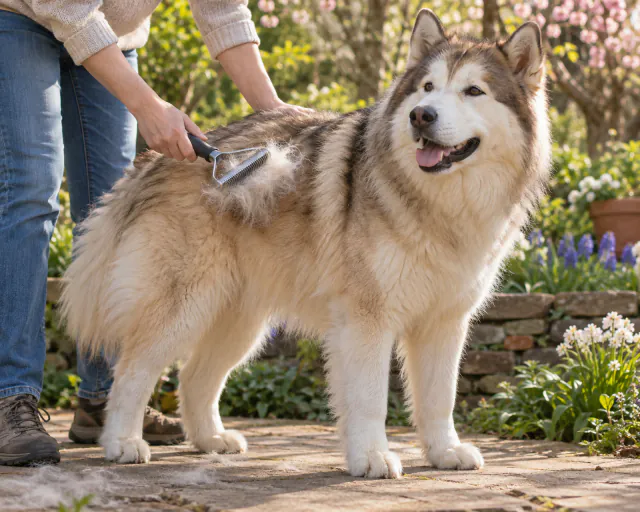
An undercoat rake, designed to pull loose undercoat out from underneath the topcoat without cutting the guard hairs, is the most effective tool during a coat blow, and is covered in more detail in grooming tool basics. Increasing brushing frequency to several times a week, or daily for a heavy shedder during the peak of the process, removes loose hair before it ends up around the home and can also make the dog more comfortable, since a coat full of loose, dead undercoat can feel hot and heavy.
A bath timed for partway through a heavy shed can help release loose coat that brushing alone has not fully removed, particularly followed by thorough drying and a further brush-through while the coat dries, covered in bathing a dog. This is not necessary for every dog during every shed, but can be useful for a particularly heavy or prolonged one.
Beyond the dog itself, accepting a temporary increase in housework, more frequent vacuuming, lint rolling and floor sweeping, during the peak weeks is often the most realistic approach. The volume of loose hair during a genuine coat blow is not something that can be fully prevented through grooming alone, only reduced and managed until it passes.
Why shaving is not the answer
It can be tempting to shave a heavily shedding double-coated dog down to the skin to deal with the volume of loose hair in one step, but this is generally discouraged. The double coat structure, a dense undercoat under a coarser topcoat, works together for insulation and weather protection in both directions, keeping a dog cooler in some conditions and warmer in others than an equivalent amount of bare skin would. Removing both layers can affect that regulation, and regrowth after shaving is not guaranteed to come back at the same rate or texture as the original coat. Managing a heavy shed with proper brushing tools and technique addresses the mess without this risk. More detail on this is covered in grooming by coat type.
When hair loss is not simply seasonal shedding
Normal seasonal shedding, even at its heaviest, still leaves an even coat underneath as the process progresses, without bare or thinning patches of visible skin. Several patterns are different from this and worth a vet’s attention rather than being managed as an unusually heavy shed:
- Patchy hair loss, particularly if the skin underneath is visible, red, scabbed or otherwise looks different from the surrounding area
- Hair loss accompanied by noticeable itching, scratching, licking or chewing at the affected area
- Hair loss occurring well outside the pattern of shedding a dog has previously shown, especially if it happens at an unusual time of year with no clear seasonal trigger
- A coat that thins overall rather than sheds in the expected pattern, particularly alongside other changes such as weight change, lethargy or altered appetite
- Shedding that seems to have no end point, continuing heavily for months rather than settling after a few weeks
Any of these patterns can have a range of underlying causes, and a vet examination is the appropriate way to work out what is happening rather than guessing from appearance alone at home. Routine checking of the skin and coat as part of a normal grooming routine, described in skin and coat health checks, makes it easier to notice when a pattern has genuinely changed rather than relying on memory of what is normal for that particular dog.
Setting realistic expectations
For an owner of a heavily shedding breed, accepting that certain weeks of the year will involve noticeably more loose hair around the home, regardless of how diligent the brushing routine is, tends to be a more realistic approach than expecting to eliminate the seasonal shed entirely. Good tools and a consistent routine reduce the mess and keep the dog more comfortable through the process, but they manage a normal biological event rather than prevent one.