Walk into a pet shop grooming aisle and it is easy to leave with several tools that do roughly the same job and none that do the one your dog actually needs. Most grooming tools are designed for a fairly specific purpose, and using the wrong one is not just inefficient, it can be uncomfortable for the dog or simply fail to achieve what you are trying to do, such as brushing over the surface of a coat that is matted underneath.
This guide runs through the common tools, what each is genuinely for, and how to think about matching tools to your own dog’s coat rather than buying everything on the shelf. Which coat type needs which approach is covered in more depth in grooming by coat type; this guide focuses on the tools themselves.
Slicker brushes
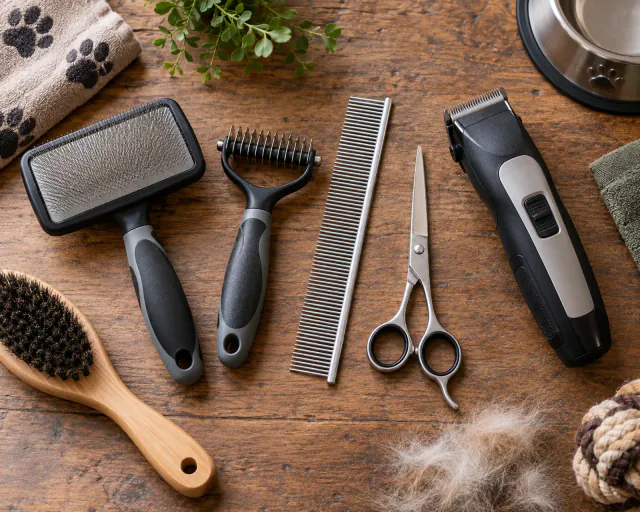
A slicker brush has a flat or slightly curved head covered in fine, closely spaced wire bristles. It is one of the most versatile tools available and works well for detangling and for general finishing across a wide range of coat types, particularly medium to long coats and coats with some texture or curl.
Used correctly, a slicker brush works through the coat in sections rather than skimming the top layer, since a coat can look tidy on the surface while carrying tangles or trapped loose hair underneath. Pressure matters: a slicker dragged too hard across the skin can cause irritation, sometimes called slicker burn, so let the tips of the bristles do the work rather than pressing down firmly.
Undercoat rakes
An undercoat rake has widely spaced, often two-level teeth designed to reach down through a topcoat and pull loose undercoat out without cutting or damaging the guard hairs above it. This is the tool for double-coated breeds, particularly during a seasonal coat blow when large amounts of undercoat release over a few weeks.
A rake is not the right tool for a coat without a distinct undercoat, since there is nothing for the wider teeth to catch, and using one on a fine, single-layer coat can simply pull at the coat without achieving anything useful. Match the rake to the job rather than assuming a more aggressive-looking tool is automatically more effective.
Bristle brushes
A natural or synthetic bristle brush, with closely packed, relatively soft bristles, suits short and smooth coats well. It lifts loose hair and adds a light polish without the more intensive detangling action of a slicker, which is not usually needed on a coat with little length or texture to catch tangles in the first place.
Bristle brushes are also commonly used as a finishing step on longer coats after a slicker and comb have already dealt with any tangles, smoothing the coat and distributing natural oils along the length of the hair.
Combs
A metal comb, often with two spacings of teeth on the same tool, serves two main purposes. First, it is the most reliable way to confirm a section of coat is genuinely free of tangles after brushing, since a comb catches small knots that a brush can glide over without fully separating. Second, parting the coat with a comb gives a clear view down to the skin, which is useful when checking for anything worth a closer look as part of a routine skin and coat check, covered in skin and coat health checks.
Wide-spaced teeth work through the bulk of a longer or thicker coat first, and a finer spacing afterwards catches anything left behind. Trying to comb a badly matted area straight through with a fine comb usually just gets stuck and can be uncomfortable for the dog, so work with a slicker or your fingers first to loosen a mat before reaching for a comb.
Scissors and thinning shears
Straight grooming scissors and thinning shears are used for tidying specific areas, such as around the paws, the face and the sanitary area, and for blending length after clipping. These require a genuinely steady hand and a calm, cooperative dog, since scissors used around sensitive areas such as the eyes, ears and paws carry real risk of injury if the dog moves unexpectedly.
For anything beyond light, careful trimming in low-risk areas, this is a task better left to a professional groomer with the experience and often a second pair of hands to keep the dog still and positioned safely. Choosing a groomer you trust for this kind of detail work is covered in choosing a dog groomer.
Clippers
Clippers remove length quickly and are the standard tool for coats that need regular full clips, such as curly and wool-type coats. They range from basic home models to professional-grade clippers with interchangeable blades for different lengths.
Using clippers well takes practice. Incorrect blade choice, angle or pressure can cut or irritate the skin, particularly over bony areas or in skin folds, and an inexperienced attempt at a full body clip often produces an uneven result with visible tramlines or missed patches, which is uncomfortable to look at for the owner even where it has caused the dog no harm. For anything beyond a very basic sanitary trim or paw tidy, professional clipping is generally the safer and more reliable choice, especially for a first attempt on a dog that has not been clipped before.
Buying tools to match the coat, not the shelf
It is tempting to buy a full range of tools in one visit, but most dogs are well served by two or three tools chosen specifically for their coat type rather than a large collection that includes several doing the same job. A short-coated dog rarely needs an undercoat rake. A curly-coated dog gets little use from a bristle brush. Start with what the coat genuinely needs, established from the guide on coat types, and add further tools only if a specific gap becomes obvious in practice.
Keeping tools clean
Hair, skin cells and natural oils build up in brushes and combs over time, and a dirty tool is less effective and can transfer debris, and potentially anything contagious such as certain skin conditions or parasites, between dogs in a multi-dog household. Remove trapped hair after each use and wash brushes and combs periodically in warm water with a small amount of mild detergent, drying them fully before the next use. Clipper blades should be cleaned and, where the manufacturer recommends it, oiled regularly to keep them cutting cleanly and running cool rather than dragging or overheating against the skin.