A dog’s coat sits directly on top of a large area of skin that owners rarely look at closely, because a healthy coat covers it completely. That makes regular grooming sessions a genuinely useful opportunity, since they already involve hands and eyes moving over the whole dog, to notice a change while it is small rather than after it has become obvious or uncomfortable for the dog.
What counts as a normal, healthy coat varies enormously between breeds and coat types, from the dense double coat of a working breed to the fine single coat of a sighthound, so this guide focuses less on a fixed standard of “healthy” and more on a repeatable checking routine, what the common findings mean in general terms, and which changes are worth a veterinary look rather than a wait-and-see approach.
What a healthy coat and skin generally look like
Healthy skin is usually a consistent colour across the body, without redness, flaking, scabbing or thickened patches, though pigmentation itself varies hugely and some breeds have naturally patchy or spotted skin pigment that is entirely normal for them. Healthy coat, whatever its type, usually has a reasonably even texture and thickness across the body, without odd bald patches, thinning in one specific spot, or scattered greasy or dull sections against otherwise glossy fur.
Shedding amount, coat density and natural oiliness vary so much between breeds that comparing your dog’s coat to a different breed’s coat is not useful. The most reliable comparison is your own dog against how it usually looks and feels, which is exactly why a regular check matters more than a single assessment.
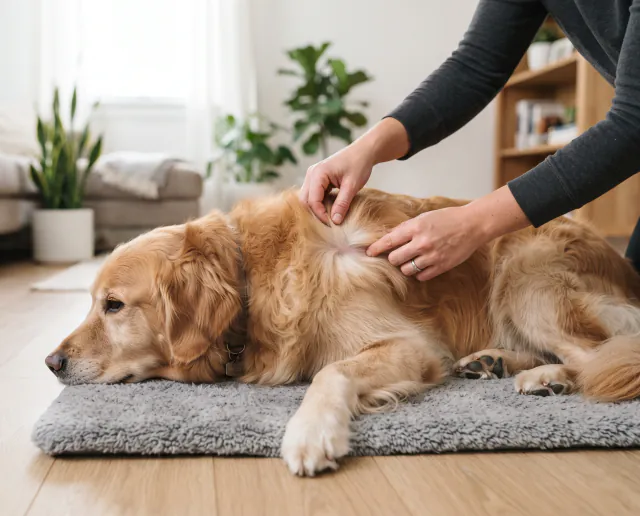
A simple hands-on routine
Build this into a normal grooming or brushing session rather than treating it as a separate task, so it happens regularly without extra effort.
- Part the coat in several places along the back, sides, belly and legs, using your fingers or a comb, so you can actually see the skin underneath rather than just the fur on top.
- Look for flakiness or dryness, which can appear as small white or grey flecks near the skin, especially visible against a dark coat.
- Check for redness or irritation, including small pink or red patches, particularly in areas that fold or rub, such as the armpits, groin, between the toes and under the neck.
- Feel for hot spots, which are areas that feel noticeably warmer, moist or tender to the touch compared with the surrounding skin, sometimes with matted or missing fur over them.
- Feel for lumps or swellings anywhere on the body, noting size, whether they are firm or soft, and whether they seem attached to the skin or move freely underneath it.
- Look for parasites and their signs, including the parasites themselves, small dark specks that could be flea dirt, or a dog scratching, licking or chewing at one spot repeatedly.
- Note any hair loss pattern, such as thinning in a specific location, a symmetrical pattern on both sides of the body, or patchy loss with visible skin underneath.
Doing this on a consistent schedule, such as during a weekly brush, means you are comparing the dog against its own recent baseline, which makes small changes far easier to spot than trying to remember what things looked like months ago.
What can affect coat condition day to day
Coat condition reflects a lot more than skin health alone. Diet plays a real part, since a coat needs adequate nutrition to grow and maintain itself, and a change in food can sometimes show up as a change in coat quality over the following weeks. Season affects coat heavily too, with many breeds shedding a noticeably larger volume of fur at predictable times of year as the coat adjusts to temperature and daylight changes.
Hormonal changes, including those linked to neutering, ageing and the reproductive cycle in unneutered females, can also shift coat texture, thickness and shedding pattern over time. General health has an effect as well: dogs recovering from illness, under stress, or dealing with an underlying condition sometimes show it first in a duller, thinner or rougher coat before other signs appear. None of this means every coat change has an underlying cause needing treatment, most do not, but it explains why coat condition is worth paying attention to as one part of a dog’s overall picture rather than treating it purely as a cosmetic issue.
Findings that need a veterinary look
Take the dog to the vet, rather than waiting to see if it settles on its own, for any of the following:
- A new lump or swelling, particularly one that appears suddenly, grows, changes shape, or bleeds or discharges
- A sore, wound or scabbed area that is not healing within a reasonable time
- Sudden or rapidly progressing hair loss, especially in a defined pattern or patch
- Persistent scratching, licking or chewing focused on one area of the body
- Any sudden skin change, such as widespread redness, swelling or hives appearing quickly
- Skin that looks thickened, darkened or has developed an unusual odour over time
A vet can examine the skin directly, and where needed take samples to look at under a microscope or send for further testing, which is the only reliable way to work out what is actually causing a skin or coat change. Trying to guess a cause and treat it at home with an over-the-counter product, without knowing what is actually going on, can delay proper treatment and sometimes make a skin surface harder to assess by the time a vet does see it.
Breeds prone to skin and coat sensitivities
Some breeds are more commonly associated with particular skin and coat sensitivities than others, generally due to coat type, skin folds or known breed tendencies. Dogs with heavy skin folds, some flat-faced breeds, and certain breeds with a known predisposition to allergic skin reactions are examples of groups where owners are often advised to pay closer routine attention. This is a difference in how closely to watch and how quickly to seek advice if something appears, not a prediction that a particular dog will develop a specific problem, and plenty of dogs from these groups have no skin issues at all through their whole lives.
If you know your dog’s breed or type carries a general tendency towards skin sensitivity, ask your vet during a routine check what signs they would want you to watch for specifically, and how often they would recommend a professional look in between annual health checks.
Making the check stick as a habit
The check works best woven into something that already happens regularly, whether that is a weekly brushing session, a bath, or simply a calm ten minutes on the floor with the dog. Keep it low-key and rewarding for the dog, since a dog that associates being handled all over with something unpleasant will start avoiding the very check that is meant to catch problems early. Persistent, worsening or unexplained findings are always worth raising with a vet, even if they seem minor, since a vet examining the dog directly is in a far better position to judge significance than a description or a photograph alone.