Handing a dog over to someone else for an hour or more, often out of sight, is a significant amount of trust to place in a stranger. Most professional groomers are competent, careful and genuinely good with dogs, but the profession is not regulated in the same way everywhere, and standards between individual groomers and salons vary. A little groundwork before the first booking makes it far easier to spot a genuinely good groomer and avoid one who cuts corners on either welfare or workmanship.
This guide covers what to look for in a facility and a groomer’s approach, questions worth asking before you book, and the signs that suggest you should look elsewhere. Qualification schemes and formal titles for groomers vary between countries, so treat the specifics below as things to ask about locally rather than a fixed international standard.
Visit or ask about the facility first
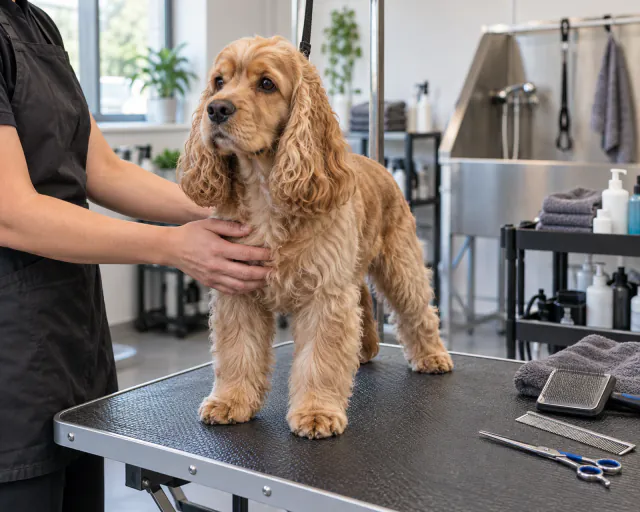
Where possible, visit the salon before booking rather than judging purely from a website or social media page. A clean, well-organised space is a reasonable baseline expectation, but look beyond tidiness for how the space is actually run. Dogs should not be left unattended on a raised grooming table at any point, since a table is a fall hazard and some dogs will attempt to jump or step off if left alone, even briefly.
Watch how staff move around dogs already in the salon, if you are able to see any part of the working area. Calm, unhurried handling, appropriate restraint that does not look like force, and a general sense of control without tension are good signs. Equipment that looks well maintained, and clippers and tools that appear to be cleaned between dogs, both matter for hygiene and for the dog’s comfort during the groom itself.
If a salon will not let you see any part of the working area or answer basic questions about how it operates, treat that as useful information rather than assuming there must be a good reason.
Ask how they handle a nervous or reactive dog
This is one of the most revealing questions you can ask a prospective groomer, because the honest answer says a great deal about their general approach. A good groomer should describe building breaks into the session, working at a pace the individual dog can tolerate, and stopping or rescheduling rather than pushing through if a dog becomes seriously distressed.
Be cautious of anyone who describes forceful restraint, muzzling as a routine first response rather than a considered last resort, or finishing a groom “no matter what” as a point of pride. A dog that struggles occasionally during a groom is not unusual, but a groomer’s response to that struggle matters more than the fact it happened at all. Ask specifically what happens if your dog becomes too distressed to continue partway through, and expect an answer that prioritises stopping over finishing.
Insurance and qualifications
Ask whether the groomer or salon carries public liability and, ideally, care, custody and control insurance, which covers the period a dog is in their care. A reputable, established business should be able to answer this without hesitation.
Formal grooming qualifications and accreditation schemes exist in a number of countries, sometimes through breed or grooming associations, sometimes through vocational training providers, but the structure, name and rigour of these schemes differ considerably from place to place, and no scheme is universal. Ask what training or qualification the groomer holds and how long they have been practising, and treat years of demonstrable, referenced experience as a reasonable substitute for formal qualification where no strong local scheme exists, rather than assuming the absence of a certificate means the groomer is unqualified.
Be clear about what you want and what your dog needs
Before the appointment, be specific about the coat length, style and any particular features you want kept or removed, ideally with a reference photo if you have a particular look in mind, since verbal descriptions of length and style are interpreted differently by different people. A groomer working from a clear brief produces a result closer to what you actually wanted, and it avoids a frustrating conversation after the fact about a misunderstanding that could have been resolved beforehand.
Mention any health conditions, sensitivities, past injuries, known allergies to specific products, or behavioural quirks before the groom starts, not partway through. A groomer who knows in advance that a dog has a sore hip, a skin condition, or a history of snapping when its back feet are touched can plan the session around that information rather than discovering it mid-groom.
Red flags worth walking away from
Some signs are worth treating as a reason to look elsewhere rather than something to overlook because a salon is convenient or inexpensive:
- Reluctance or outright refusal to let you see any part of the working area, even briefly
- Dismissiveness when you raise a concern about your dog’s comfort, temperament or a specific handling need
- Pressure to add extra services or products beyond what you asked for, especially if the pressure continues after you have declined
- Vague or evasive answers about insurance, experience or how they handle a struggling dog
- A pattern of dogs returning from previous appointments with unexplained nicks, mats left in place, or an obviously rushed, uneven finish
A single awkward answer to one question is not necessarily disqualifying, but a pattern across several of these areas is a reasonable basis to choose a different groomer, even if it means a longer wait or a slightly higher price elsewhere.
Building a long-term relationship
Once you find a groomer who handles your dog well, sticking with them has real value beyond convenience. A groomer who sees the same dog repeatedly gets to know its individual temperament, coat and any sensitivities, and is better placed to notice a change worth mentioning to you, such as a new lump, a change in skin condition or a shift in how the dog tolerates handling compared with previous visits. That continuity is worth more than switching between different groomers purely to compare prices, particularly for a dog that took real effort to settle into the process in the first place, as described in introducing grooming to a puppy.