A routine bath needs a plain dog shampoo that cleans, rinses out fully and suits the coat. This guide is for owners washing a healthy dog at home who want to know what to look for on the label, and which kinds of shampoo are worth having: fragrance-free, puppy, conditioning, and concentrates for heavy coats. Medicated and flea shampoos are left out, because they are a vet’s choice rather than a shopping decision. The steps of the bath itself, from brushing out tangles to drying, are in our guide to bathing a dog.
How products are chosen
Canine Origin has not tested these shampoos hands-on. Each one was chosen from the maker’s published product page and a UK stockist’s listing, and every detail on the product cards names its source. The criteria were a routine, cosmetic shampoo with no active ingredient sold to treat a condition; a published ingredient list or a clear account of what is in it; a stated scent, or a plain statement that it is fragrance-free; the maker’s minimum age, where there is one; dilution instructions for concentrates; the coats the maker says it is for; and a current UK listing. Anything sold against fleas, and any product whose own page centres on treating skin problems, was left out. How a shampoo lathers, how quickly it rinses from a dense coat, how the coat feels afterwards and whether a particular dog’s skin tolerates it can only be judged in use, so no claim is made about any of those.
Why a dog needs its own shampoo
Skin has a pH, a measure of how acidic or alkaline its surface is, and dogs and people differ. A 2025 study in Veterinary Dermatology describes dog skin as more alkaline than human skin, with median readings across its age groups of roughly 5.9 to 6.6, and found that pH also varies with age, sex and the part of the body measured. Human shampoos are formulated around human skin, and the PDSA advises using a dog-specific shampoo because human products can irritate a dog’s skin. The RSPCA’s advice on choosing a groomer names shampoos of the right pH for dogs as a sign of good practice.
Washing-up liquid is a degreaser made for dishes, not skin. Flea shampoos and other medicated washes contain active ingredients, so they are used only on a vet’s advice, at the dilution and frequency the vet sets.
What separates one shampoo from another
Scent. Most dog shampoos are scented, and the fragrance appears on the ingredient list as parfum, sometimes with named components such as linalool or coumarin. The scent is there for the owner, not the dog. If you want as few added ingredients as possible, choose one the maker states is fragrance-free and check the list for parfum.
Concentrate or ready to use. Some shampoos go straight onto the wet coat; others are concentrates to be mixed with water first, at the ratio printed on the label. A diluted concentrate spreads through a dense coat more easily, but used neat it puts far more product on the skin than intended and is much harder to rinse out.
The ingredient list. A published list lets you compare products and avoid anything a dog has reacted to before. Words such as mild, gentle or sensitive describe how a product is sold, not a measured result, and no label tells you how an individual dog’s skin will respond.
Minimum age. Puppy shampoos state the youngest age the maker has in mind. It is a lower limit, not a sign that a young puppy needs a bath.
The coat it is made for. A maker’s note that a shampoo is for long, thick or white coats is a fair guide to its scent and conditioners. No shampoo removes a mat or replaces brushing.
Matching the shampoo to the coat
Short, smooth coats, such as a Whippet or a Boxer, need only an occasional wash with any plain dog shampoo; the rinse matters more than the product.
Double and thick coats, such as a Labrador or German Shepherd, are hard to wet through and hard to rinse. Soak the coat to the skin first, work a diluted shampoo in with your fingers rather than squirting it on top, and rinse for longer than seems necessary. Brushing out loose undercoat beforehand leaves less hair to wash and dry.
Long and silky coats tangle. Brush and comb them out before the bath, because water tightens a knot into a mat; a conditioning shampoo can make combing easier afterwards but does not undo a mat. Our grooming brush guide covers the tools.
Curly and wool coats, such as a Poodle or many Doodles, mat close to the skin and are often best bathed by a groomer, who can dry and brush them in one session.
White and light coats show every mark, and a shampoo sold for them is a cosmetic choice. Reddish-brown staining that keeps returning around the eyes, mouth or paws is worth showing a vet rather than washing harder. Our guide to grooming by coat type covers each coat group in detail.
Puppies and sensitive skin
A puppy needs very few baths. Wiping muddy paws and spot-cleaning keep most puppies clean, and the early weeks are better spent getting a puppy used to being handled, brushed and towelled. When a wash is needed, choose a mild puppy shampoo and check the maker’s minimum age; the Animology shampoos here all state 6 weeks. Keep the head dry, wipe the face with a damp cloth, and make sure the puppy is dry and warm before it goes back to bed. Our guide to introducing grooming to a puppy sets out a gradual start.
For an adult dog, a fragrance-free shampoo with a short ingredient list is a sensible default. That is a preference, not a treatment. A dog that scratches, licks or chews at itself, or has redness, sores, flaking, bald patches, a smell that returns soon after a bath, or skin trouble that keeps coming back, needs a vet, not a different shampoo. Changing product can mask a problem for a while and delay the right help. The PDSA advises contacting a vet about a skin problem that does not clear up within a few days, and seeing one promptly if there is blood or pus. Our guide to skin and coat health checks shows what to look for at home.
How the shampoos on this page differ
Animology Essentials Sensitive is the plainest choice: stated fragrance-free, no dilution step, and a minimum age of 6 weeks. It is the one to choose if you want no added scent, though a large, heavy-coated dog will need a fair amount from a small bottle.
Animology Puppy Love and Hair of the Dog come from the same UK maker and share the same directions: lather from the neck down, avoid the eyes and ears, and leave for five minutes before rinsing. Puppy Love is baby-powder scented and sold for puppies. Hair of the Dog adds conditioners and is sold as an anti-tangle shampoo, so it is the one to consider for a long coat, once the knots are brushed out.
The two Wahl shampoos are concentrates, which suits a big or heavy-coated dog but adds a mixing step to every bath. Dirty Beastie is sold for dirty, thick coats and Diamond White for white and light coats. Both are scented, so neither suits an owner who wants an unscented concentrate.
Waterless foams and sprays are also sold for quick cleans between baths. None is recommended here. They are towelled off rather than rinsed, so some product stays in the coat, where a dog can lick it, and the one checked for this page named plant extracts without any published warnings or concentrations. For a dirty patch, a damp cloth or a rinse with warm water, as the PDSA suggests for a muddy dog, does the job with nothing left behind.
Dilution, frequency and rinsing
How often. Dogs rarely need frequent baths. The PDSA notes that shampoo can strip the coat’s natural oils, and that a dog that is simply muddy can be rinsed with warm water instead. A bath is due when the coat looks dull, feels greasy or smells, not because a date has come round; a dog on a vet’s bathing routine sticks to that routine.
Mixing a concentrate. Mix it in a jug or clean squeeze bottle before it touches the dog. At 15 parts water to 1 part shampoo, 30 ml of shampoo makes about 480 ml of wash. Mix only enough for one bath, and follow the ratio printed on your bottle.
Eyes and ears. Apply shampoo from the neck down and keep it out of the eyes. Clean the face with a damp cloth instead of lathering it, and angle the water away from the ears so none runs into the canal. Our ear care guide explains why that matters.
Rinsing. Rinse until the water runs clear, then rinse again. Leftover shampoo is a common reason for a dog to scratch after a bath, and it hides in the armpits, the groin, under the tail, between the toes and along the collar line.
Drying. Towel well, then keep the dog somewhere warm until the coat is dry to the skin; a thick coat can feel dry on top while the undercoat stays damp for hours. Keep a dryer on low heat and moving, and never leave the dog alone with it running.
Safety and when to stop
Patch-test any new shampoo: mix it as directed, wash and rinse a small patch of skin such as the inside of a back leg, and check it the next day before washing the whole dog. If shampoo gets in an eye, rinse with plenty of clean water; a dog that keeps squinting, paws at an eye or has a red eye afterwards needs a vet.
Stop and speak to a vet if the skin looks red, bumpy or flaky after a bath, or the dog starts scratching, licking or rubbing, and take the bottle or a photo of its ingredients with you. If your dog already has a skin condition, the PDSA advises checking with your vet before using any shampoo.
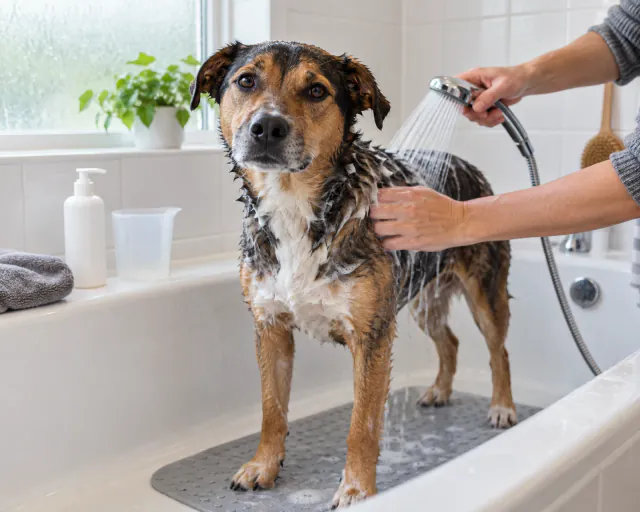
Never use human shampoo, washing-up liquid or a flea shampoo on a dog unless a vet has prescribed or advised it, and do not mix products. Keep bottles out of reach of children and dogs, and call a vet if a dog swallows shampoo. Use a non-slip mat and lukewarm water, and never leave a dog alone in the bath. If your dog finds baths hard, the handling for grooming lesson builds tolerance in short steps.
Storing shampoo and when to buy again
Keep bottles closed, upright and away from frost and direct heat, and check the label for a use-by date or the open-jar symbol showing how many months it keeps once opened. Throw away a shampoo that separates, changes colour or smells different, and never store a diluted mix: make it fresh for each bath.
Before you buy
- Is it made for dogs, with no active ingredient sold to treat a condition?
- Does the maker publish the ingredients, and state a scent or that it is fragrance-free?
- Is it a concentrate, and is the dilution printed clearly on the bottle?
- Does it suit your dog’s coat, and do you have the brush and comb to prepare that coat first?
- If your dog has any skin trouble at all, have you asked a vet before buying anything?