
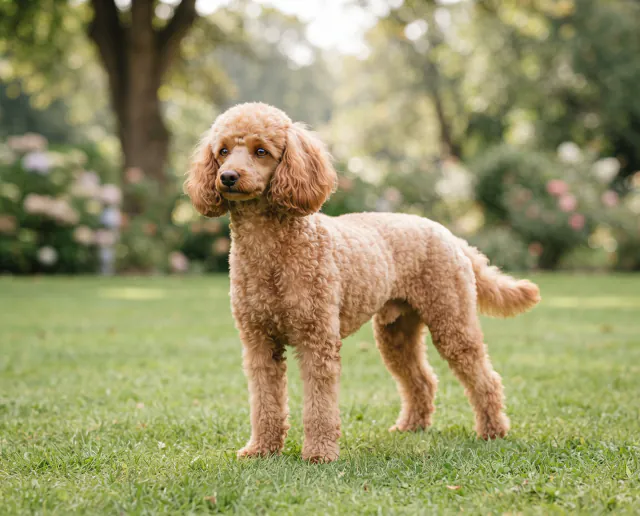
At a glance
Key facts
The essentials to compare before deciding whether this breed fits your home and routine.
- Size
- Small
- Lifespan
- 12 to 15 years
- Energy
- Medium to high
- Temperament
- Clever, sociable and quick to learn
- Good with children
- Usually very good with children who include the dog in games
- Exercise
- About 45 minutes to an hour a day plus training
- Trainability
- Beginner friendly
- Grooming
- Brushing two or three times weekly with clipping every six to eight weeks
- Estimated monthly cost, GBP
- £90 to £160 per month
Scale the Standard Poodle down without losing any of its working brain and the result is the Miniature, a dog bred specifically for a smaller build rather than for a different temperament. European and British breeders selected down from the original water retriever over the nineteenth century, aiming at a companion dog that kept the intelligence and trainability of its larger relative in a body better suited to a household without acres of exercise space. The plan worked rather too well in one respect, since a Miniature Poodle bored in a small flat is just as capable of finding trouble as a Standard Poodle would be, only from lower down.
Its later career as a circus and performing dog was no accident either, since the breed learns sequences of behaviour with real speed and clearly enjoys the process. A Miniature Poodle bought purely for its low shedding coat, without any plan for its mind, tends to become a demanding, occasionally destructive project rather than the easy small dog its size promises.
Living with the breed
Miniature Poodles are sociable, attentive and generally very good with children old enough to include the dog in games rather than treat it as a toy. The breed reads its household closely and tends to develop a particular sensitivity to tension or raised voices, responding better to calm, consistent handling than to sharpness. Left alone for long stretches, a Miniature Poodle can develop genuine separation anxiety rather than simple boredom, so building up time alone gradually from puppyhood matters more here than with a naturally independent breed. Space is rarely a limiting factor, and the breed suits a flat as readily as a house, provided daily exercise and mental work are genuinely delivered rather than assumed to happen on their own.
Daily exercise
Around forty five minutes to an hour a day, combined with some form of training or games, suits most adults well. The breed enjoys retrieving, agility style obstacles improvised in a garden and water where it is available, which connects back to its working ancestry more directly than a simple walk around the block. Puppies should have their exercise kept short and frequent while growing, since forced repetition and jumping before the growth plates close can affect joints later. A Miniature Poodle that gets enough to think about generally settles well indoors, whereas one given only physical exercise without any mental component often channels the surplus energy into barking or chewing instead.
Training and mental work
Few small breeds learn as quickly, and most Miniature Poodles pick up new cues within a handful of repetitions, which makes early, consistent training genuinely rewarding rather than a chore. That same speed means bad habits form just as fast as good ones, so an owner who laughs off jumping up or barking in a puppy will find both firmly established by adulthood. Reward based methods suit the breed’s sensitivity far better than firm correction, which tends to produce a worried, shut down dog rather than a compliant one. Scent games, puzzle feeders and short daily training sessions give the breed’s active mind somewhere useful to go, and a Miniature Poodle without that outlet will invent one, usually at a volume the neighbours notice.
Grooming and shedding
The dense, curled coat grows continuously rather than moulting seasonally, and loose hair tends to stay caught within the curl instead of dropping onto furniture, which is why the breed is often described as low shedding. That description is not a promise of no maintenance. Left unbrushed, the coat mats quickly, particularly behind the ears, under the legs and around the collar, and a badly matted coat can become painful and require clipping down to the skin to correct. A thorough brush two or three times a week with a slicker and comb, combined with professional clipping roughly every six to eight weeks, keeps the coat manageable. Hair growing into the ear canal should be checked and removed by a groomer, since it contributes to the ear infections small poodles are prone to.
Health and costs
Progressive retinal atrophy is recognised in the breed, and a DNA test exists that responsible breeders should be using and able to produce results for. Patellar luxation, where the kneecap slips from its normal position, is common enough in small breeds generally to be worth asking about, and Legg Calve Perthes disease, affecting the hip joint in young dogs, is also documented in small poodles. Ear infections linked to hair growth in the canal are a recurring nuisance rather than a serious threat, provided they are treated promptly. Typical running costs of £90 to £160 a month cover food, insurance and veterinary care, though grooming is the item newcomers most often underestimate, since a Miniature Poodle kept in a practical short clip still needs regular professional attention throughout its life.
Verdict
A Miniature Poodle suits an owner who wants a genuinely clever, trainable small dog, who has planned for a lifetime of grooming costs, and who will provide mental work rather than relying on the coat’s low shedding reputation to describe the whole dog. Active households and first time owners prepared to learn reward based training both tend to do well with the breed.
It is a poor fit for anyone wanting a low maintenance coat, a dog content with its own company for long days, or an owner unwilling to book in regular professional grooming for the next twelve to fifteen years.