- Session length
- 1 to 2 minutes at a time, repeated throughout the day and every time mouthing happens in play
- Skill
- Impulse control
- Suits
- Puppy
What you need
- A selection of appropriate chews and a soft tug toy, kept ready in more than one room
- Soft food the size of a pea, taken from the daily ration
- A stair gate or a lead trailing indoors, for moments when you need distance without a chase
Puppies explore the world with their mouths, and play between littermates is full of nipping, wrestling and being nipped back. A puppy who has just left that environment has no idea yet that human skin is more sensitive than a sibling’s coat. Mouthing is not aggression and it is not a training failure on your part. It is a normal developmental behaviour that needs shaping, not eliminating overnight, and the goal of this lesson is a puppy who mouths softly, if at all, rather than a puppy who never puts a mouth on a person.
Purpose
To teach a puppy that human skin means play stops, while giving them a legitimate place to put their mouth so the behaviour has somewhere to go. Bite inhibition, the learned habit of controlling how hard a mouth closes, is a skill dogs use for life, including moments such as an accidental step on a paw or a startle at the vet. A puppy who never learns to soften a bite because it was suppressed rather than shaped can be more dangerous as an adult, not less, if a genuine trigger ever produces a full-force bite.
Prerequisites
None specifically. This lesson applies as soon as a puppy is mouthing hands, sleeves or feet during ordinary play, which is common from the day a puppy arrives home. There is nothing to teach first.
Equipment
Keep two or three chews and a soft tug toy within reach in the rooms where the puppy spends time, so you are never searching for an alternative while teeth are already on your hand. Use soft food from the measured ration for the calmer stages of this lesson. Work in whatever room the puppy is already playing in. There is no need for a special quiet setting here, because mouthing happens during normal daily life rather than in a dedicated session.
Method
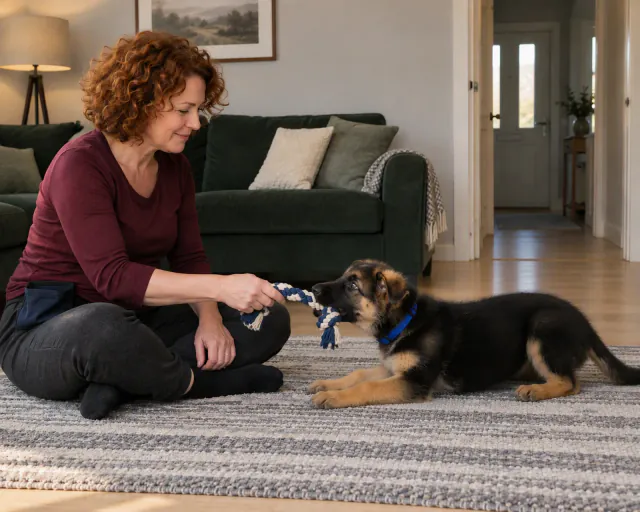
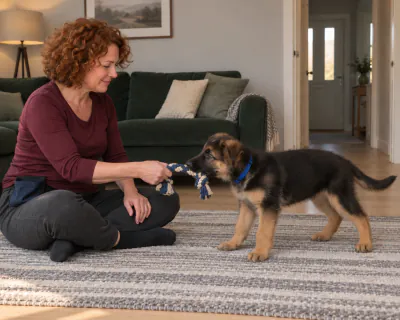
- Play with your puppy using a toy rather than bare hands wherever possible, so the target for teeth is built in from the start.
- When teeth touch skin, say a short, calm word such as “ouch” in a normal tone, not a sharp yelp or a shout. Some puppies find a loud yelp exciting rather than informative, and it can escalate the game instead of ending it.
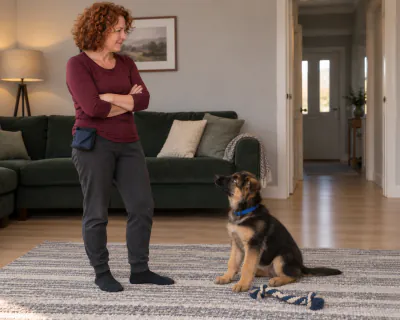
- Immediately stop moving the hand, stand up and turn away for a few seconds. This removes the fun rather than punishing the puppy, and the puppy learns that hard mouthing switches play off.
- Sit back down once the puppy is calm and resume play, offering a toy rather than a hand.
- If the puppy goes straight for your hand again, end the game for one to two minutes rather than repeating the cycle immediately. Walk to another room or step behind a gate.
- Reward voluntary soft mouth contact or licking, if it happens, with calm praise, so the puppy learns that gentle contact keeps the game going.
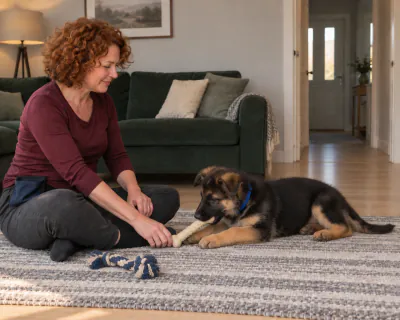
- Offer a chew whenever the puppy seems to want to gnaw on something, particularly during teething, so mouthing has an obvious, rewarding outlet that is not your hand.
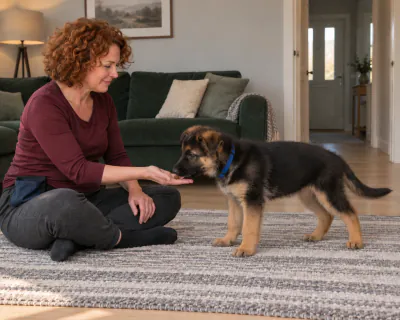
- Practise a short “gentle” exercise separately: offer a piece of food in a flat, open palm and only release your hold on it once the puppy’s mouth is soft. If teeth press hard, close your hand briefly and try again.
- Gradually raise your standard over several weeks rather than days. Accept firm mouthing early on, then ask for softer and softer contact as the puppy matures.
- Keep every family member and regular visitor using the same response, because a puppy who is allowed to mouth hard with one person and stopped with another cannot learn a consistent rule.
Session length
This is not a scheduled session in the way other lessons are. Respond consistently every time mouthing happens during play, which for most puppies is several times a day for the first few months. Keep each withdrawal brief, a few seconds rather than minutes, so the puppy has a fair chance to try again and get it right.
Progression criteria
Look for a countable shift rather than a single dramatic change: over two weeks, count how many play sessions end with a hard, unexpected nip. Move on once you see that number fall consistently, alongside a puppy who mouths with visibly less pressure and redirects onto a chew or toy without being asked in at least eight sessions out of ten. From there, increase difficulty one variable at a time. First extend how long the puppy can play with a toy before excitement rises enough to produce mouthing. Then introduce the same rules with a different family member. Only once mouthing is reliably gentle with familiar people should you begin allowing calm, supervised contact with new visitors, since novelty and excitement both raise the chance of a harder mouth.
Common mistakes
Reacting differently depending on how busy or tired you are teaches an inconsistent rule that a puppy cannot learn from. Wrestling roughly with hands, even in fun, directly rewards the behaviour you are trying to reduce. Punishing every single mouth contact, including gentle ones, can suppress the behaviour on the surface while removing a puppy’s ability to signal discomfort later in life, which is the opposite of what bite inhibition is meant to protect. Ignoring teething entirely, rather than providing chews, leaves a puppy with nowhere appropriate to put a very real physical need.
Troubleshooting
If your puppy gets more excited rather than less after you say “ouch” and turn away, drop your volume and movement further; a flat, quiet response works better than an animated one for excitable puppies. If mouthing mostly happens at the end of the day, look at total daily activity and sleep before assuming this is a training problem, since overtired puppies mouth harder and more often. If a puppy chases your feet or trouser legs specifically, redirect onto a dragged toy rather than continuing to walk away, which can turn into a game of chase.
Safety and when to stop
Ordinary puppy mouthing, even when it stings, is not a medical or behavioural emergency, and most puppies grow out of hard mouthing with consistent handling over the following months. Stop and seek help if your puppy’s mouthing draws blood repeatedly rather than occasionally nicking skin during rough play, if a puppy freezes, stiffens or growls before making contact rather than simply playing, or if mouthing intensity is increasing over weeks rather than decreasing. Those patterns need an individual assessment from a qualified behaviourist working alongside your vet, since they fall outside what home management alone can safely resolve.
Next lesson
Once mouthing is softening and redirecting reliably, move on to calm greetings at home, which channels the same excitable energy into a different, more sociable habit.
Useful tool
A puppy who is short on physical and mental outlets mouths more from simple boredom and pent-up energy, so the dog exercise planner is worth using alongside this lesson to check your puppy is getting enough age-appropriate activity across the day.