- Session length
- A few seconds at a time, repeated at every greeting throughout the day
- Skill
- Impulse control
- Suits
- Puppy
What you need
- Soft food the size of a pea, kept in a pot near the main door and in a pocket around the house
- A lead or house line for moments when a puppy is too excited to control by voice alone
- A stair gate or crate, for separating an over-threshold puppy from an arriving visitor
The greeting habits a puppy practises in the first few months tend to stick, because every early jump that gets a laugh, a fuss or even eye contact has been rewarded without anyone intending it. This lesson is the puppy-level foundation of calm greetings: a simple, low-key habit built at home before a later lesson in the pathway proofs it against real visitors and outdoor excitement. The aim now is prevention rather than correction, so the jumping habit never becomes rehearsed in the first place.
Purpose
To teach a puppy that four paws on the floor is what gets attention, food and affection when people appear, whether that is a returning family member or a visitor at the door. This matters because a small puppy who jumps up is often encouraged, but the same behaviour in an adult dog can knock over a child, frighten a nervous visitor or dirty clothing, and by then the habit is far more established and harder to change.
Prerequisites
Your puppy already sits briefly for food in a quiet room, from earlier in this pathway, and everyone in the household, including regular visitors where possible, is willing to greet the puppy the same calm way every time. One person doing this correctly while another scoops the puppy up and encourages jumping will undo the work faster than it is built.
Equipment
Keep food within easy reach wherever greetings tend to happen, particularly by the main door and in a pocket during the parts of the day when family members come and go. A lead or house line, which is a light lead left trailing indoors under supervision, gives you a way to prevent a rushed greeting without grabbing at the puppy. A stair gate or crate is useful for separating a puppy who is already too excited to think, so the greeting can happen calmly once they have settled.
Method
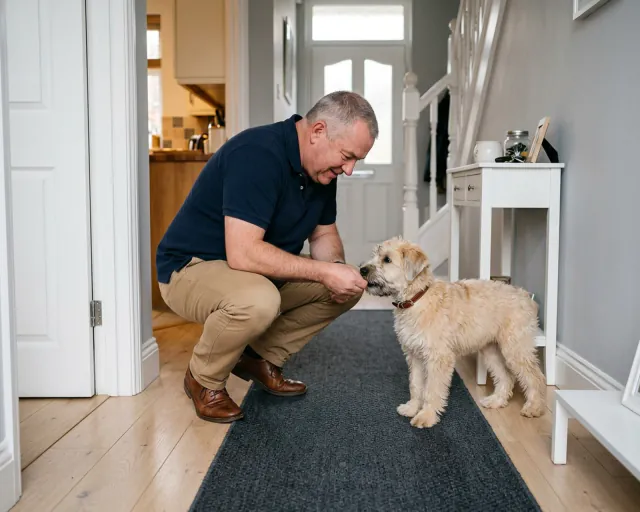
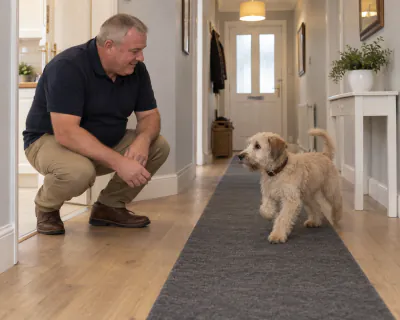
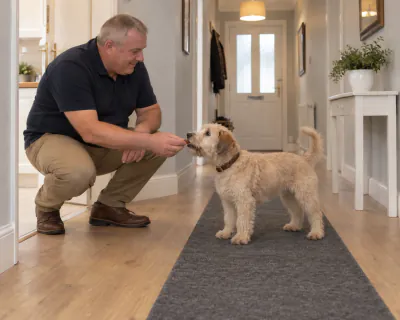
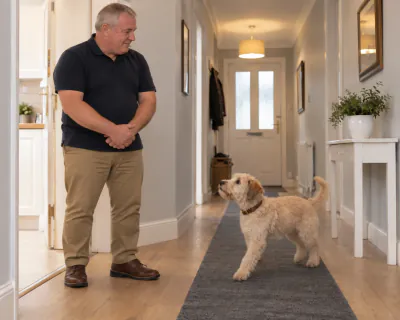
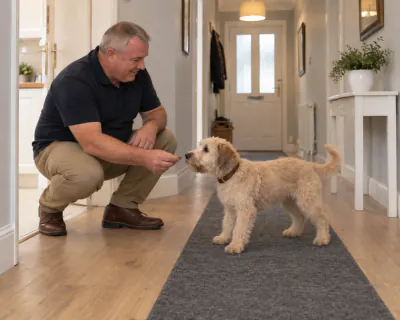
- Practise low-stakes greetings first: leave the room for a few seconds, then return and crouch down immediately rather than standing over the puppy or using an excited voice.
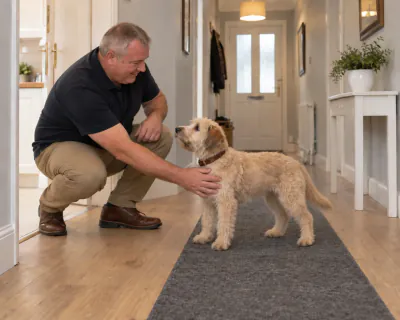
- The instant all four paws are on the floor, feed and quietly praise. If the puppy jumps as you crouch, stand back up straight away and wait for the paws to settle before crouching again.
- Keep your own voice low and unhurried. An excited, high-pitched greeting from you raises the puppy’s arousal and makes jumping more likely, not less.
- Repeat this several times a day with ordinary comings and goings, not just as a dedicated session, since real greetings are what the habit needs to generalise to.
- When the puppy is reliably calm with family members leaving and returning, apply the same rule the moment a visitor arrives, using a lead or gate to manage the greeting rather than hoping the puppy remembers on their own.
- Ask visitors to ignore the puppy, including no eye contact and no talking to them, until all four paws are settled on the floor, then let them crouch low and offer a hand.
- If the puppy is too excited to settle at all, use the gate or lead to create distance, let them calm down away from the visitor, then try a shorter, quieter greeting.
- Brief every regular visitor, including family members who do not live in the house, on the same rule before they arrive, rather than explaining it after the puppy has already jumped up.
Session length
There is no fixed session here. Apply the same response for a few seconds at every greeting throughout the day, which for a young puppy in an active household can be dozens of brief repetitions rather than one practice block.
Progression criteria
Move on when your puppy greets returning family members with four paws on the floor in most everyday greetings, without a lead or gate being needed, across several days in a row. Increase difficulty one variable at a time from there. Extend duration first, so the puppy stays calm for a few seconds of fuss rather than just the first moment of contact. Then add distance, greeting from further down a hallway rather than right at the door. Only once both of those are solid should you add the distraction of an unfamiliar visitor, which is where the later beginner-level lesson in this pathway takes over.
Common mistakes
Allowing jumping when the puppy is small because it feels harmless builds a habit that becomes a real problem as the puppy grows. Reacting to jumping with a big, excited voice, even while pushing the puppy away, still delivers attention and can make the behaviour more persistent. Skipping the management step, and simply hoping a puppy will remember not to jump on a genuinely exciting occasion such as a returning family member, sets the puppy up to rehearse the wrong behaviour before you get a chance to reward the right one.
Troubleshooting
If your puppy jumps the moment you crouch down, you are still moving quickly or using an exciting tone without meaning to, so slow everything down and keep your voice flat. If they settle for family but not for visitors, that is a normal distraction gap rather than a failure, and it means you need more repetitions at the current difficulty before adding a stranger into the mix. If greetings are consistently chaotic regardless of who arrives, check whether the puppy is simply getting too little structured rest across the day, since an overtired puppy has far less impulse control at exactly the moments greetings happen.
Safety and when to stop
Keep all greeting practice low-key rather than encouraging jumping up at people or onto furniture, since a growing puppy’s joints should not be repeatedly loaded this way. If your puppy is too large or too excitable to safely manage around young children or elderly visitors, use a gate or lead for every real greeting until the training is well established, rather than testing it on people who could be knocked over. A puppy who barks, backs away, freezes or shows stiff, worried body language at greetings, rather than simple over-excitement, may be fearful rather than enthusiastic, and that pattern is better assessed by a qualified behaviourist working with your vet than trained through repetition alone.
Next lesson
With greetings settling into a habit, move on to handling and cooperative care for puppies, which builds the same calm approach into everyday grooming and health checks.
Useful tool
A puppy who is well exercised and mentally satisfied across the day has far less spare excitement to spend on jumping at every arrival, so the dog exercise planner is a useful companion to this lesson.