Recall is the one behaviour that decides how much freedom a dog gets, and it is the one most often trained by accident. A dog who has learned that the recall word means the walk is over, or that it is repeated four times before anything happens, has learned exactly what was taught.
The approach below builds the cue from scratch in easy conditions, keeps the dog attached to a long line while it is unproven, and raises the difficulty in steps you choose rather than steps the environment chooses for you.
Set the standard and pick a fresh cue
Decide what you want the cue to produce: the dog turns immediately, runs to you and stays close enough to be touched until released. Turning and drifting over is not recall, and accepting it in practice guarantees it in an emergency.
Choose a word the dog has not already heard shouted across a field. If the old cue has been poisoned by repetition, punishment or the end of every walk, retire it and start again with something distinctive. A whistle carries further than a voice, sounds identical whoever blows it and does not leak your frustration, which makes it worth teaching alongside the word.
Also decide what you are paying with. Recall earns the best food you have, not the kibble used for sits, and it is delivered in a handful over several seconds rather than one piece.
Charge the cue at home
Start in the kitchen with the dog a couple of metres away and no competition. Say the cue once, and the moment the dog moves towards you, mark it with a word such as yes and pay generously when they arrive. Take hold of the collar or harness before feeding, so that being touched at the end becomes part of the pattern rather than a nasty surprise.
Ten repetitions a day, spread through the day, is plenty. Never call the dog to do something they dislike. Go and get them for nail clipping, baths and the vet, and keep the cue clean.
Once the dog spins towards you every time in the kitchen, move to the hallway, the garden and the far end of the garden. Same cue, same payment, slightly more distance.
Add a long line before you add freedom
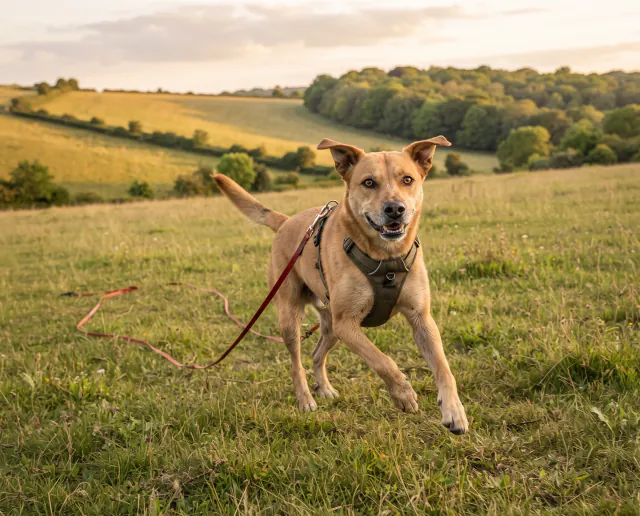
A long line of five to ten metres attached to a well-fitted harness, never to a collar, lets the dog make choices while removing the option of self-rewarding by running off. Let it trail rather than holding it taut, wear gloves, and keep the line clear of legs.
Work in a quiet field or a corner of a park. Let the dog wander to the end of the line and get interested in something mild, then call once. If they come, pay well and release them back to what they were doing, so the cue predicts a good outcome and continued freedom. If they do not come, do not reel them in on the cue. Move away, make a noise, become interesting, and reward the moment they commit.
Aim for something like nine successes out of ten before making anything harder.
Raise the distraction one variable at a time
Distance, distraction and duration all make recall harder, so change one at a time. A dog who succeeds at ten metres in an empty field will often fail at ten metres with another dog fifty metres away.
Build a rough ladder for your own dog and work up it: a quiet field, a field with rabbits in the hedges, a path with dog walkers at a distance, a park at a busy hour. Practise the recall when the dog is sniffing, when they are playing with you, when a dog is visible in the distance, and when they are mid-trot in the opposite direction.
Recall away from something exciting is the hardest version and needs the highest payment. Dogs bred to work at a distance, such as a Border Collie, or to follow their nose for as long as it takes, such as a Springer Spaniel, will need more practice at this stage than a dog who prefers to stay close.
When the dog does not come back
Do not repeat the cue. Repeating it teaches that the first one is optional. Say it once, then help: run in the opposite direction, crouch, clap, rustle a bag, or produce a toy. Reward whatever brings the dog back, then note the situation as too hard for now and go back a step next session.
Never punish a dog who comes back late. Whatever you do at the moment of arrival is what the dog associates with returning, and a told-off dog takes longer to come next time.
If the dog is repeatedly ignoring you off lead, put the long line back on for a few weeks. Freedom is the reward for a reliable recall, not the way to build one. Persistent failure in an otherwise trainable dog is worth mentioning to your vet, since hearing loss and pain both look like disobedience.
Livestock, wildlife and roads
Recall in the British countryside carries legal and practical weight. On land with livestock, keep the dog on a lead regardless of how good the recall is at home, and be aware that farmers are entitled to act to protect their animals. Cattle with calves are a particular risk, and current advice is to let the dog go if cattle approach rather than trying to hold on to it.
Ground-nesting birds need dogs on paths and on leads through the spring and early summer, and beaches, moorland and nature reserves often carry seasonal restrictions. Near roads, use a lead. No recall is a substitute for a closed gate or a clipped lead beside traffic.
Keep it working
Recall decays if it only ever gets tested. Keep paying it. Several times a week, call the dog for nothing more than a good handful of food and a release, so the cue never becomes a reliable predictor of the lead going on.
Clip the lead on and off several times during a walk so that being caught is unremarkable. End walks by calling the dog, paying, walking on for a minute, then leaving. A recall practised at that rate stays useful for years.
For a slower, session-by-session build-up starting from a puppy’s very first recall through to a structured long-line pathway, see your puppy’s first recall and recall on a long line.