At a glance
Key facts
The essentials to compare before deciding whether this breed fits your home and routine.
- Size
- Medium
- Lifespan
- 12 to 15 years
- Energy
- Very high
- Temperament
- Alert, responsive and intensely work-focused
- Good with children
- Can be good with experienced supervision
- Exercise
- At least 2 hours plus structured mental work
- Trainability
- Experienced handler
- Grooming
- Weekly brushing, more for longer coats
- Estimated monthly cost, GBP
- £80 to £150 per month
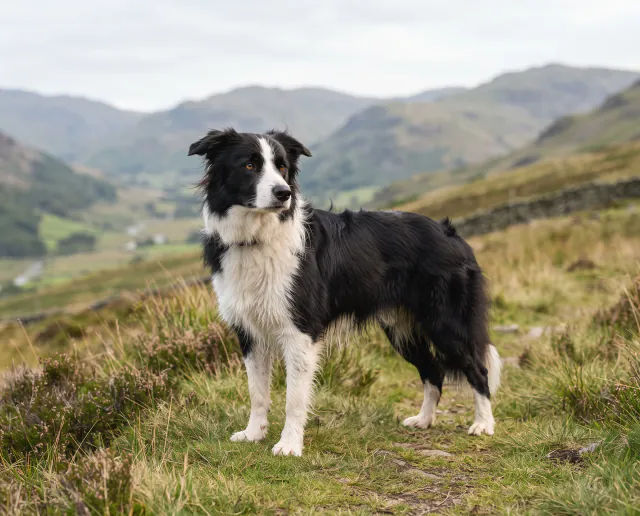
Border Collies were developed to control livestock through stamina, responsiveness and intense concentration. Those qualities make them outstanding working and sports dogs, but not automatically easy pets. A Collie may notice every movement, sound and change in routine. Without suitable outlets, that sensitivity can become chasing, shadow fixation, barking or difficulty settling. The breed suits people who want to train regularly and understand that more frantic exercise is not the answer to every behaviour.
Origin and purpose
Border Collies take their name from the hill country along the England and Scotland border, where shepherds spent the nineteenth century breeding for working ability and nothing else. The selection pressure was narrow and severe. A dog had to gather sheep at distance, answer whistles and hand signals, and move stock by presence and eye rather than by biting. Almost every modern Border Collie traces back to a single dog, Old Hemp, bred in Northumberland in 1893. The breed entered the show ring only much later, and many working lines have stayed outside it.
Those roots explain the everyday dog. The crouch, the fixed stare, the circling of anything that moves as a group and the readiness to work past exhaustion are not habits acquired at home. They are the job. A Collie with nothing to gather will usually find a substitute, whether that is cars, bicycles, children or shadows.
Suitability
Experienced, active owners often provide the clearest match. A dedicated first-time owner can succeed with good professional support and realistic expectations. Busy roads, young children running indoors and frequent visitors may be difficult for an individual inclined to control movement. Early management is important. Children should never be allowed to chase or corner the dog. Most live peaceably with other dogs and can share a home with cats, although the urge to control movement means a fleeing cat is liable to be herded rather than ignored. Few cope well with long stretches alone, and a bored Collie will generally find an outlet the household would rather it had not. Space helps, but a rural address alone does not meet the breed’s needs. A calm resting area and predictable periods of inactivity are as important as outdoor access.
Exercise
Healthy adults need substantial daily activity, usually at least two hours, combined with mental work. Choose varied walks, controlled running, scent tasks, obedience exercises or an appropriate dog sport. Constant ball throwing can create extreme arousal and does not teach the dog to switch off. Young dogs should build strength and coordination gradually. Recall around livestock must be dependable, and a lead should be used wherever control is uncertain. Collies can continue working beyond sensible fatigue, so owners need to schedule water, rest and recovery.
Grooming
Both rough and smooth coat types need regular brushing, although longer feathering requires more attention. Check behind the ears, around the trousers and between the toes for tangles and debris. The double coat sheds seasonally. After field walks, look for grass seeds, ticks and small injuries that a focused dog may ignore. Keep nails comfortable and introduce tooth brushing through rewards. Bathe only as needed with dog-suitable products and dry the coat fully. Grooming time also provides practice in calm, cooperative handling.
Health
Responsible breeders should use the health tests and screening relevant to Border Collies, including current eye and hip recommendations. Several inherited conditions have DNA tests, so ask which apply to the proposed mating and request written results. A clear result for one condition is not a complete health programme. Collies can hide discomfort while engaged in work. Changes in stride, reluctance to jump, repeated disorientation or unusual sensitivity deserve veterinary attention. Maintain a lean body condition and avoid pushing an unfit dog into demanding sport.
Choosing and training
Ask why the litter was bred and how the parents work and relax in ordinary life. High-drive working lines may be unsuitable for a pet home even if the puppies are attractive and clever. A rescue can assess an adult’s reactions to traffic, dogs and household movement. Use reward-based teaching, short sessions and clear cues. Build a strong settle, recall and disengagement from moving objects. Socialisation means calm, positive exposure at the dog’s pace, not uncontrolled greetings with every person and dog.
Size and lifespan
Males typically stand 48 to 56 cm (19 to 22 in) at the withers and weigh 14 to 20 kg (31 to 44 lb). Females usually measure 46 to 53 cm (18 to 21 in) and weigh 12 to 19 kg (26 to 42 lb). Working lines vary more widely than show lines, and a fit Collie should look lean without looking underfed. Adult height arrives at around a year and physical maturity by roughly eighteen months, later than the dog’s apparent readiness for hard exercise suggests.
The breed is comparatively long-lived, commonly 12 to 15 years, and an ageing Collie often remains mentally demanding long after its body has slowed. The eye and hip screening referred to above is organised through recognised schemes, including the BVA and Kennel Club programmes in the United Kingdom and the Orthopedic Foundation for Animals in the United States, alongside the DNA tests available for the breed. Take the written results to your own vet and ask what they mean for the dog in front of you.
Verdict
For an owner who enjoys thoughtful daily training, a Border Collie can be an extraordinary partner. Intelligence does not reduce the work involved. It increases the need for well-designed activity and consistent communication. The breed is unlikely to thrive as a casual walking companion left to invent its own jobs. Choose one only if you can provide purpose without creating constant excitement, protect it from unsafe chasing opportunities and help an alert mind learn how to rest.
Spend time with adult Collies in ordinary settings before deciding. Their response to traffic, visitors and quiet evenings is more relevant to pet life than one impressive training display. An honest view of daily management helps the household make a sound choice.