At a glance
Key facts
The essentials to compare before deciding whether this breed fits your home and routine.
- Size
- Medium
- Lifespan
- 12 to 14 years
- Energy
- Very high
- Temperament
- Tireless, independent and intensely work driven
- Good with children
- Needs supervision, may try to herd running children
- Exercise
- Two hours or more plus daily purposeful work
- Trainability
- Experienced handler
- Grooming
- Weekly brushing, more during seasonal moults
- Estimated monthly cost, GBP
- £70 to £130 per month
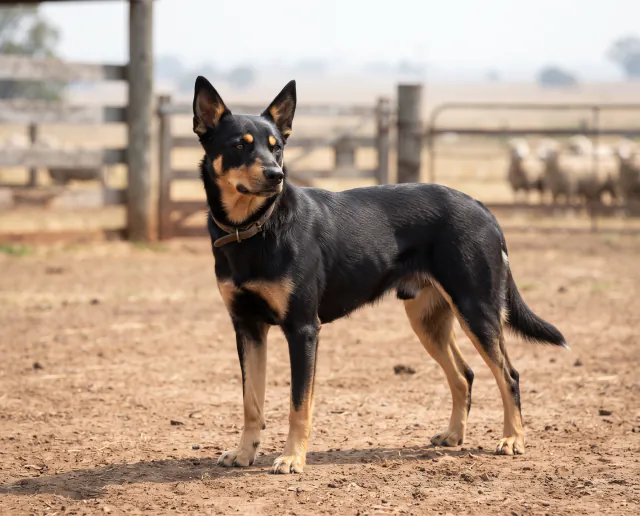
The Australian Kelpie is one of the most capable herding dogs in the world and one of the least suited to an ordinary domestic life. Bred to move large flocks across hot, open country for hours at a stretch, it combines endurance, independent judgement and a compulsion to work that does not fade because the household has run out of jobs. A well matched Kelpie is a superb partner. A poorly matched one becomes a frustrated, restless dog that invents work its owner never wanted, and that outcome is common enough to be worth saying outright.
Origin and purpose
The breed was developed in Australia from the 1870s onwards, built on smooth coated collies imported from Scotland and selected hard for performance in conditions those imports had never faced. Vast paddocks, extreme heat and thin water supplies meant the surviving type had to cover enormous distances and think for itself well beyond a handler’s voice. The name is generally traced to an influential bitch called Kelpie whose descendants dominated early trials. Working Kelpies are still bred primarily on stock work ability, often outside the show registries, and the breed remains a mainstay of commercial sheep and cattle operations.
Temperament and behaviour
Expect intensity, focus and constant assessment of the environment. Kelpies are typically loyal and attentive to their handler while reserved with strangers, and many are more independent minded than the closely watched biddability of some other herding breeds. Behavioural problems in pet homes follow a predictable pattern. An under-occupied Kelpie paces, patrols fences, chases traffic and cyclists, nips at moving heels, digs, and struggles to settle indoors even after long walks. Barking is moderate in a satisfied dog and escalates sharply in a frustrated one. This is arousal, not disobedience.
Family life and other animals
Kelpies bond strongly with a household and can be affectionate at home, but the herding instinct makes supervision around children essential rather than optional. Running, shrieking children trigger circling and heel nipping in many individuals, which frightens the child and reinforces the behaviour. Older children who can follow calm rules manage far better. Other dogs are usually tolerated, though same sex tension occurs and some individuals are bossy. Cats and small pets need careful management. This breed is not a sensible choice for a first-time owner, however committed, without substantial experienced support.
Exercise and mental stimulation
Two hours or more of daily activity is a floor rather than a target, and the important point is that duration alone does not solve the problem. A Kelpie run to exhaustion simply becomes a fitter Kelpie with a higher threshold. What genuinely satisfies the breed is purposeful work, whether that means real stock handling, herding training, competitive obedience, agility, tracking, canicross or complex scent tasks. Repetitive ball throwing is actively counterproductive, since it builds arousal without teaching self control. Teaching a Kelpie to switch off and rest on cue is as important as any physical outlet.
Training
Trainability is exceptional in skilled hands and frustrating in inexperienced ones. The breed learns at speed, including the things nobody intended to teach, and it will take initiative when a handler is vague. Reward based training with clear criteria, short sessions and precise timing works well. Priorities are a rock solid recall, disengagement from moving objects, a reliable settle and impulse control around livestock and vehicles. Recall around sheep must be dependable before any off lead work near stock, and in many countries a dog worrying livestock carries serious legal consequences for the owner.
Coat, grooming and shedding
Grooming is one of the easiest aspects of the breed. The weather resistant double coat is short and close, with a hard outer layer over a dense undercoat, and a weekly brush keeps it in good order for most of the year. Shedding is moderate overall but concentrated into heavy seasonal moults, when daily brushing is worthwhile. Bathing should be occasional, since the coat sheds dirt readily on its own. Working dogs need routine checks for grass seeds, ticks, cuts and footpad damage, because a Kelpie will keep working through discomfort.
Size, lifespan and health
Adults typically stand 43 to 51 cm (17 to 20 in) at the withers and weigh 14 to 20 kg (31 to 44 lb), with bitches usually at the lower end of both ranges. A lifespan of 12 to 14 years is normal, and fit working dogs often reach the upper end. Recognised screening themes include hip and elbow scoring, eye testing for inherited eye disease including progressive retinal atrophy and collie eye anomaly, and DNA tests available for conditions such as cerebellar abiotrophy. Ask breeders for written results and discuss their significance with a vet.
Living costs, space and time alone
Monthly costs sit in a moderate band, with a hard working dog eating more and insurance reflecting an active lifestyle prone to sprains and cuts. Rural or large properties with secure fencing suit the breed best, though land is not a substitute for handler involvement, and a Kelpie alone in a paddock is still an unemployed Kelpie. Time alone is the breed’s weakest area. Long working days on a regular basis reliably produce fence running, escape attempts, destruction and noise. Most pet Kelpie failures trace back to isolation and boredom.
Verdict
The Australian Kelpie suits a handler with stock work, a serious dog sport commitment or a genuinely outdoor working life, and the experience to shape a fast, self directed dog. Under those conditions it is remarkable.
For most households it is the wrong dog. Anyone drawn to the breed’s intelligence and athleticism without a real job to offer should look honestly at the daily reality first, and consider a less demanding herding breed instead.