At a glance
Key facts
The essentials to compare before deciding whether this breed fits your home and routine.
- Size
- Medium
- Lifespan
- 12 to 15 years
- Energy
- Very high
- Temperament
- Energetic, biddable and watchful with strangers
- Good with children
- Often good, once herding of running children is managed
- Exercise
- At least 2 hours a day plus structured training
- Trainability
- Experienced handler
- Grooming
- Regular brushing with heavy seasonal shedding
- Estimated monthly cost, GBP
- £90 to £160 per month
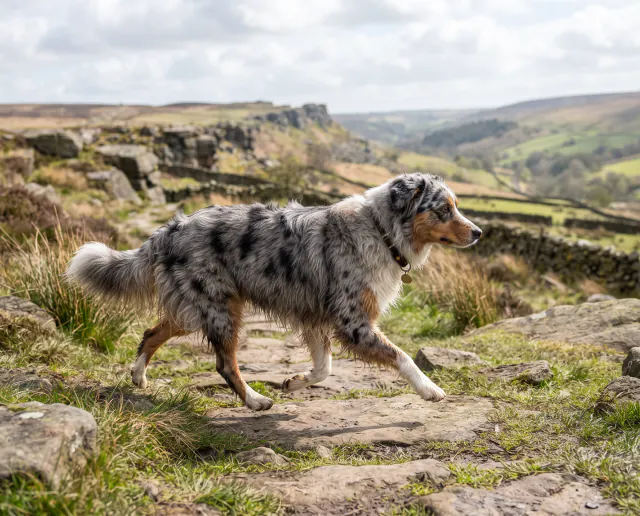
Australian Shepherds are not Australian. The breed was shaped on ranches in the western United States, most likely from Collie-type imports that arrived by way of Australia, and the name attached itself to a dog whose working life was spent moving sheep and cattle across large holdings. That job explains the animal. An Aussie was expected to think ahead, cover ground all day and take direction from a handler working at a distance.
Buyers now choose them largely for their looks, and the merle coats and copper markings do much of the selling. Underneath is a working stock dog with strong opinions about movement, arriving in a house that has neither sheep nor a hundred acres.
Temperament in the home
Indoors, a well-exercised Aussie is often calm, affectionate and strongly bonded to one or two people in the household. The breed tends to be reserved rather than effusive with strangers, and puppies need patient, positive introductions to visitors, traffic, other dogs and household noise if that reserve is not to harden into suspicion. Herding instinct shows up as circling, nudging and following running children or cyclists, which is manageable when redirected early and much harder once it has become a habit. Aussies notice everything from a car door to a change in routine, and some become vocal watchdogs. Few cope well with long days alone.
Exercise and training
Two hours of daily activity is a realistic floor for a healthy adult, and part of it should engage the brain. Structured work suits the breed better than free running, so agility, obedience, rally, scent work or trick training all earn their place alongside walks. A dog exercised only by chasing a ball becomes fitter and more frantic rather than more settled. Recall around livestock has to be dependable before any off-lead work in the countryside. Training itself is usually the easy part, since Aussies learn quickly and enjoy the process, but that speed cuts both ways and unwanted habits stick just as fast. Keep sessions short and teach a settle on a mat as deliberately as any other cue.
Coat and grooming
The double coat is medium in length with feathering on the legs and a fuller ruff, and it needs regular brushing to stay comfortable. Concentrate on the trousers, behind the ears and under the elbows, where mats build unnoticed. Shedding is constant and rises sharply twice a year, when an undercoat rake and a tolerant attitude to hair on clothing both help. Clipping an Aussie to reduce moulting is a mistake, since the coat insulates against heat as well as cold. After walks through stubble or long grass, check for grass seeds between the toes and inside the ear flaps.
Health and lifespan
Most Australian Shepherds live twelve to fifteen years. Hip and elbow scoring and eye testing should be documented for both parents, and the breed also has DNA tests worth asking about, including the MDR1 mutation, which affects how a dog processes several common veterinary drugs. Any dog carrying it needs that result on file at its practice. Eye conditions including collie eye anomaly, cataract and progressive retinal atrophy are seen in the breed. Merle to merle matings can produce puppies with serious sight and hearing defects, so ask about the colour of both parents and avoid any breeder advertising double merle litters. Epilepsy occurs occasionally, and any seizure or collapse needs veterinary investigation.
Costs and space
Running costs for a medium, active dog commonly land between £90 and £160 a month once feeding, insurance, worming, flea treatment and kit are added up, though that range is indicative and moves with location, insurer and the individual dog’s health. Grooming can be done at home by anyone willing to commit to it. Space matters less than access. A flat works when the dog leaves it several times a day and has real work to do, while a large house standing empty from eight until six does not. Fencing needs to be secure and reasonably high, and the car needs room for a crate.
Size and lifespan
Males typically stand 51 to 58 cm (20 to 23 in) at the shoulder and weigh 25 to 32 kg (55 to 70 lb). Females are smaller, usually 46 to 53 cm (18 to 21 in) and 16 to 25 kg (35 to 55 lb). It is a lean, athletic, medium-sized herding breed built for agility and endurance rather than bulk.
A typical lifespan is 12 to 15 years, a good outcome for a dog of this size, and most stay physically capable well into their senior years provided their exercise and mental stimulation needs continue to be met.
Verdict
The Australian Shepherd suits an owner who genuinely wants to train a dog several times a week and enjoys having a clever, watchful animal involved in everything. Active families, dog sports competitors and rural households with real jobs to offer tend to do well here.
The wrong home picks a first dog on appearance, works away from the house all day, or hopes that one long walk will settle the matter. Before buying, spend an evening with adult Aussies at home rather than watching one run an agility course. How the breed behaves on a quiet Tuesday says more about the next thirteen years than any performance on a good day.