
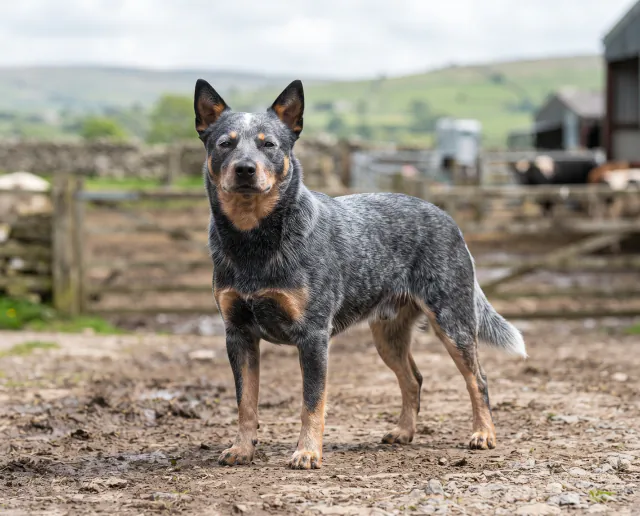
Also known as: Blue Heeler, Queensland Heeler.
At a glance
Key facts
The essentials to compare before deciding whether this breed fits your home and routine.
- Size
- Medium
- Lifespan
- 12 to 15 years
- Energy
- Very high
- Temperament
- Sharp, driven and intensely focused on work
- Good with children
- Better suited to older children who respect calm play
- Exercise
- Two or more hours a day of real work, not just walking
- Trainability
- Moderate
- Grooming
- A weekly brush is enough outside the twice yearly heavy shed
- Estimated monthly cost, GBP
- £85 to £150 per month
A Border Collie will try to out think a flock. An Australian Cattle Dog is built to argue with one, nose to nose with an animal ten times its weight, using a low nip to the heel and a fast retreat to make the point. The breed was developed in nineteenth century Australia to move semi wild cattle across vast unfenced distances, and that job demanded a dog tougher, more independent and considerably more willing to use its teeth than the collies it was crossed with.
The result is a compact, muscular dog usually weighing between fifteen and twenty two kilograms, with a blue or red mottled coat and an intensity that surprises people meeting the breed for the first time. Cattle Dogs bond hard to one person or family and can be genuinely difficult for anyone who does not give them consistent work to do.
Temperament in the home
Loyalty in this breed runs close to obsession. Most Cattle Dogs attach strongly to one adult, follow that person from room to room, and treat the rest of the household as acceptable company rather than the main event. The nipping instinct that made the breed useful on a cattle station does not disappear indoors, and a dog with nothing to do will happily herd children, joggers, cyclists or the family cat, using teeth on ankles as a matter of course. This is a breed trait, not bad temperament, but it makes life with young or boisterous children genuinely difficult unless the dog has an outlet and the children have been taught not to run screaming past it. Cattle Dogs guard their home and family with real conviction, and a stranger arriving unannounced will be told about it loudly.
Exercise and training
Two hours a day of proper activity is closer to the truth than a single walk, and the activity has to involve the brain as much as the legs. Herding trials, agility, flyball, long line work and structured jobs around the house all suit the breed far better than repetitive lead walking, which barely touches the surface of what a working line dog needs. Boredom in a Cattle Dog does not look like a nap on the sofa, it looks like a hole through a fence, a chewed door frame or a dog that has taught itself to herd the postman. Training itself comes easily to a breed this intelligent, and most pick up commands within a handful of repetitions, but that same intelligence means a Cattle Dog quickly works out which rules are optional. Consistency from day one avoids months of correcting bad habits later.
Coat and grooming
The short, dense double coat is genuinely low maintenance for most of the year, needing only a weekly brush to keep loose hair off the sofa. Twice yearly the undercoat blows out in earnest, and daily brushing for a couple of weeks during that period saves a great deal of vacuuming. Baths are rarely needed, since the coat sheds dirt as readily as it sheds hair, and there is no clipping or trimming involved at any stage. Nails wear down naturally on a dog this active, though they still need checking, and the breed’s naturally clean ears and short coat mean parasite checks are quick.
Health and lifespan
Cattle Dogs are often cited among the longer lived medium breeds, with many reaching thirteen to fifteen years in good health. Congenital deafness linked to the same genetics that produce the mottled coat is well documented, and reputable breeders test puppies’ hearing before homing them. Progressive retinal atrophy has a DNA test available through the Kennel Club scheme and should be checked in breeding stock. Hip dysplasia occurs, so BVA and Kennel Club hip scores are worth asking about even though the breed carries the condition less often than many similarly sized dogs. Because the breed rarely turns down food and burns it off through constant activity, owners who cut back exercise for any reason, injury, age or a change in routine, need to adjust meals just as quickly or weight creeps on fast.
Costs and space
Running costs sit around the middle of the scale for a dog this size, though the real cost of ownership is time rather than money, since an under exercised Cattle Dog becomes an expensive dog through vet bills, damaged property and behavioural training. A house with a securely fenced garden suits the breed far better than a flat, not because of size but because of the noise and energy involved in confined boredom. This is not a breed for a household that is out at work all day with nobody able to provide a substantial midday outlet. Rural and semi rural settings, or an owner involved in dog sport, tend to produce the happiest dogs and the most manageable ones.
Verdict
The Australian Cattle Dog suits active, experienced owners who want a genuine working partner, enjoy dog sport or physical farm type work, and can commit to daily mental and physical demands for well over a decade.
It is a poor match for a first dog, a household with young children who cannot be supervised constantly, or anyone hoping for a low key companion that will settle for a daily stroll. Given a real job, the breed is exceptional. Left without one, it becomes its own project.