At a glance
Key facts
The essentials to compare before deciding whether this breed fits your home and routine.
- Size
- Small
- Lifespan
- 12 to 14 years
- Energy
- High
- Temperament
- Quick, biddable and packed with working collie instinct
- Good with children
- Often good with older children who join in the activity
- Exercise
- About 1 to 2 hours a day of proper mental and physical work
- Trainability
- Beginner friendly
- Grooming
- Weekly brushing with more attention during seasonal shedding
- Estimated monthly cost, GBP
- £85 to £150 per month
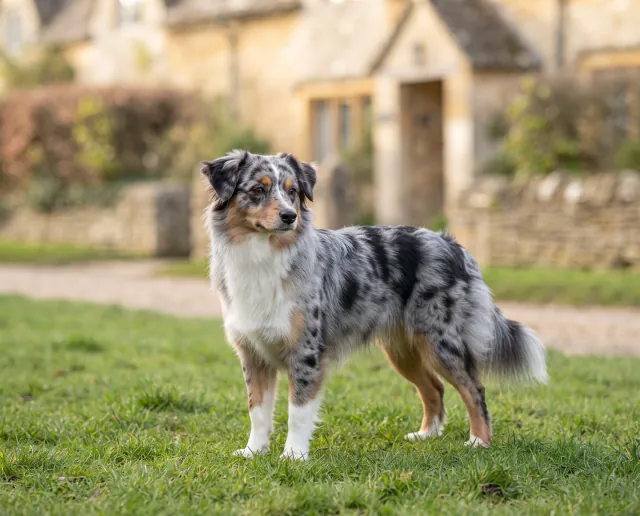
American ranch hands in the mid twentieth century wanted the working brain of an Australian Shepherd in a smaller, more manageable frame, one that could travel easily and still handle stock or perform in the show ring at rodeos between events. Selective breeding down in size, rather than crossing to a different breed, produced the Miniature American Shepherd, and the result kept nearly all of the intelligence and drive of its larger relative in a dog that fits far more households on paper than in temperament.
That distinction matters enormously here. This is a working collie type compressed into a small body, not a toy dog with a fancy coat, and owners drawn to the size without understanding the drive behind it often struggle. The breed remains genuinely rare outside North America and appears on the UK Kennel Club’s Imported Breed Register, so anyone wanting one should expect a long search and probably an imported dog somewhere in the pedigree.
Suitability
A well matched owner for this breed wants an intensely engaged small dog rather than a decorative one. The Miniature American Shepherd tends to bond tightly with its family, follows household members from room to room and can develop real anxiety if left without enough to occupy its mind. Herding instinct surfaces readily around children, cyclists and other pets, sometimes as gentle nudging and sometimes as an attempt to circle and control movement, so supervision and early guidance matter with younger children in particular. Other dogs are usually accepted well, especially with proper introduction, and the breed’s watchfulness makes it an effective, if noisy, early warning system at the front door.
Exercise
Between one and two hours of activity most days keeps the breed content, and that time needs genuine variety rather than a single repetitive walk. Agility, flyball, treibball and structured herding style games all suit the temperament far better than a plain lead walk alone, and a bored Miniature American Shepherd tends to invent its own outlets, some of them destructive. Puppies should have exercise limited and controlled while growing, since enthusiasm regularly outpaces the maturity of young joints. Owners who can offer a job, even an invented one built around training and games, get a considerably calmer dog indoors than those relying on physical tiredness alone.
Grooming
The medium length double coat needs a thorough weekly brush to prevent matting behind the ears, in the armpits and around the trousers, with daily attention useful during the heavier seasonal moults common to the breed. The coat is naturally weather resistant and sheds dirt reasonably well, so bathing is only occasionally required. Nails, ears and teeth need the standard routine care. Coat colour in this breed includes merle patterning, and prospective owners should understand how that gene works in breeding decisions, since it carries welfare implications when handled carelessly.
Health
The breed carries the MDR1 gene mutation found across collie type breeds, which affects how certain drugs, including some common parasite treatments and sedatives, are processed by the body. A DNA test for MDR1 status is available and should be checked before any medication is given, and a responsible breeder will know the status of their breeding stock. Eye conditions linked to the merle gene are a genuine concern, particularly in dogs bred from two merle parents, and reputable breeders avoid that pairing entirely along with screening under the BVA and Kennel Club eye scheme. Hip evaluation and hearing checks are also worth asking about. Well bred individuals commonly live into their mid teens.
Choosing and training
Training tends to be genuinely rewarding with this breed, since the same intelligence that creates behavioural problems when unused makes formal obedience, agility and trick work progress quickly with a competent handler. Early socialisation should include controlled exposure to children, other animals and busy environments, channelling the herding instinct into acceptable outlets before it becomes a habit around moving joggers or cars. Given the breed’s rarity, buyers should expect to wait, to contact the breed club directly, and to be prepared that a chosen puppy may come from imported lines or require travel to collect.
Size and lifespan
The breed standard covers a wide range: adults typically stand 35.5 to 46 cm (14 to 18 in) at the shoulder, with weight scaling accordingly from around 9 kg (20 lb) at the smaller end to 20 kg (44 lb) at the larger end of the range. This is one of the more variable breeds for size, so meeting the parents gives a far better idea of an individual puppy’s likely adult size than the breed standard alone.
A typical lifespan is 12 to 14 years. Keeping the dog lean throughout life supports joint health, particularly at the upper end of the size range where extra weight has more impact.
Verdict
The Miniature American Shepherd suits an active household prepared to provide genuine mental work daily, families with older children who can join in training and games, and owners drawn to collie intelligence in a smaller package. Dog sport enthusiasts often find the breed particularly rewarding.
It is a poor fit for anyone wanting a low key companion, households that are out most of the day, or buyers focused purely on the compact size without appetite for the working brain that comes with it.