At a glance
Key facts
The essentials to compare before deciding whether this breed fits your home and routine.
- Size
- Small
- Lifespan
- 12 to 14 years
- Energy
- Medium to high
- Temperament
- Bright, devoted and highly reactive to sound and movement
- Good with children
- Often good with calm children who are taught not to chase
- Exercise
- About an hour a day plus daily training
- Trainability
- Beginner friendly
- Grooming
- Brush several times weekly, with dense undercoat shedding twice a year
- Estimated monthly cost, GBP
- £70 to £130 per month
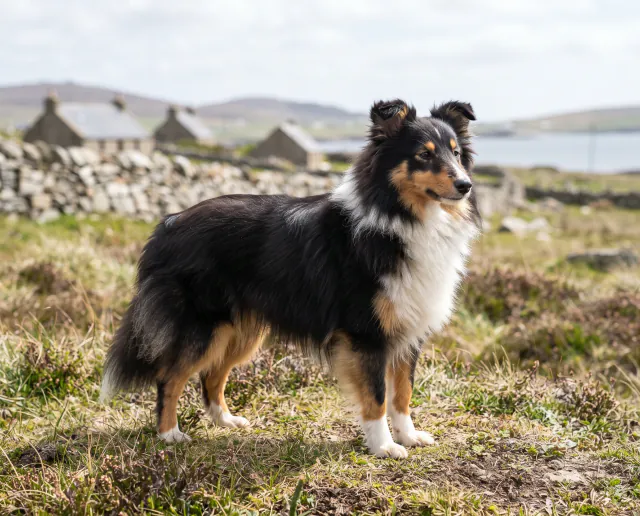
The Sheltie is not a miniature Rough Collie, although the resemblance is close enough that most people assume it. The type developed on the Shetland Islands, where crofters needed a small, thrifty dog to keep sheep, ponies and poultry off unfenced crops on a diet that could be spared. Collie blood was introduced later, when the breed was tidied up for the show ring. The result is a dog of roughly 35 to 37 centimetres and 6 to 12 kilograms carrying the working brain of an animal three times the size.
Anyone researching the breed should look past the coat and the intelligence, both genuine, and consider the noise. Almost every Sheltie that ends up in rescue leaves for the same reason, and it is not exercise or grooming.
Living with the breed
A Shetland Sheepdog attaches itself thoroughly to its household and would rather be underfoot than anywhere else. With strangers it is naturally cautious, and a puppy that misses early socialisation can become an adult that shrinks from visitors or barks from behind a chair. Barking itself is the defining management task. Shelties alarm at movement outside a window, at footsteps in a shared hallway and at delivery vans, and the sound is high and penetrating. Reducing visual triggers, teaching an alternative behaviour at the door and rewarding quiet from the first week are far easier than reversing an established habit. Herding instinct appears as circling and occasional nipping at the heels of running children, which needs redirecting early. The breed is small enough for most homes, dislikes being left for long stretches, and generally lives well with other dogs and with cats it has grown up alongside. A first-time owner can manage a Sheltie well, since the training is straightforward, provided the noise and the coat are both treated as commitments rather than surprises.
Daily exercise
An hour a day across two walks satisfies a healthy adult, and the physical requirement is modest compared with larger herding breeds. Shape matters more than distance. A Sheltie walked for an hour without using its head stays restless, while thirty minutes of walking followed by a training session or a scent game produces a dog that sleeps. Chasing is the risk to plan for, since bicycles, cars and joggers all attract a dog bred to react to movement. Recall is usually good, and the breed can earn genuine off-lead freedom in safe places, provided road sense is never assumed.
Training and mental work
Few breeds learn faster. A Sheltie often grasps a new cue within a handful of repetitions, which is why the breed appears near the top of obedience, rally and agility results in this country. That speed applies equally to habits nobody intended to teach, so the barking that is rewarded with attention on day three becomes the household routine by the end of the month. Handling should stay gentle, since this is a soft breed that shuts down under pressure and works beautifully for food, praise and short cheerful sessions. Useful early priorities are a settle on a mat, a quiet cue built by rewarding the pause after the first bark, and a recall away from moving objects. Scent work, trick training and small-scale agility all give the mind something to do, and a weekly class is usually money well spent.
Grooming and shedding
The double coat consists of a long, harsh outer layer over a short, dense undercoat, with a pronounced mane and feathering on the legs. Brushing several times a week in sections, right down to the skin, keeps it comfortable, and the places to work are behind the ears, inside the elbows and along the collar line, where mats form unseen. Twice a year the undercoat sheds in quantity, producing far more hair than a dog this size looks able to hold. An undercoat rake shortens the process considerably. Clipping the coat off is a mistake, since it protects against sun as much as frost and often regrows badly. Trim the hair between the pads and keep the sanitary area neat. Small mouths crowd easily, so daily tooth brushing is worth establishing in puppyhood.
Health and costs
Twelve to fourteen years is typical. Collie eye anomaly and progressive retinal atrophy both occur in the breed, so ask whether puppies have been examined by an ophthalmologist and whether the parents hold current eye certificates. The MDR1 mutation, which changes how a dog responds to several routine veterinary medicines, is found in Shelties as in other collie types, and the DNA status of both parents is worth requesting. Von Willebrand disease, a bleeding disorder, has a test available. Hypothyroidism, patellar luxation, dermatomyositis, epilepsy and a gallbladder condition recognised in the breed are all worth discussing with a breeder, and any collapse, unexplained bruising or sudden abdominal pain warrants prompt assessment. A monthly figure between £70 and £130 is an indicative guide rather than a quotation, since food, insurance, preventive treatment and grooming equipment vary between households and regions.
Verdict
The Shetland Sheepdog suits an owner who actively wants to train a dog, has a sense of humour about hair and is prepared to work on noise from the first day. Families with older, quieter children, retired owners with time, and anyone interested in dog sports usually find the breed exceptional value for its size.
It is a poor match for a flat with thin walls, for a home that is empty through the working day, or for someone hoping that a small dog means a small commitment. Spend an afternoon with adult Shelties in a normal house rather than at a show, and listen.