At a glance
Key facts
The essentials to compare before deciding whether this breed fits your home and routine.
- Size
- Large
- Lifespan
- 12 to 14 years
- Energy
- Medium
- Temperament
- Gentle, sensitive and quick to comment on anything unusual
- Good with children
- Usually very good with children in a settled household
- Exercise
- About an hour a day, comfortably more if offered
- Trainability
- Beginner friendly
- Grooming
- Brush several times weekly, with very heavy seasonal shedding
- Estimated monthly cost, GBP
- £80 to £150 per month
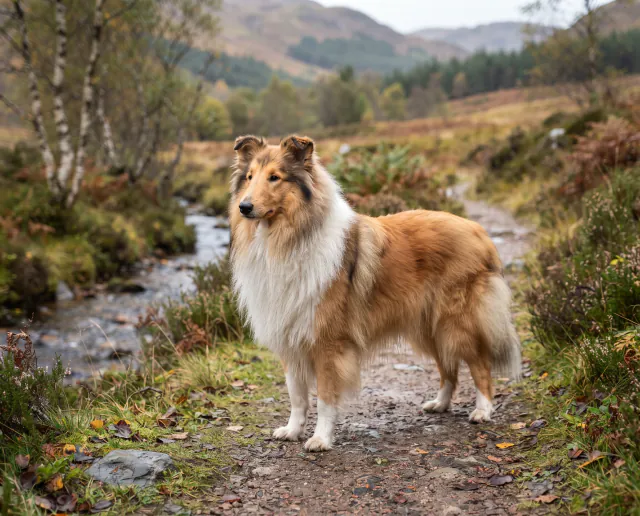
Buyers frequently assume a Rough Collie is a Border Collie with more hair, and the two have not been the same animal for well over a century. The Rough Collie was drawn out of the Scottish farm collie population, reshaped by Victorian show fashion after Queen Victoria took an interest in the type, and finally fixed in the public imagination by a series of American films about a dog called Lassie. Generations of selection for appearance and companionship rather than stock work have produced a dog with a fraction of the drive of its working relatives.
The result is a breed considerably easier to live with day to day. Its difficulties lie in coat, noise and sensitivity rather than in unspent working energy, and owners arriving with either a farm dog or an ornament in mind are both caught out.
Temperament in the home
Most Rough Collies are soft, courteous animals that attach to a family rather than one person and prefer to be in whichever room is occupied. They are gentle in the way they use their bodies, rarely mouthing or barging, which underlies a long reputation with children. Herding instinct survives as circling rather than gripping, and a puppy that follows running children is easily redirected. Sensitivity is the trait to understand before buying. Raised voices, fireworks and sudden bangs affect this breed more than most, and noise phobia is a recognised problem within the type. Alarm barking is the other characteristic that decides whether ownership works. A Collie announces the post, the neighbour’s car and a bird landing on the fence in a high, carrying voice, which needs managing from the first week rather than after complaints start. Long days alone suit them badly. A thoughtful first-time owner can do very well here, provided grooming and barking are both taken seriously from the beginning.
Exercise and training
An hour a day across two outings keeps a healthy adult content, and the breed will cheerfully take three times that on a hill walk. Collies are not endurance athletes in the modern sense and do not spiral into frustration when a day is quiet, which makes them flexible for a busy family. Training is a pleasure, since they learn fast, watch their handler closely and work willingly for praise as well as food, so obedience, rally, scent work and agility all suit them. Harsh handling is counterproductive to a surprising degree, since a shouted correction can flatten a sensitive Collie for the rest of a session. Recall is usually reliable, though bicycles, joggers and cars attract attention and deserve a deliberate response.
Coat and grooming
The coat has a harsh, straight outer layer over a very dense soft undercoat, with a full mane, feathering behind the legs and a heavy skirt at the rear. Its texture means it mats less readily than the volume suggests, but the friction points behind the ears, in the armpits, under the collar and through the trousers will felt quietly if left. Several sessions a week with a slicker and a wide-toothed comb, working in lines from the skin outwards, keeps a pet coat in order. Moulting is the part nobody is prepared for. Once or twice a year the dog lets its undercoat go in handfuls across two or three weeks, enough to fill a bin bag, and an undercoat rake is the only answer. Clipping is a poor idea, since the coat regulates heat in both directions and can regrow badly.
Health and lifespan
Twelve to fourteen years is normal for a well-kept Collie. The first question for any buyer concerns the MDR1 gene, a mutation common in collie breeds that alters how a dog handles several ordinary veterinary drugs. A DNA result should be available for the parents, and any affected dog needs that fact recorded clearly at its practice. Eye screening matters as much, because collie eye anomaly is widespread and puppies are usually examined by an ophthalmologist at a few weeks old, with progressive retinal atrophy also worth asking about. Dermatomyositis, an inherited skin and muscle condition, is recognised within the type, so unexplained crusting or hair loss on a young dog’s face and legs deserves attention. Hip scoring and epilepsy are worth raising with a breeder, and dated certificates count for more than verbal assurance.
Costs and space
Around £80 to £150 a month is a fair planning figure, read as an approximation, because food, insurance, veterinary care and any professional grooming shift with location and with the dog. Coat care is the controllable expense. Owners who buy proper equipment and do the work themselves spend little, while regular groomer visits for a large double-coated dog add up. Space works differently here, since height and weight are manageable and the real requirements are somewhere to brush, a vacuum that copes and a car boot that takes a hairy passenger. Terraced housing and flats work only if the barking has genuinely been addressed.
Verdict
The Rough Collie suits a family wanting a gentle, responsive dog of real size without the intensity of a working herding breed, and finding the coat routine satisfying rather than tedious. Households with school-age children, a calm atmosphere and an adult around for most of the day get the best from it.
It is unsuitable for a noisy, chaotic home, for anyone unwilling to manage alarm barking, or for an owner who imagines the coat can be handled with an occasional brush. Watch an adult being groomed properly and ask its owner how it copes with fireworks.