At a glance
Key facts
The essentials to compare before deciding whether this breed fits your home and routine.
- Size
- Medium
- Lifespan
- 12 to 14 years
- Energy
- High
- Temperament
- Gentle, watchful and eager to please
- Good with children
- Usually very good with children of any age
- Exercise
- About 1 to 2 hours a day including mental work
- Trainability
- Beginner friendly
- Grooming
- Weekly brushing, heavier during seasonal moults
- Estimated monthly cost, GBP
- £90 to £150 per month
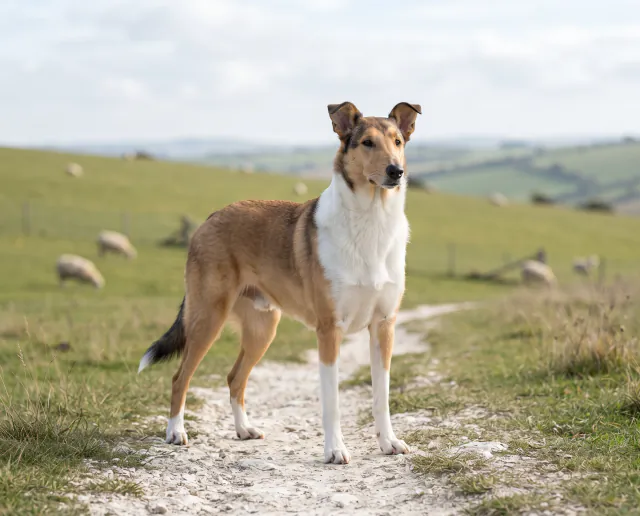
Ask most people to picture a collie and they describe the rough coated dog made famous by Lassie, all mane and feathered legs. The Smooth Collie carries the same working ancestry from the Scottish Borders, the same build and the same watchful temperament, but its short flat coat marks it out as a distinct variety with its own following, its own show classes and, on the Kennel Club’s list of vulnerable native breeds, its own worryingly small annual registration figures.
Numbers have fallen far enough that anyone wanting a puppy should expect to wait and to travel, sometimes considerable distances, to find a litter. The breed club is worth contacting early, since it usually knows more about upcoming litters than any general website. Rarity has not dented the temperament that made the wider collie type so popular, and most owners describe a genuinely biddable, gentle dog once the coat question is settled.
Living with the breed
At home a Smooth Collie tends to be sensitive, affectionate and eager to fit in with whatever the household is doing. The breed reads tone of voice closely and responds badly to shouting or heavy handed correction, doing far better with calm, consistent handling. Many are naturally reserved with strangers without tipping into nervousness, and most settle well with children, dogs and cats when introductions are managed sensibly. A collie left without company or occupation for long stretches can become anxious, since the breed bonds tightly with its people and was never bred to work alone at a distance in the way some pastoral breeds were. Barking tends to be moderate rather than constant, usually reserved for visitors or something genuinely out of place.
Daily exercise
An hour to two hours a day, split into more than one outing, keeps an adult content, with plenty of scope for training games, retrieving and off lead exploration where it is safe. The breed has real stamina inherited from droving work and enjoys agility, obedience and other structured activities as much as a simple walk. Puppies should be exercised more conservatively while bones and joints develop, with free play in a garden generally safer than long forced walks or repeated jumping. One point specific to this breed and its rough coated relative deserves early attention from any owner. A proportion of collies carry a mutation in the MDR1 gene that affects how the body clears certain drugs, including some common wormers and anti-parasitic treatments, and a simple DNA test identifies carriers so a vet can prescribe accordingly.
Training and mental work
Few breeds take to training more readily. Smooth Collies are quick to learn, keen to please and generally food or toy motivated, which makes early classes and reward based work productive from a young age. Mental stimulation matters as much as physical exercise, since a bored, understimulated collie will invent its own entertainment, often involving furniture, laundry or the neighbour’s cat. Scent games, puzzle feeders and short daily training sessions channel the breed’s intelligence usefully. Herding instinct persists even generations removed from working stock, and a young collie chasing joggers, cyclists or the children in the garden is not being naughty so much as doing what its ancestors were bred to do, which means the behaviour needs redirecting rather than simply scolding.
Grooming and shedding
The short dense double coat is far less work than the rough variety but still sheds steadily throughout the year, with a heavier coat blow in spring and autumn when daily brushing helps rather than just weekly. A rubber grooming mitt or a bristle brush lifts loose hair efficiently and keeps shedding around the house to a manageable level. Bathing is needed only occasionally, and the coat dries quickly compared with longer haired breeds. Ears, teeth and nails should be checked on the same weekly schedule, and owners who keep on top of the routine find the breed considerably less demanding than its appearance among collies might suggest.
Health and costs
Twelve to fourteen years is typical for the breed, and most lines are considered generally sound. Hip scoring under the British Veterinary Association and Kennel Club scheme is worth asking about, along with the eye scheme the same organisations run jointly, since inherited eye conditions including collie eye anomaly are documented in the wider collie family and a DNA test exists for some of them. The MDR1 status of both parents is a fair question for any breeder, since knowing a puppy’s genotype in advance avoids problems later at the vet. Monthly costs of around ninety to one hundred and fifty pounds are typical, covering food, insurance and routine care, though prices vary by region and by individual dog. Because the breed is uncommon, a specialist vet consultation is rarely needed beyond routine care.
Verdict
The Smooth Collie suits a family or individual wanting an intelligent, biddable dog with modest grooming needs and the time to give it proper exercise, training and company. Anyone drawn to the classic collie look but put off by heavy coat care has good reason to look at this variety specifically.
It is not the right choice for households wanting a dog that tolerates long absences, nor for anyone unwilling to search patiently for a litter from a breed that remains genuinely hard to find in most countries.