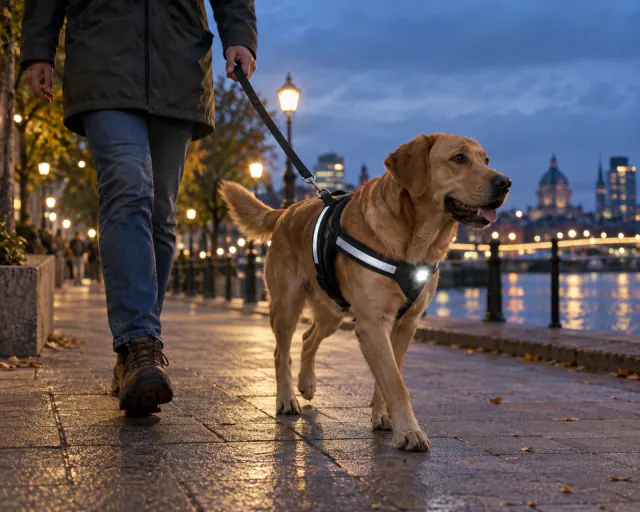
Many dog walks happen before sunrise or after sunset, whether by choice or because a working day leaves no other option. How much of the year this applies to depends heavily on where you live. Daylight hours shift with latitude and season far more dramatically in some countries than others, and a walk that is comfortably lit in June can be full dark by the same time in December. Poor visibility is not only a winter, early-morning problem either: fog, heavy rain and low winter sun glare all reduce how well you and your dog can be seen, and how well you can see what is ahead.
This guide covers the equipment that makes a dog visible in low light, the route and behaviour choices that reduce risk, and the extra caution worth applying around traffic, other path users and wildlife when visibility drops.
Making the dog visible
A dog’s natural colouring, especially a dark coat, can make them very hard to see against a road, a hedge line or a dim path, even at a distance a driver or cyclist would otherwise have time to react to. A few pieces of kit close that gap.
- Reflective or hi-vis leads and harnesses. Reflective piping or a hi-vis panel catches headlights and torchlight at a distance, well before a plain-coloured item would be visible. Choose equipment where the reflective element runs around the body rather than a single small strip, since visibility from the side and from behind matters as much as from the front.
- Reflective or hi-vis collars. A collar sits at the highest point on most dogs and works well combined with reflective lead and harness elements rather than instead of them.
- Clip-on lights. A small battery or rechargeable light clipped to a collar or harness gives active, attention-grabbing visibility that passive reflective material cannot match on an unlit path with no other light source to bounce off. Steady and slow-flash modes are generally easier for other people to judge distance and speed from than a fast strobe.
- Choose colour with contrast in mind. Bright yellow, orange and white stand out well against most UK and northern European backgrounds. In snow-covered areas, a darker contrasting colour can actually be more visible than white.
None of this equipment lets a dog see any better in the dark. It only helps other people, drivers and cyclists in particular, see the dog in time to react.
Choosing a route for poor visibility
The safest route in daylight is not automatically the safest route after dark. A path that is fine to navigate by eye in full light can hide tripping hazards, uneven kerbs, loose paving or standing water once the light drops, and a route that shares space with cars during the day can become genuinely dangerous once headlights are the main source of light and drivers have less time to spot a pedestrian or a dog.
- Favour well-lit streets and paths over unlit shortcuts, even if the well-lit route takes longer.
- Stick to routes you already know well, so you are not trying to judge unfamiliar terrain, junctions or off-lead areas in poor light for the first time.
- Where a route has no choice but to use a road without a pavement, walk facing oncoming traffic so you can see vehicles approaching and react, and keep the dog on the side away from the traffic.
- Carry your own torch or head torch, not only equipment on the dog. Lighting the ground ahead of you helps you spot hazards and helps oncoming traffic see a person is present.
Extra caution near traffic and crossings
Reaction time drops in low light for everyone involved, drivers included. Build in a wider margin than you would in daylight: cross at a formal crossing point rather than wherever looks clear, pause longer to judge an approaching vehicle’s speed and distance, and do not assume a driver has seen you or the dog just because headlights are pointed in your direction. Keep the dog close and under control, ideally on a shorter lead rather than a long line, at any point where a road is nearby, since the margin for a dog to react to a sudden hazard is smaller for you and for the driver alike.
A hi-vis element for the handler too
Equipment on the dog only solves half the visibility problem. A driver, cyclist or another dog walker needs to see the person as well, particularly since a walker often stands or moves independently of the dog on a longer lead. A hi-vis armband, vest or a reflective strip on an existing coat is a small addition that meaningfully increases how early you are spotted, and it costs little in comfort or convenience.
Wildlife and livestock are harder to spot too
Low light cuts both ways. Just as it is harder for others to see you and the dog, it is harder for you to spot wildlife, livestock or other hazards on the path ahead until you are close to them. An encounter with livestock that would be avoidable with clear sightlines in daylight can happen with much less warning in the dark, and the guide on walking near livestock covers the specific precautions and legal considerations that apply around farm animals in more detail. A dog off lead or on a long line in low light near fields, hedgerows or open countryside is harder to keep track of and harder to call back with confidence if something unexpected appears, so keeping the dog closer than usual on a shorter lead is a reasonable trade-off when visibility is poor.
Adjust rather than avoid
None of this means low-light walks should be avoided altogether. For many owners they are unavoidable, and for some dogs a quieter, cooler evening walk suits their temperament better than a busy daytime one. The aim is to adjust equipment, route and behaviour to match the reduced visibility, rather than walking the same route the same way regardless of how dark or how poor the conditions are. A small kit of reflective gear and a torch, combined with a familiar and well-lit route, removes most of the added risk that low light brings.