- Session length
- 5 to 10 minutes, once a day
- Skill
- Recall
- Suits
- Any age
What you need
- A long line of ten metres (about thirty three feet), fabric or biothane, without a handle loop
- A well-fitted Y-shaped harness with a back ring for the line
- High value soft food, cut to pea size, carried in a pouch
- One toy the dog enjoys, and a lidded food container with holes in the lid
- Gloves for handling the line in wet weather
A recall that works in an empty field has been learned. A recall that works when there is something better to do has been proofed, and that is the difference between a dog you can trust near a picnic and one you cannot. This lesson keeps the long line on and adds distractions deliberately, starting far away and closing in, so the dog practises winning the choice rather than losing it.
Purpose
By the end of this lesson the dog should turn and come back on one cue, from ten metres on a long line, with a toy or food container lying ten metres away in the same field. It is still a long-line recall. The line is the safety net that makes it possible to practise against real temptation without giving the dog the chance to rehearse ignoring you.
Prerequisites
- The dog comes back on one cue from ten metres in a quiet place, as taught in recall on a long line.
- The dog can lie down or wait on a word without food in your hand.
- You have access to a large open space with a distant or secure boundary and no dogs close by during your session.
Equipment
A ten metre (thirty three foot) line gives the dog room to be genuinely distracted while you stay in control. Clip it to the back ring of a Y-shaped harness, never a collar. The long line buying guide compares lengths, materials and clips. You also need one toy the dog likes and a food container with a lid, which lets the dog smell food without being able to eat it. Bring higher value food than you use at home.
Method
- Arrive, clip on the line and let the dog explore on the full line for two or three minutes so the place is no longer new.
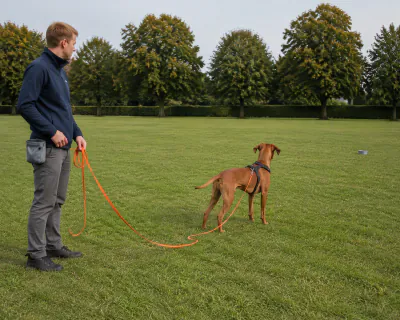
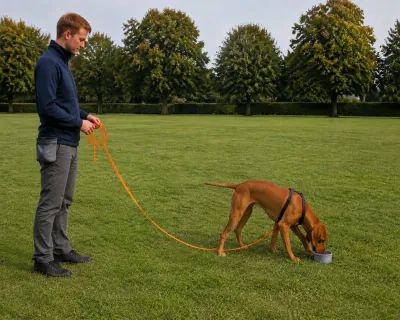
- Place the lidded food container on the grass about twenty metres (sixty five feet) away, well beyond where the line can reach. Walk the dog back to your starting point.
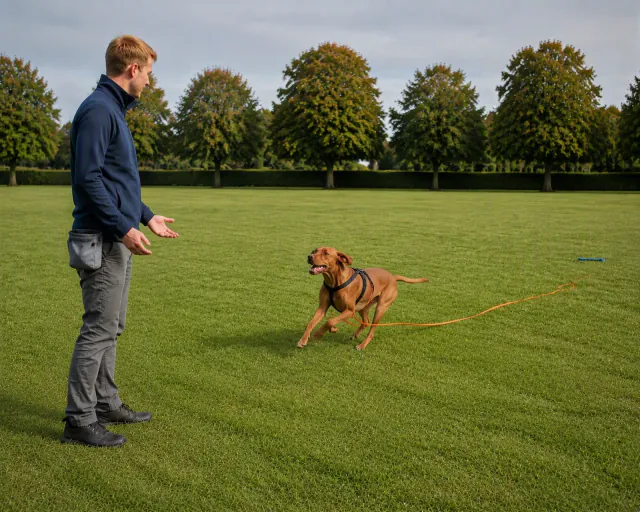
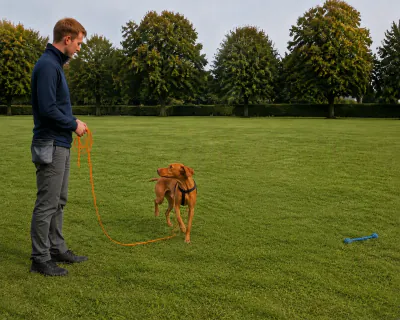
- Let the dog notice the container. While the dog is looking at it, say your recall cue once.
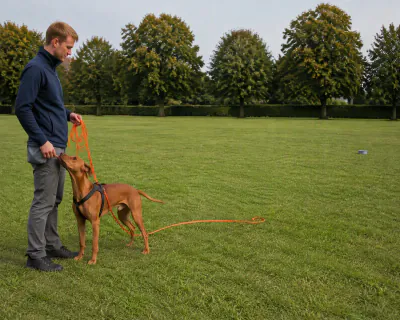
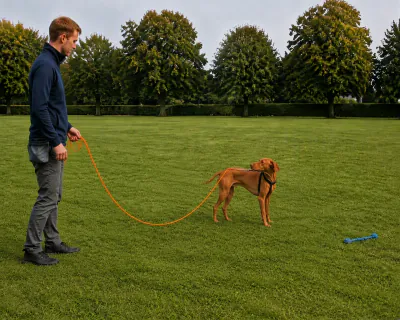
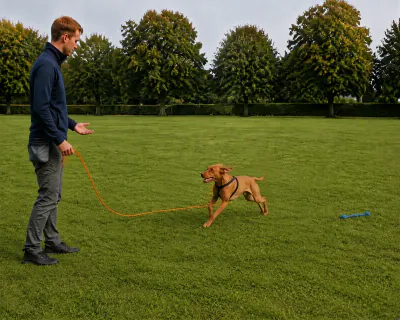
- The instant the dog turns, stand upright and still, hands low. Pay three or four pieces one after another at the seam of your trousers as the dog arrives.
- Now release the dog to the distraction as a second reward. Walk them on the line to sniff the closed container, or pick up the toy and throw it a short way for them. The lesson the dog learns is that coming away from something often leads back to it.
- Repeat four to six times with the container at twenty metres. Keep the line length and the field the same.
- In later sessions, change distance only. Move the distraction to fifteen metres (fifty feet), then ten metres (thirty three feet). Keep it out of reach of the line at every distance.
- If the dog does not turn within about three seconds, do not repeat the cue and do not reel the dog in. Take up slack gently, walk backwards to create movement, pay the dog on arrival, and move the distraction further away for the next repetition.
- Only when ten metres is reliable, change the type of distraction. Replace the food container with the toy, then with a toy you move gently on the ground with your foot, going back to twenty metres each time the distraction changes.
- Call several times in each session and release the dog back to exploring most times, so the cue never predicts the end of fun.
- Finish every session on a successful recall while the dog is still keen.
Session length
Five to ten minutes, once a day. Six to ten recalls is a full session. Proofing is demanding for the dog, and a tired dog chooses the distraction more often.
Progression criteria
Move on when the dog turns on the first call nine times out of ten, with a distraction at ten metres, across three sessions in two different places. A repetition where you called twice, stepped towards the dog or used the line to bring them in does not count.
Common mistakes
Moving the distraction closer and changing the field in the same week asks two questions at once. Change one thing, and if it fails, go back to the last setting that worked. Calling while the dog is already fixed on the distraction, nose down and moving towards it, sets up a failure; call as the dog notices it, before the commitment. Paying only one small piece of food for leaving something exciting makes coming back a poor bargain. Using the line to reel the dog in teaches them that the cue means being pulled, not choosing.
Troubleshooting
If the dog comes back well to the container but not to the toy, the toy is a bigger distraction for this dog, so start it further away. If the dog comes most of the way and then veers back, you are probably moving towards them or reaching down too early. If a particular dog struggles far more than expected, especially a scent hound or a dog bred to hunt, the guide to recall and prey drive sets out realistic expectations and management. The broader teaching reliable recall guide covers why each repetition needs to pay.
Safety and when to stop
Stop if the dog is limping, panting heavily or suddenly unwilling to run. Changes in willingness to move can have a physical cause and belong with your vet. Stop immediately if another dog, a person or an animal approaches and you are not sure how either animal will react; shorten the line and move away calmly. If the dog lunges, barks or panics at dogs, people or traffic, that is a matter for a qualified behaviourist working with your vet. Never use a check chain, a prong collar or any device that works through startle or discomfort to enforce a recall.
Next lesson
Continue with from long line to off lead, which turns this proofed long-line recall into off-lead freedom in a secure space, step by step.
Useful tool
A dog who gets enough free running and sniffing each week finds distractions easier to leave. The dog exercise planner helps you work out a realistic weekly balance of exercise and training.