- Session length
- 3 to 5 minutes, two or three times a day
- Skill
- Foundations
- Suits
- Any age
What you need
- A treat pouch worn on your hip, or a pocket you can reach with one hand
- Small soft food rewards the dog will work for, cut to pea size
- A non-slip mat or rug if the floor is hard or slippery
- A quiet room with nothing on the floor to distract the dog
A lure is the fastest way to show a dog what a behaviour looks like, and it is also the most common reason a well-taught behaviour stops working outside the kitchen. The dog learns to follow the hand, not the word, and when the hand is empty or busy with a lead, the behaviour disappears. This lesson moves the dog’s attention from the food in your fingers to the cue you say, while the reward keeps arriving exactly as generously as before.
Purpose
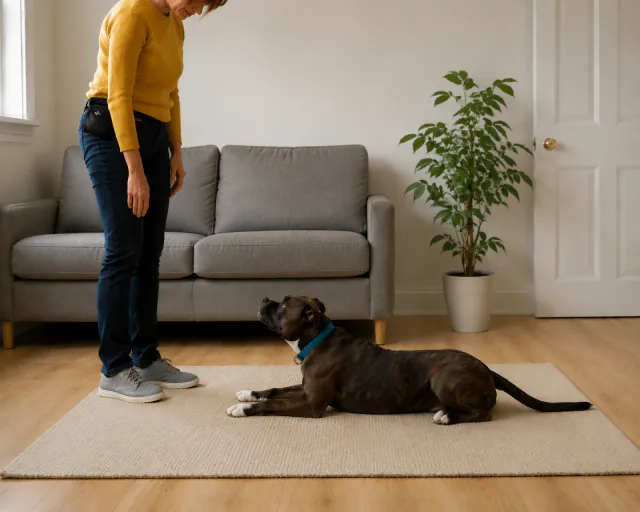
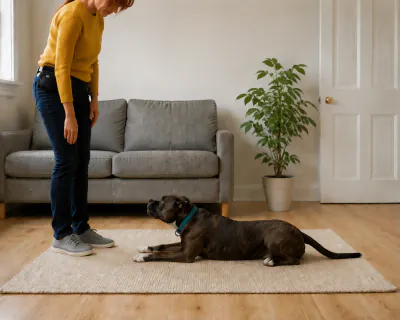
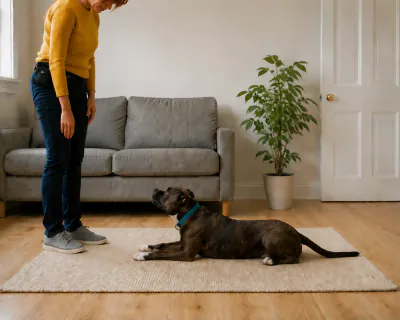
By the end of this lesson the dog should lie down when you say the cue once, with your hands still at your sides and no food visible, in a quiet familiar room. The same method works for sit, stand, a hand target and most behaviours taught with a lure. Down is used here because it is the behaviour most often left dependent on a pointing hand.
The goal is not to stop rewarding. It is to change what predicts the reward. A dog paid from a pouch after a verbal cue is still paid every time at this stage; the difference is that the food no longer appears first to tell the dog what to do.
Prerequisites
- The dog already lies down reliably when you lure with food in a quiet room. If that is shaky, go back to the puppy lesson on lying down first.
- The dog understands a marker word and expects food to follow it.
- You can take food from a pouch with one hand quickly, without looking down for long.
Equipment
Wear a pouch on your hip so the reward hand has somewhere to go that is not in front of the dog’s face. A pouch that opens and closes with one hand makes the timing far easier, and the treat pouch buying guide compares the opening styles. Cut the food small, because this lesson pays many repetitions in a short session. Put down a rug or mat if the floor is hard.
Method
- Choose a quiet room the dog knows well. Stand facing the dog with the pouch on your hip and food already inside it, not in your hand.
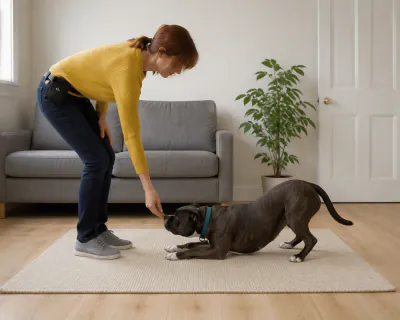
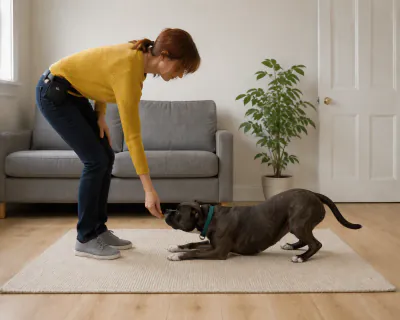
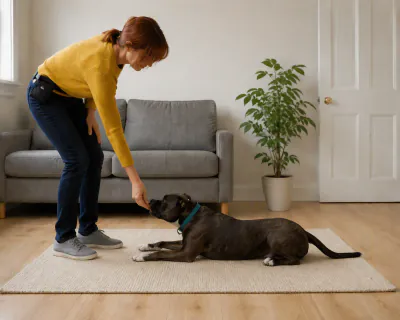
- Do three ordinary lured downs to remind both of you what the gesture looks like: food pinched between finger and thumb, drawn from the nose straight down to the floor, marked and paid as the elbows touch.
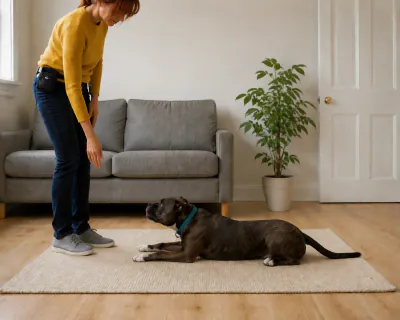
- Now make exactly the same movement with the same pinched fingers and no food in them. Keep the speed and the shape identical.
- The moment the elbows touch the floor, say your marker word. Then take a piece of food from the pouch with your other hand and deliver it low, between the front paws, so the dog stays down to eat it.
- Release the dog with your usual release word and invite them to stand. Repeat five to eight times.
- If the dog does not follow the empty hand within about three seconds, do one lured repetition and then try the empty hand again. Three misses in a row tells you to stay at the lured stage for another session.
- Over the next few sessions, shrink the gesture. Stop the hand a little higher each time, until a small downward flick of the fingers at knee height is enough. Change only the size of the signal; keep the room and your position the same.
- Now introduce the word. Say your cue once, pause for a silent count of one, and then give the small hand signal. Pay every correct down from the pouch.
- Watch for the dog starting to fold into the down during the pause, before your hand moves. When that happens, mark it and pay more than usual, three or four pieces one after another.
- Once the dog anticipates the hand on most repetitions, try the word alone with your hands resting at your sides. If the dog lies down, mark and pay. If not, give the small signal after a two-second wait, pay a little less, and try the word alone again two repetitions later.
- Only when the word works on its own in the quiet room, add difficulty by changing one thing: sit instead of stand yourself, or turn slightly away, or move to a second room. Never add two changes in the same session.
Session length
Three to five minutes, two or three times a day. Ten to fifteen repetitions is plenty for one session. Lure fading is slow, careful work for a dog, and short sessions keep them guessing less.
Progression criteria
Move on when the dog lies down on the word alone, with your hands at your sides, eight times out of ten across three separate sessions. Count honestly: a repetition where you leaned forward, pointed or reached towards the pouch before the dog moved counts as a prompted one, not a word-alone one.
Common mistakes
The most common mistake is moving the reward hand towards the pouch before the dog responds. Dogs read that movement quickly, and it becomes the new lure. Keep both hands still until after the marker. The second is repeating the cue. If the dog does not respond, say nothing, wait two seconds and help with the smallest signal that works. The third is dropping the rate of reward at the same time as fading the lure, which asks the dog to do more for less at exactly the moment the task got harder.
Troubleshooting
If the dog stares at your hands and waits, the signal has faded faster than the word has been learned. Go back one stage and add more repetitions with the pause between word and gesture. If the dog lies down only when you stand in one exact spot, the position has become part of the cue, so practise in two or three positions within the same room before changing rooms. If the dog loses interest once the food is out of sight, use a higher value food for this lesson and keep sessions to two or three minutes. The guide on moving from food lures to reliable verbal cues explains the stages in more depth.
Safety and when to stop
Stop the session if the dog starts barking, mouthing your hands or jumping at the pouch. Those are signs of frustration, and the fix is an easier step rather than more attempts. Stop and speak to your vet if lying down seems uncomfortable, if the dog lies on one hip only, or if they are slow to get up. A sudden change in willingness to take a position they used to offer easily can have a physical cause. If the dog shows fear, freezes or seems worried by your hands, speak to a qualified behaviourist working alongside your vet rather than pushing on.
Next lesson
Continue with recall around distractions, which uses the same principle of removing help to make a long-line recall hold up when something interesting is nearby.
Related reading
Why treats alone are not a complete training plan sets out where food fits alongside timing, markers and structure, which is useful context once food stops being visible in your hand.