A lure and a cue get used almost interchangeably by owners, and the confusion is understandable, because both involve food and both happen while a dog is learning a new behaviour. They are not the same thing, and mixing them up is one of the most common reasons a dog appears to know a behaviour for years while genuinely only ever responding to the sight of food in a hand.
A lure is a piece of food used to physically guide a dog’s body into a position, and it is meant to be temporary from the moment it is introduced. A cue is a word or signal that predicts what is wanted, and it is meant to be permanent. The whole purpose of a lure is to get itself out of the picture once it has done its job of showing the dog the movement. When that handover never happens properly, the dog has not learned a cue; it has learned to watch a hand.
What a lure is actually for
A lure works by shaping movement directly. Food held at a dog’s nose and drawn up and back over the head, for example, naturally tips the dog’s head back and drops the hindquarters into a sit. The dog is not thinking about the word “sit” at this stage; it is physically following food, and the resulting position happens to be the one the handler wants. This is a legitimate and efficient way to introduce a brand-new behaviour, particularly with a dog that has no prior association with the movement at all. The mistake is not using a lure. The mistake is leaving it in place indefinitely, long after its job of introducing the movement is finished.
The standard fading sequence
Moving from lure to cue works best as a deliberate sequence rather than something left to happen on its own:
Stage one is the full lure: food visible in the hand, guiding the dog’s body through the motion, with a reward delivered from that same hand immediately afterwards.
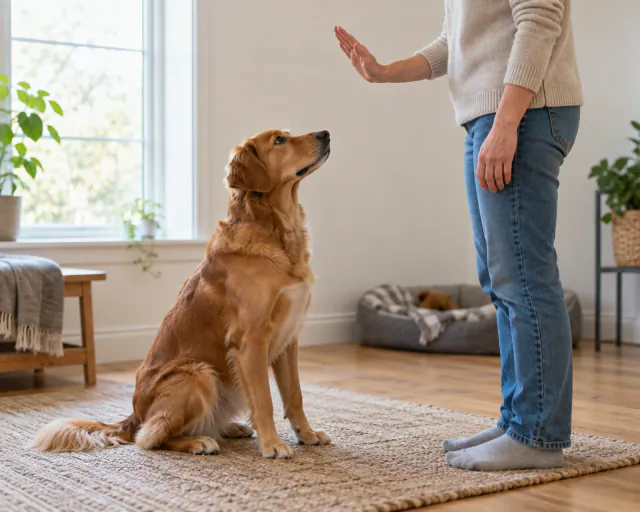
Stage two removes the food from the guiding hand but keeps the same hand motion. The dog follows a now-empty hand through the identical movement, and the reward is delivered from the other hand or from a pouch once the position is achieved. This step matters because it separates the physical prompt from the food itself; the dog starts responding to the gesture rather than to the smell.
Stage three introduces the verbal cue before any hand motion happens at all: say the word, pause briefly, then use the fading hand signal only if needed. Over further repetitions the hand motion itself shrinks and eventually disappears, leaving the verbal cue on its own, still followed by a reward from the pouch or the other hand.
Throughout all three stages, the reward keeps arriving for a correct response. What changes across the sequence is not whether the dog gets paid, but what triggers the payment: first a full physical prompt, then a fading physical prompt, then eventually the word alone.
Why an empty, visibly empty hand matters
Testing a cue with a hand that is deliberately shown to be empty, palm open and fingers spread, is a more honest test than testing it with a closed fist a dog has learned might be holding food. A dog that only performs reliably when a treat pouch is visibly worn on the handler’s body has not generalised the cue to the word; it has generalised it to the presence of food nearby. Genuine proof that a cue has transferred from lure to word is a dog responding to the word alone, hands demonstrably empty, with no pouch in sight, and still being rewarded afterwards from a pocket or a location out of the dog’s direct view.
Common mistakes in fading
Fading too fast is a frequent error. An owner drops the lure after only two or three repetitions, the dog has not yet connected the word with the movement, the dog fails to respond, and the owner concludes the dog has “forgotten” a behaviour it never actually learned as a verbal cue in the first place. The fix is simply more repetitions at the stage before the one that failed, not starting again from nothing.
Fading too slowly causes the opposite problem. An owner who keeps a visible lure in hand for months, long after the dog is clearly anticipating the movement, ends up with a dog dependent on seeing food before it will respond. The behaviour looks reliable in every session that happens to include visible food and falls apart the instant it does not.
Repeating the verbal cue multiple times before doing anything about it is a third, very common mistake, and it teaches something specific and unhelpful: that the first one or two repetitions of the word carry no consequence and can safely be ignored. A cue said once, followed by help if the dog does not respond (a brief return to the fading hand signal, or a step closer), teaches a dog to act on the first instance. A cue repeated four or five times in a row before anything happens teaches a dog to wait for roughly the fourth repetition.
Proofing means testing in genuinely different conditions
A cue that only ever gets practised in the same room, with the handler standing in the same spot, is not proofed, no matter how solid it looks there. Proofing means deliberately testing the cue somewhere new, with the handler in a different position relative to the dog (sitting rather than standing, at a distance rather than close, with their back turned), and with a mild distraction present. A dog that sits instantly in a familiar kitchen and appears not to know the word at all in a new location or with the handler at an angle has not regressed; it has simply never had the cue tested outside the one context where it was taught. This mirrors the staged difficulty covered in teaching reliable recall and in the beginner recall on a long line lesson: distance, novelty and distraction each need their own round of practice, one at a time, before a cue can be called reliable.
Reintroducing a short-term lure without sliding back into dependency
If a dog genuinely gets stuck at a fading stage, most often the jump from a fading hand signal to a bare verbal cue, a brief, deliberate return to a lure is a reasonable adjustment rather than a failure. The distinction that keeps this useful, rather than a step backwards, is treating it as short-term: a handful of repetitions with food back in the guiding hand, immediately followed by fading it out again over the next few repetitions rather than leaving it in place for days. A lure reintroduced as a quick refresher and faded again within the same short session is a normal part of teaching. A lure that quietly becomes permanent again is the exact problem the fading sequence exists to prevent.
What this looks like once it has worked
A properly faded cue produces a dog that responds to a single word, hands empty, in a range of locations, without needing to see or smell food to comply. The reward for that response is still worth delivering, ideally on a schedule that pays generously to start with and becomes less predictable over time, because intermittent reinforcement is what keeps a well-learned behaviour durable. For the underlying reasoning about why food alone, delivered without this kind of structure, is not a complete plan on its own, see why treats alone are not a complete training plan. Disengagement that looks like a forgotten cue is often, in fact, a cue that was never fully faded from the lure in the first place; training a disengaged dog that ignores food covers how to tell the two apart.