
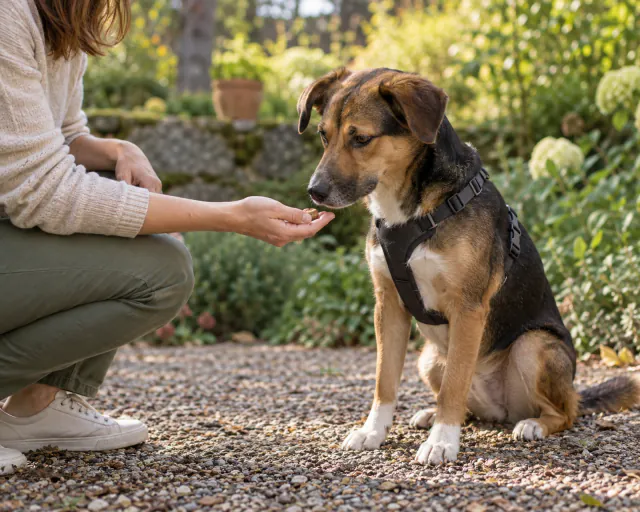
Food works. It is fast, it produces high repetition rates in a short session, and it carries very little emotional fallout compared with most alternatives. None of that is in question, and this article is not an argument for replacing food with corrections. The argument is narrower and more common in practice: presenting food to a dog is not automatically the same thing as running a training plan, and a lot of stalled training comes from treating the treat pouch as the entire method rather than one part of one.
Owners who feel their dog “knows sit but won’t do it outside” or “used to be food motivated and now ignores treats” are usually not describing a food problem. They are describing the gap between what food is good at and what it cannot do on its own, and closing that gap needs a slightly more structured view of what a lure, a marker and a reward are each actually for.
Why food earns its place in almost every programme
Food is a primary reinforcer that most dogs will work for without any prior conditioning, it can be delivered in a fraction of a second, and it allows dozens of repetitions in a two-minute session without the dog losing enthusiasm the way it might with a single big toy reward. Because delivery is quick and low-stakes, mistakes cost very little: a mistimed treat rarely damages anything, where a mistimed correction can. For teaching new behaviours, building engagement in a young or nervous dog, and running the kind of high-repetition sessions that produce reliable learning, food is genuinely hard to beat.
None of this means food should remain a permanent lure for every behaviour indefinitely. A behaviour still dependent on a visible piece of food in the handler’s hand months after it was first taught has not become reliable; it has become dependent on a prompt that will not always be available, particularly in the exact moments, a dog bolting towards a road or fixating on another dog, when reliability actually matters.
Three different jobs: luring, marking and rewarding
These three get run together constantly, and separating them clarifies most confusion about “using food properly.”
Luring shows the dog what to do. It is a physical prompt, usually food held where the dog can see and follow it, used before the dog has any idea what movement earns reinforcement. It belongs at the very start of teaching a new behaviour and should be phased out within a small number of repetitions once the dog is offering the movement on its own.
Marking is a signal, a word such as “yes” or a clicker, delivered at the exact instant the correct behaviour happens, that tells the dog precisely what was correct before the reward itself arrives. Marking solves a timing problem: food delivery always lags slightly behind the moment worth reinforcing, and the marker bridges that gap so the dog knows what it was paid for.
Rewarding is the consequence that follows the mark, whatever it happens to be, food included. It is what makes the marked behaviour more likely to happen again. A programme that lures constantly but never marks and never fades the lure has confused prompting with teaching; a programme that marks and rewards precisely but never uses a lure to introduce brand-new behaviour has simply chosen a different, often slower, way to start.
When a dog stops taking food, that is information, not failure
A dog that ignores food around a strong enough distraction, or once arousal has climbed high enough, is not being stubborn and is not proof the owner has done something wrong. It is information about where the current training’s limits sit. A highly aroused or fixated dog is not in a state to process a treat as a meaningful offer; the nervous system priority in that moment is the trigger, not the food, and no amount of higher-value treat closes that gap by itself. Recognising this changes what the next step should be: not a better treat, but less distance to the trigger, a lower baseline arousal before the session even starts, or physical removal from the situation to reset before trying again. Treating a refused treat as a training failure, rather than as feedback about criteria set too high for the environment, is one of the most common ways owners get stuck.
Environment and distance change what is achievable
The same dog that sits instantly in the kitchen and completely ignores the cue at the park has not forgotten anything. Distance from a distraction, the specific environment, and how aroused the dog already is when the cue is given all change what is achievable in that particular session. A sensible session plan works this out deliberately rather than assuming a behaviour that is solid at home should simply transfer. Practical steps include starting further from whatever is competing for attention, at a quieter time of day, and only reducing that distance once the easier version is consistently reliable, in line with the general approach in teaching a dog to settle and teaching reliable recall, both of which depend on exactly this kind of staged difficulty.
Physical or spatial guidance is not the same as punishment
Within an agreed training system, clear physical or spatial guidance, a body block that closes off a doorway, stepping into a dog’s space to interrupt a rush towards a gate, or guiding pressure on a well-fitted harness to redirect a dog’s direction, can be used alongside rewards without being a punishment. The distinction is what the guidance is for: it shapes or redirects the dog towards a position or direction, it does not apply an unpleasant consequence intended to suppress the behaviour. A body block that stops a dog surging through a door, followed immediately by rewarding the dog once it is calmly behind the threshold, is guidance connected to a reward, not a correction. The behaviour that results from a prompt or guidance should still be marked and rewarded exactly as if the dog had offered it independently; the presence of help does not make the correct outcome less worth reinforcing, particularly early in teaching.
Fade the prompt deliberately, or the dog never actually learns the cue
Every kind of prompt, a food lure, a hand signal, a physical guide, needs a deliberate, planned reduction over time, not an assumption that it will disappear on its own. A practical fading sequence looks something like: full lure, then a lure that becomes an empty hand gesture in the same motion, then a verbal cue given before any hand movement, with a reward still following every correct response throughout. Skipping this step is why some dogs appear to “know” a cue for years while never actually responding to the word alone; what they have learned is to watch the hand or the pocket, not to understand the instruction. A dog that only performs when it can see the food in your hand has learned to watch your hand, not to understand the cue, and that difference matters most exactly when reliability is needed and no treat is visible.
The goal is understanding, not visible dependence on the hand
The purpose of a food-based teaching phase is to arrive at a dog that understands a cue and performs it reliably in a range of conditions, with intermittent reinforcement maintaining the behaviour long term rather than a treat visibly present every single time. This is not an argument that corrections should replace food, and it is not a claim that reward-based methods fail; it is an argument against mistaking food presentation, on its own, for a complete plan. A complete plan includes deliberate fading of prompts, attention to environment and arousal, honest reading of when a dog is not in a state to respond to food at all, and the structural pieces, consistent expectations, appropriate management, proportionate correction where genuinely needed, covered in more depth in structure, boundaries, rewards and correction. For the underlying distinction between force-free, reward-based and balanced philosophies that this article assumes, see definitions without marketing spin.