A dog that will not take a treat is not automatically stubborn, and a dog that will not respond to a cue it “knows” at home is not automatically confused or being difficult. Both situations get labelled disengagement, and both tend to receive the same well-meaning but incomplete advice: try a better treat. Sometimes that genuinely resolves it. Often it does not, and repeating the offer while the dog gets more aroused, more fixated on something else, or further from the handler teaches nothing except that food keeps arriving regardless of what the dog does.
Disengagement has several distinct causes, and they call for different responses. Working out which one is actually in front of you, rather than assuming food value is always the missing ingredient, is the difference between training that progresses over weeks and a routine that looks identical after months of repeated sessions.
Work out what is actually happening before changing anything
Before changing the food, the cue or the environment, take stock of what is genuinely going on. Several factors commonly overlap:
Environmental distraction is the most visible cause: another dog, a jogger, food dropped by a child, wildlife. The dog’s attention has a limited budget and something else is currently spending it.
Arousal level matters independently of what is causing it. A dog can be over-aroused with excitement (about to greet a friend) or over-aroused with alarm (a delivery van reversing), and in both states the part of the nervous system handling food evaluation is not the part currently in charge.
Actual motivation for that specific food or toy right now is worth checking honestly. A dog fed shortly before a walk, a dog overheated on a warm day, or a dog that has simply had the same dry treat offered forty times this month may have little interest in it regardless of distraction or arousal.
Whether the cue was ever reliably trained, as opposed to assumed learned, is often the real answer. A behaviour practised a handful of times in one room of the house has not been taught to a criterion that holds up anywhere else; it has been demonstrated once, and owners regularly mistake early success for finished learning.
Distance from whatever is competing for attention changes what is achievable in that moment, independent of any of the above. The same dog and the same treat can look completely different at ten metres from a distraction and at two.
The reward’s value only matters relative to what else is on offer
Food value is not a fixed number stamped on a treat. It only means anything set against what else is currently available to the dog, which trainers usually call competing reinforcement. A piece of cheese is a strong reward in a quiet kitchen and a weak one against a squirrel breaking cover fifteen metres away. The dog has not become less food motivated between those two moments; the competition has simply changed.
This is also where general exercise and outlet matter. A dog getting too little opportunity to run, sniff and settle tends to arrive at training sessions carrying arousal that has nowhere else to go, which makes almost any competing stimulus harder to out-value with food. The Dog Exercise Planner is a reasonable starting point for checking whether a dog’s baseline arousal is being set up for failure before a session even begins.
Handler timing, body position and lead handling change what the dog can do
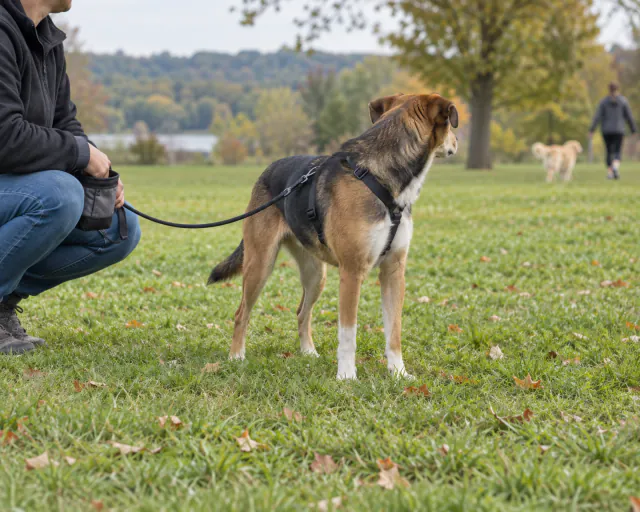
Some disengagement is not about the dog at all. A late marker, delivered a second after the correct moment rather than at it, tells the dog something different from what the handler intended, and enough of that mistiming looks exactly like a dog ignoring cues it has, in fact, understood correctly. Standing square in front of a dog, blocking its view of the handler’s hand, or holding a lead too high and too tight so that constant pressure sits on the harness or collar, all interfere with a dog’s ability to respond even when it is willing to. Loose lead handling, discussed in more detail in how to stop a dog pulling on the lead, and clear, consistent body position are not decorative details. They are part of the communication, and a dog that cannot read a confusing signal is not disengaged, it is receiving unclear information.
Physical guidance is a legitimate tool, used within an agreed method
Within a training method the handler has chosen and is applying consistently, physical guidance, a hand gently steering a dog’s chest into a sit, gentle lead pressure guiding a dog back towards a heel position, a body block closing off an unwanted path, is one legitimate tool among several. It is not the same thing as punishment. The distinction is in what the guidance is for: it helps the dog arrive at the correct position or direction, it does not apply an unpleasant consequence intended to suppress a behaviour. Handlers who feel physical guidance is somehow cheating, or purely a fallback for balanced training, are drawing a line that does not reflect how most competent reward-based training is actually taught.
What matters is that guidance reduces over repetition. A dog steered into position on the first ten repetitions and still being steered on the hundredth has not been taught the behaviour, it has been physically moved through it repeatedly. See moving from food lures to reliable verbal cues for the practical fading sequence that applies equally to a lure and to physical guidance.
Mark and reward the behaviour, even when help was needed to get there
When a prompt or physical guidance helps a dog reach the correct position, the resulting behaviour should still be marked and rewarded, exactly as if the dog had offered it independently. Withholding the reward because “the dog did not do it alone” punishes the outcome rather than shaping the process, and it slows learning rather than speeding it up. Early in teaching a new behaviour, almost every correct repetition involves some form of prompt. The reward is what builds the association between the position and the pay-off; the prompt is simply how the dog got there while the picture was still being learned.
Recognise when the environment itself is not right for learning
Some sessions should not be pushed through. A car park at school pick-up time, a beach on a bank holiday, or any setting where a dog is already well past the arousal level it can function at, is not the moment to raise criteria, offer better treats or repeat a cue more insistently. The correct response is to reduce difficulty, moving further away, choosing a quieter time, or shortening the session, or to simply leave and try again somewhere calmer. This is not giving up. A dog cannot learn effectively while its nervous system is fully occupied by something else, and treating every refusal as a training failure to be pushed through, rather than as information about a session set up badly for the conditions, is one of the most common ways progress stalls.
Immediate control and teaching reliable behaviour are different goals
It is worth keeping two separate goals clearly apart, because conflating them causes a great deal of confusion. Immediate control, stopping a dog jumping up, pulling towards a road, or barrelling towards another dog right now, can often be achieved with management or a well-timed interruption. That stops the behaviour in the moment. It does not, on its own, teach the dog a reliable alternative for next time. Teaching reliable behaviour, a dog that sits calmly at the door, walks past distractions on a loose lead, or comes back on the first cue, takes structured, repeated practice over time, built the way described in teaching reliable recall and in the beginner focus and attention lessons. An owner who achieves control today and assumes the dog has therefore learned something durable is usually disappointed the next time the same situation arises.
When to change the plan, not repeat it
If the same approach has failed several sessions in a row in broadly similar conditions, repeating it again with slightly more patience is rarely the answer. That is the point to step back and reconsider the whole plan: is the criterion too high for this stage, is the environment consistently too difficult, has the cue actually been taught to the standard being assumed, or has the dog’s arousal baseline simply not been addressed. For a young, naturally biddable dog this recalibration is often straightforward. For a large, powerful, highly driven or already behaviourally established dog, or one showing signs that go beyond ordinary distraction, a qualified trainer working with the dog in person, rather than a generic article, is the appropriate next step. See reward-based, force-free and balanced training: definitions and structure, boundaries, rewards and correction for the wider framework this fits into.