- Session length
- 5 to 10 minutes, once or twice a day
- Skill
- Loose-lead walking
- Suits
- Any age
What you need
- A well-fitted Y-shaped harness, ideally with a front chest ring as well as a back ring
- A fixed lead of about two metres (six feet), or a double-ended lead
- Soft food rewards the dog values more than ordinary kibble, cut small
- A treat pouch you can open with one hand
A dog who walks beautifully on an empty street has learned where to be. A dog who holds that position while a cyclist passes, a jogger overtakes and another dog crosses the far side of a field has learned that the position still pays when the world is interesting. This lesson closes that gap by treating every distraction as something you can measure and control, then raising difficulty in small, deliberate steps.
Purpose
By the end of this lesson the dog should walk past a person, a cyclist and a calm dog on a slack lead, at a distance you chose in advance, with the food still working. The goal is not a dog who ignores everything. It is a dog who notices, checks back with you and carries on, because that has been paid far more often than leaning towards the distraction ever was.
Prerequisites
- Twenty slack-lead paces on a quiet street, four times out of five, from the beginner loose lead walking lesson.
- A U-turn cue the dog follows willingly when something appears ahead.
- A dog who will still eat outdoors when another dog or person is visible at a distance. If food stops working the moment anything appears, stay at beginner level for longer.
Equipment
A Y-shaped harness with a front ring gives you gentle steering without pressure on the throat, and a back ring for ordinary walking. Our guide to no-pull harnesses compares front-ring designs and explains what they can and cannot do. A fixed lead of about two metres (six feet) gives the dog room to move without the constant tension of a retractable lead. Carry better food than usual, because a busier place costs the dog more attention, and wear a pouch you can open with one hand while the other holds the lead.
Method
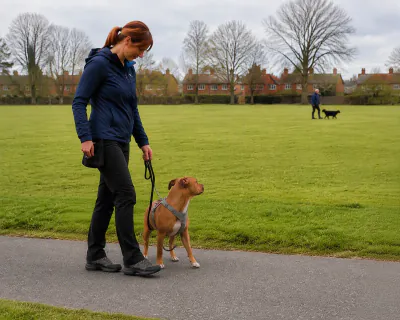
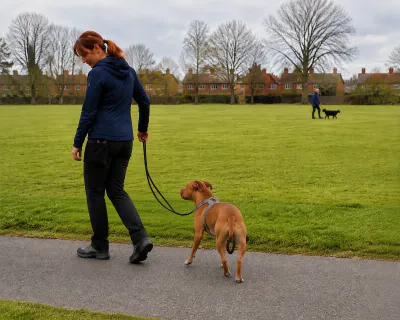
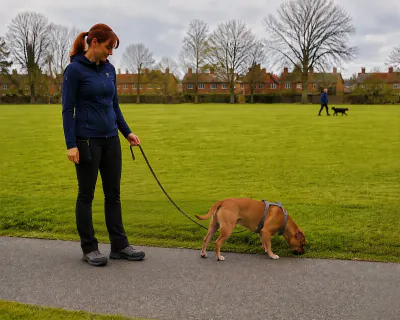
- Choose a place where distractions appear at a predictable distance, such as the edge of a playing field where people walk on the far side, or a wide path with a verge. Avoid narrow pavements for the first sessions, because you cannot choose the distance there.
- Walk the dog on the far edge of the space. Note where the dog first notices a distraction. That point is your working distance.
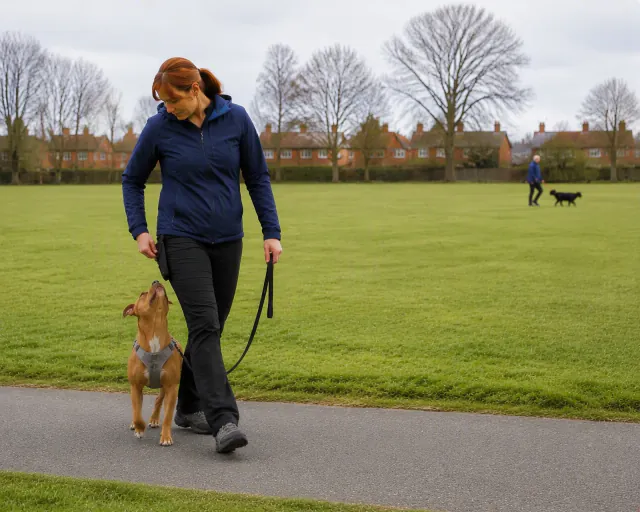
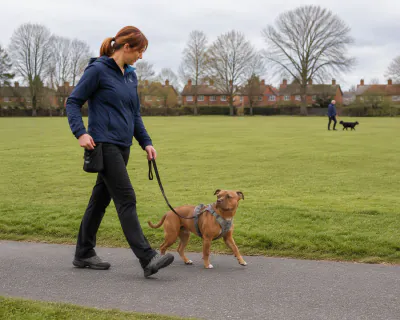
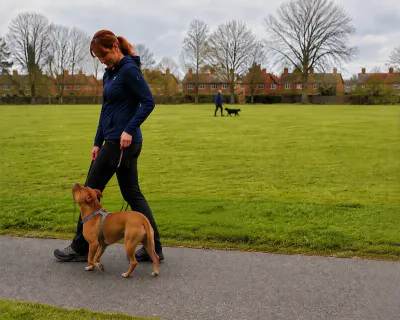
- At that distance, walk on and pay at the seam of your trousers every three to five paces while the lead is slack. Pay more often, not less, when something moves in the distance.
- When the dog looks at the distraction and then back at you, mark it and pay. Looking is information gathering, not disobedience. The turn back towards you is the behaviour you are building.
- Keep duration and distraction the same and change distance only. Move a few metres closer over several repetitions. If the dog stops eating, or the lead tightens twice in a row, move back to the last distance that worked.
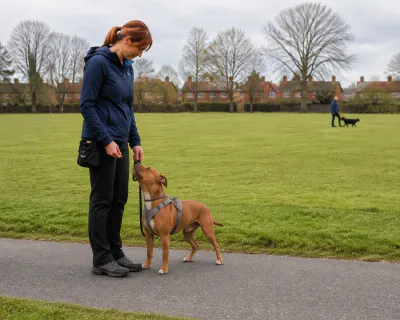
- If the lead goes tight towards the distraction, use your U-turn cue and walk calmly away. Pay the dog for catching up at your leg, then approach again from slightly further out.
- When you pass, keep your body between the dog and the distraction. Walk at an ordinary pace, keep paying at your leg, and do not stop to let the dog stare.
- After the distraction is behind you, give your release cue and let the dog sniff. A good pass followed by freedom teaches the dog that walking nicely is how interesting things happen.
- Once passing holds at a moderate distance, change the type of distraction rather than the distance. A person walking is easiest for most dogs, then a jogger, then a cyclist, then a calm dog on lead. Start each new type back at a comfortable distance.
- Finally, extend duration by walking longer stretches between rewards past familiar distractions, while keeping distance and type unchanged.
Session length
Five to ten minutes, once or twice a day, is plenty. Busy places are tiring, and a dog who has spent ten minutes working hard around distraction has done more than it looks. Finish with a sniff or a relaxed walk home, and keep some walks free of any training at all.
Progression criteria
Move on when the dog passes each distraction type on a slack lead, four times out of five, at your chosen distance, across three sessions in two different places. Count a pass as failed if the lead tightens at any point while the distraction is in view. When a distance holds reliably, you can close it a little, but change one thing at a time.
Common mistakes
Moving closer because the dog did well once is the most common mistake. Distance should shrink over sessions, not within a single good minute. Stopping the food as soon as the dog is doing well removes the reason the dog is doing well, so keep paying past distractions for months. Letting the dog stare at another dog while you wait for it to settle usually raises arousal rather than lowering it. Walking the same route at the same time every day can also mean the dog only learns to pass the same three people.
Troubleshooting
If the dog passes people well but pulls towards dogs, treat dogs as a separate distraction and start again at a much greater distance. If the dog copes well early in a walk and falls apart later, the problem is cumulative, so read our guide to preventing trigger stacking and keep sessions shorter. If the dog stops eating entirely, you are too close or the place is too busy, and the right response is more distance, not better food. Strong, powerful dogs are harder to hold on a busy path, so practise the U-turn until it is automatic before you rely on it near roads.
Safety and when to stop
Stop and reconsider if the dog lunges, barks, growls, freezes, hides behind you or tries to leave. Those are emotional responses, not lead manners, and working through them at close range can make them worse. The right next step is a qualified behaviourist working alongside your vet, who can assess the individual dog. Stop too if the dog is lame, stiff or suddenly reluctant to walk, and speak to your vet. Never practise near livestock, and check local rules on lead use and shared paths before training in a new area.
Next lesson
Continue with stop at a distance, which takes the same idea of building a skill from close range outwards and applies it to a down the dog can hold far from your side.
Useful tool
The dog harness size helper takes you through the measurements that decide whether a harness sits clear of the shoulder, which matters here because a harness that rubs or slips will make a dog less settled around distractions.