- Session length
- 2 to 3 minutes, two or three times a day
- Skill
- Impulse control
- Suits
- Puppy
What you need
- Small soft food for rewarding the wait
- An internal door in a quiet part of the home, such as a bedroom or a hallway door
- A lead, for later repetitions at doors that lead outside
A door that opens the moment a puppy leans on it teaches the puppy that pushing works. This lesson teaches the opposite, that a door opens only once the puppy is calm and waiting, and it is worth doing well before it becomes urgent. Beyond manners, a puppy who waits at doors is a puppy who is far less likely to bolt through a gap into a road, a car park or a stairwell, which makes this one of the more safety-relevant skills in the early pathway.
Purpose
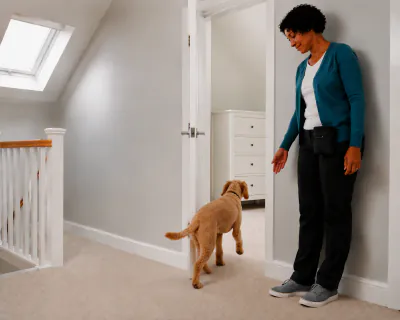
To teach your puppy to stop and hold position at a doorway until you release them, rather than pushing through as soon as there is a gap. The finished behaviour is a puppy who sits or stands calmly at a door while it opens, and who moves through only on a clear release word, not on their own judgement of when the wait is over.
Prerequisites
Your puppy already holds a brief sit on request and has had some practice with leave it, since waiting at a door is really leave it applied to an opening gap rather than an object. If your puppy cannot yet hold a sit for two or three seconds in a quiet room, spend more time on that lesson first, since this one builds directly on it.
Equipment
Work at an internal door somewhere quiet, such as a bedroom door or an interior hallway door, where nothing exciting waits on the other side. Small, soft food kept ready in a pocket or pouch lets you reward quickly without fumbling. Once you move to doors that lead outside, add a lead, so a puppy who breaks the wait cannot get further than the end of it.
Method
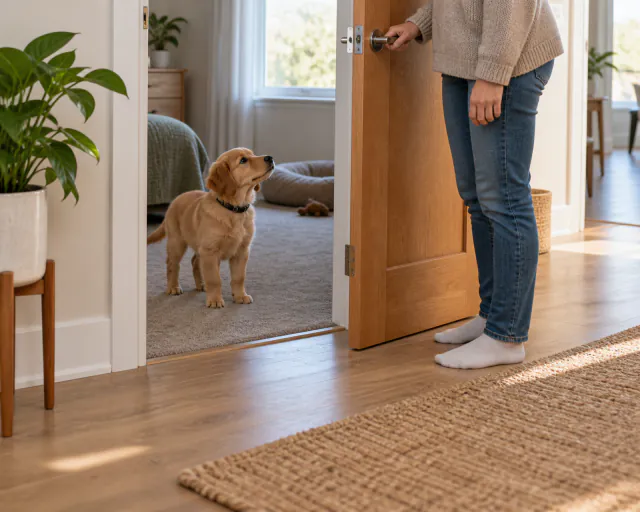
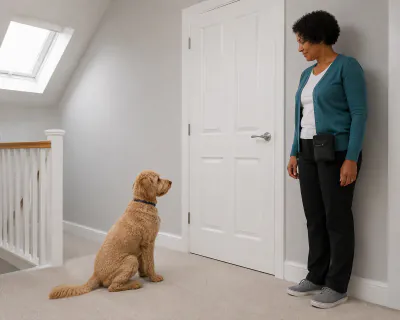
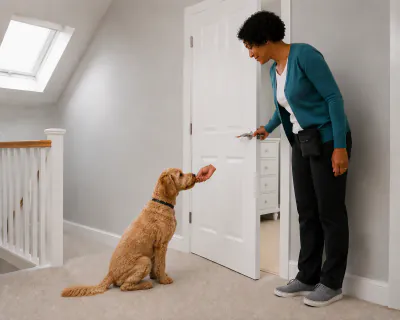
- Ask your puppy to sit facing the closed door, with you standing beside the door rather than between the puppy and it.
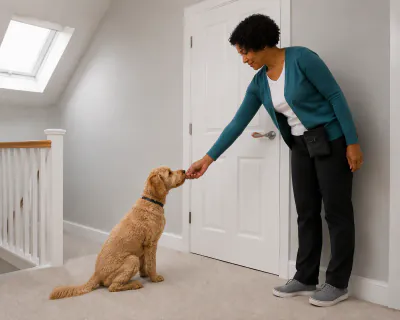
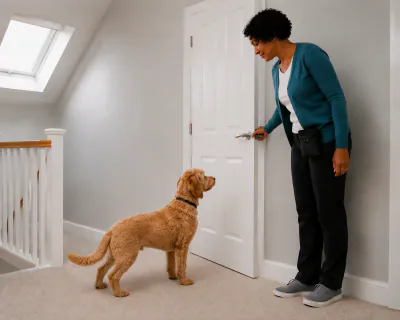
- Reach for the handle. If the puppy stays sitting, reward. If they get up, simply remove your hand from the handle and ask for the sit again before trying once more.
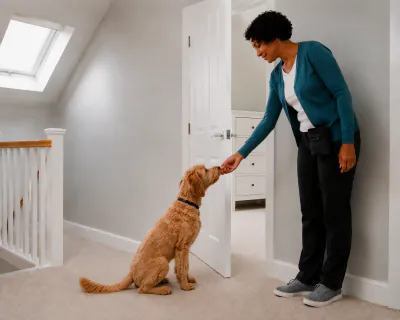
- Once your puppy holds the sit while you touch the handle, open the door a crack. Reward for staying seated with the door open a few centimetres.
- If the puppy moves towards the gap, close the door gently and start again from the sit. The door only opens further when the puppy is still.
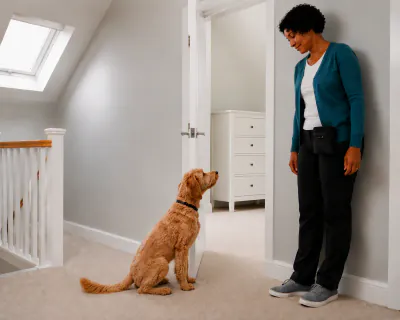
- Gradually open the door wider across repeated attempts, rewarding the puppy for holding position at each new width.
- Once the door is fully open and the puppy is still waiting, release with a clear word such as okay, and let them walk through calmly.
- Repeat at two or three different internal doors around the home before trying an exterior door, always on a lead outdoors and always in a securely enclosed area to begin with.
- Build up gradually to doors used more often, such as the kitchen door to the garden, before ever testing the behaviour at a front door or a door near traffic.
Session length
Two to three minutes, two or three times a day, worked into normal trips through the house rather than as a separate block of training. Five or six doorway repetitions is plenty for one session.
Progression criteria
Move on when your puppy holds a sit at a fully open internal door for three seconds without moving, until released, on eight out of ten attempts across three separate sessions on different days. Then raise the difficulty one variable at a time: extend how long the puppy waits before release, then practise at a door used more frequently, and only later ask for a wait at an exterior door with genuine distraction on the other side, such as a person walking past.
Common mistakes
Opening the door anyway when the puppy gets up teaches that pushing eventually works, even if it takes a moment longer. Standing between the puppy and the door turns this into a physical block rather than a taught behaviour, and the puppy never learns to control themselves without you in the way. Releasing the puppy with no clear word leaves them guessing when the wait ends, so they start guessing early. Practising only at doors the puppy finds boring means the skill has never been tested where it actually matters, such as the front door or the car boot.
Troubleshooting
If the puppy gets up the instant your hand touches the handle, you have moved a step too fast; go back to rewarding stillness with your hand resting on the door frame instead, and rebuild from there. If the puppy holds the sit but scrambles up the moment the door opens, slow down how far you open it each time and reward more often at each small increment. If a puppy is reliable at a bedroom door but falls apart at the door to the garden, that is expected, since the reward waiting on the other side has changed; treat it as a new door and start the sequence again from the beginning rather than assuming the puppy is being deliberately difficult.
Safety and when to stop
Never trial this behaviour for the first time at a front door, a door onto a driveway, or any door near a road; build it up gradually at low-stakes internal doors first. Keep your puppy on a lead at any exterior door until the wait is thoroughly reliable, since a young puppy who slips through a gap onto a road is a serious hazard regardless of how good their training generally is. Stop the session if the puppy becomes frantic, barks at the door, or starts scratching at it, since this points to over-arousal rather than confusion, and a short break will do more good than another attempt. If your puppy shows persistent anxiety around doors, such as trying to escape through them repeatedly or showing signs of distress when confined, speak to your vet or a qualified behaviourist.
Next lesson
With a reliable wait at doors, move on to your puppy’s first recall, which asks your puppy to come back through open space rather than simply hold still.
Useful tool
If doorways are the moment your puppy struggles most to settle, it is worth reviewing your daily routine with the dog exercise planner, since a puppy who is short of appropriate outlets during the day is often the one most desperate to burst through every open door.