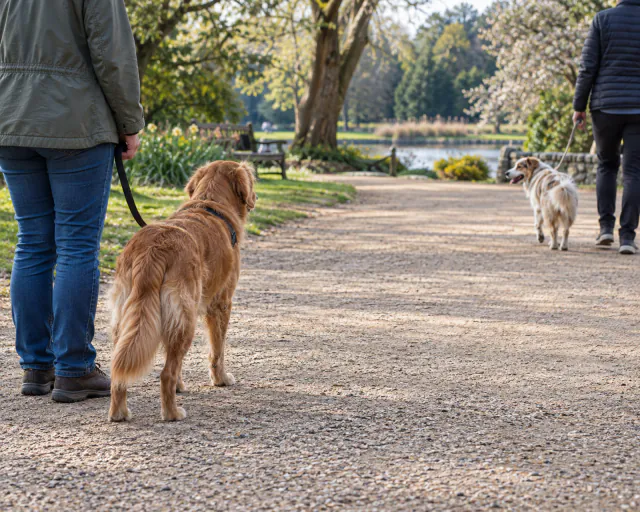
Most dogs pass dozens of unfamiliar dogs in an ordinary week without any deliberate introduction taking place: another dog crossing the same field at a distance, one tied up outside a shop, two dogs approaching each other on a narrow path. None of these are the planned, controlled meetings covered in the guide to introducing dogs safely, which deals with a new dog joining a household or two dogs who will actually be spending time together. This guide is about something more everyday: how comfortable your dog is with unfamiliar dogs simply existing nearby, in passing, with no expectation that anything happens between them at all.
It covers working out your own dog’s comfortable distance and respecting it, using distance and the environment proactively rather than only reacting once a response has already started, being willing to advocate for your dog’s space when another owner is not managing things sensibly, rewarding calm at a distance your dog can genuinely manage, and telling a dog who is simply uninterested in other dogs apart from one who is fearful or reactive around them, since those need a different, more specific approach.
Work out your dog’s comfortable distance
Every dog has a distance from an unfamiliar dog at which they can stay relaxed, and a point closer than that where tension starts to build. This distance is not fixed. It changes with the individual dog approaching, the environment, how fast the other dog is moving, whether it is on or off a lead, and how your own dog is feeling that day. A dog who copes fine with another dog crossing calmly at twenty metres in an open field may struggle with the same distance on a narrow towpath, where there is less room to move and no obvious way to increase the gap.
Watching your dog’s body language, rather than assuming a fixed number of metres, is the more reliable guide. A loose, relaxed body, a brief glance towards the other dog followed by disengagement, and a willingness to keep taking food or carrying on with the walk are all signs your dog is comfortable at the current distance. A stiffening body, a hard stare, ears pricked fully forward, a raised tail, or refusal of food they would normally take are early signs that the distance is too close for this particular encounter. The guide to understanding canine body language covers these signals in more detail and is worth reading so you can catch the early, subtle signs rather than only the obvious ones.
The point of working this out is not to fix your dog’s comfortable distance as a permanent limit but to respect it in the moment rather than assuming that closer is always fine, or that a dog “should” be more sociable than they currently are. Repeatedly pushing a dog past a distance they can manage, on the assumption that they will simply get used to it, is far more likely to build a negative association than to build confidence.
Use distance and the environment proactively
The most effective tool here is acting before a response starts, not after. Once a dog has already begun barking, lunging, or freezing, you are managing an active response rather than preventing one, which is harder and less pleasant for everyone involved. Watching ahead on a walk and noticing an approaching dog while it is still well within your dog’s comfortable range gives you time to act calmly rather than reactively.
Practical options include crossing the road, turning down a side street, stepping behind a parked car or a hedge to break the line of sight, choosing a wider path or verge instead of continuing on a narrow one, or doing an unhurried U-turn. None of these need to be dramatic or obvious to be effective. Choosing quieter walking times and quieter routes in the first place, particularly while you are still working out your dog’s comfortable distance, reduces how often you need to manage a close encounter at all. A well-fitted, secure harness and a sturdy lead also matter here, since good physical control during a walk makes it easier to act early and calmly rather than being caught off guard by a sudden pull.
Advocate for your dog’s space
Not every dog owner, and not every off-lead dog, will manage an approaching encounter sensibly. Some owners assume all dogs want to greet each other, some are not watching their dog closely enough to call them back promptly, and an off-lead dog can close a gap far faster than its owner expects. Waiting for another owner to notice and act is not always a safe strategy, and it is entirely reasonable to advocate for your own dog’s space directly.
This can mean calmly asking another owner to call their dog back or keep it on lead as they approach, stepping away and putting distance between the dogs yourself rather than waiting to see what happens, or using a visual signal where a local convention exists, such as a coloured lead sleeve, bandana or “give me space” tag used in some countries and communities to indicate a dog needs room. These signals are useful where they are recognised locally, but they are not universal and should not be relied upon as a substitute for actively managing the encounter yourself, since many owners will not know what the signal means. Speaking up in the moment can feel awkward, but it is a reasonable and often necessary part of managing your dog’s welfare and safety, and most owners respond sensibly when asked directly and calmly.
Reward calm behaviour at a distance your dog can manage
Once you know roughly what distance your dog can cope with, use it deliberately. Reward calm noticing of another dog while your dog is at ease, comfortable, and still willing to engage with you, rather than waiting for a reaction to manage. This might mean feeding a few pieces of food in a row as another dog passes at a safe distance, or praising your dog for a brief, relaxed glance followed by returning attention to you.
Reducing the working distance over time should happen gradually and only when your dog is genuinely, consistently comfortable at the current one, never as a test to see how close is “too close.” Treating a closer encounter as an experiment to find your dog’s limit risks a bad experience that can set progress back considerably. Small, repeated, comfortable successes at a manageable distance build a much more reliable pattern than occasional pushes towards a harder one.
Disinterest is not a problem to fix
Some dogs are simply not that interested in other dogs, and this is a perfectly normal temperament rather than something that needs correcting. A dog who glances briefly at another dog, shows no tension in their body, and carries on with the walk without any particular engagement is not missing out on anything and does not need to be encouraged to be more sociable. Not every dog wants, or needs, a wide circle of dog friends.
This is different from a dog who is fearful or reactive around unfamiliar dogs. Fear tends to show as avoidance, freezing, attempts to increase distance, or signs of significant stress such as trembling or excessive panting, covered in more detail in the guide to fearful behaviour. Reactivity tends to show as an exaggerated response once a dog notices a trigger, commonly barking, lunging or spinning on the lead, covered in the guide to reactivity: what it is and what to do. Both of these need the more specific, graded approach described in those guides rather than the general everyday habits covered here. The guide to nervous, fearful, reactive or aggressive is a useful starting point for telling these presentations apart before deciding which approach actually fits your dog.
Rules and etiquette vary by country and location
Off-lead dog etiquette, the legal definition of a dog “under control,” and recall requirements in shared or public spaces all vary considerably between countries and even between local authorities within the same country. Some places require dogs to be on lead near livestock, in certain parks, or during specific seasons such as ground-nesting bird season, and some have specific legal consequences for a dog that approaches or worries another animal or person regardless of intent. It is worth knowing the specific rules that apply where you actually walk your dog rather than assuming a general standard applies everywhere, since both the etiquette and the law can differ significantly from one location to the next.
When to look further
If your dog’s response to unfamiliar dogs is more than everyday preference, if it involves clear fear, escalating reactivity, or any risk of aggression towards another dog, this moves beyond what everyday management can safely resolve on its own. The guide on when to contact a qualified dog behaviour professional covers the situations that call for individual assessment rather than continued general management, and getting that input sooner rather than later tends to produce a better outcome for the dog.