Whether you are bringing a new dog or puppy into a home with a resident dog, or your dog is meeting another one on a walk, the first few minutes and the first few weeks both matter more than most people expect. A calm first meeting does not guarantee a smooth relationship, and a slightly awkward one does not doom it, but the way an introduction is handled has a real effect on how quickly, and how safely, two dogs settle around each other.
This guide covers the general principles that apply to both situations: bringing a new dog into an existing household, and dogs meeting out and about, along with what to watch for during and after, and when to slow down or bring in professional help rather than assuming things will sort themselves out.
Start on neutral ground where you can
Dogs are more likely to feel territorial or defensive on ground they consider their own, so a first meeting on neutral territory generally goes better than one where a resident dog has to greet a newcomer in their own home, garden or car. For a new dog joining the household, this can mean a short introductory walk in a local park or quiet street before either dog goes near the house, rather than opening the front door and letting them meet in the hallway.
This is a general principle rather than an absolute rule, and it is not always practical, particularly with a young puppy who cannot yet go out safely, or in situations where a neutral outdoor meeting cannot be arranged. Where a home introduction is unavoidable, keep the first few minutes especially calm and structured, using the steps below, and expect to move more gradually.
For two dogs meeting on a walk, whether that is a planned introduction between dogs who will be spending time together, or simply an unplanned encounter with another dog and owner, the same underlying principle holds: a bit of open space rather than a narrow path, a gate, or a doorway gives both dogs room to choose their own distance rather than feeling boxed in.
Parallel walking before a close greeting
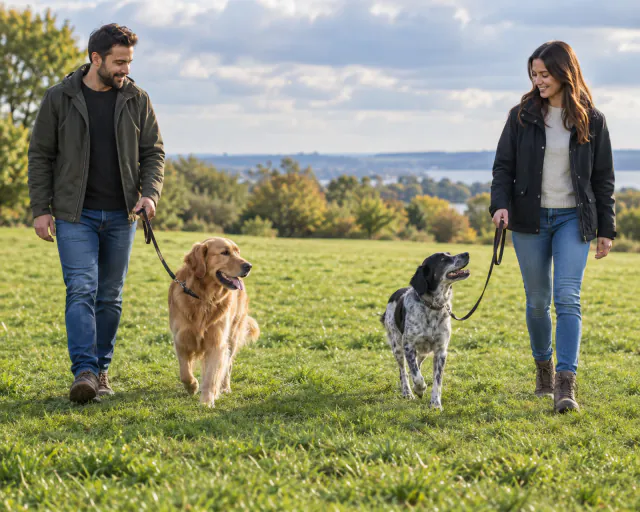
Rather than walking two dogs straight towards each other for a nose-to-nose meeting, which can feel confrontational even between dogs who would get on fine, start with both dogs walking in the same direction at a distance neither finds worrying, ideally with a handler each. Gradually close the gap over the course of the walk if both dogs seem loose and relaxed, checking in with their body language regularly rather than watching the road ahead.
This parallel approach lets dogs get used to each other’s presence and scent without the pressure of a direct, close introduction from the first moment. It works well both for a new household dog meeting the resident dog for the first time, and for two dogs who will be seeing more of each other, such as new neighbours or a friend’s dog.
Keep the actual greeting short
When you do let the dogs meet directly, keep it brief, ideally under thirty seconds for a first close greeting, and separate them calmly before either dog has a chance to become overwhelmed, over-excited or defensive. A long, hovering greeting where both owners stand and watch and hope for the best often outlasts what either dog is actually comfortable with, and tension tends to build the longer it goes on.
Use loose leads rather than tight ones, since a tight lead restricts a dog’s ability to move away or turn side-on, which are both normal and useful calming signals between dogs, and can make a dog feel trapped in a situation it would otherwise handle fine. Avoid greetings on lead in narrow spaces for the same reason. If both dogs seem comfortable after a short first greeting, you can let them interact a little longer, but keep checking in rather than assuming a good start means the rest will take care of itself.
Read body language throughout, not just at the start
The most useful skill in any introduction is reading what both dogs are actually communicating, not just watching whether tails are wagging. Loose, wiggly bodies, relaxed faces, play bows, and voluntary breaks in interaction are good signs. A stiff, still body, a hard stare, raised hackles, a tucked tail, lip curling, growling, or one dog repeatedly trying to move away while the other follows are all signs to intervene calmly and create distance. The guide to understanding canine body language covers these signals in detail and is worth reading before any planned introduction, since being able to spot early tension gives you the chance to separate calmly before anything escalates.
Manage the early days at home
Once a new dog has joined the household, treat the first few weeks as a settling-in period rather than assuming the relationship is fixed after one good meeting. Give each dog their own bed, bowls and favourite toys, especially early on, since sharing resources before a relationship is established is a common source of tension. Feed separately, at a distance or in separate rooms, and pick up high-value chews and toys when you cannot actively supervise, since these are the items most likely to cause a squabble between otherwise friendly dogs.
Supervise all interactions closely for a good while, not just the first day. Many introductions go well at first and then produce tension a week or two in, once the novelty wears off and normal household competition for attention, space and resources begins. Separate the dogs with a stair gate, crate or different rooms whenever you cannot watch them directly, particularly overnight, until you are genuinely confident in how they interact unsupervised.
Give each dog individual time with you as well as time together, so that the new arrangement does not feel like a straightforward loss of attention for the resident dog. This matters just as much for two dogs who already live together and are adjusting to a change in the household, such as a foster dog, a returning family member’s dog, or a change in routine.
When an introduction is not going well
Some signs mean stop and rethink rather than pushing on and hoping it improves: repeated stiff, frozen postures from either dog, growling that does not stop with distance, snapping, one dog persistently avoiding or hiding from the other over several days, guarding of food, toys, people or resting spots, or an actual fight, even a brief one with no injury. Separate the dogs calmly rather than shouting or physically intervening between them, since pulling at a dog engaged in a scuffle carries a real risk of being bitten.
Rather than assuming dogs will “sort it out themselves,” which can allow a genuinely unsafe pattern to become established, slow the introduction right down, go back to parallel walks and separate resources, and get support from a qualified behaviourist if tension continues or if any actual aggression has occurred. This is especially important when a puppy is involved, since a frightening early experience with an adult dog can affect how that puppy responds to other dogs for a long time afterwards, and equally important when an adult dog with a known bite history is part of the introduction. A slower, professionally guided approach costs time but meaningfully reduces the risk of a bad outcome for either dog.