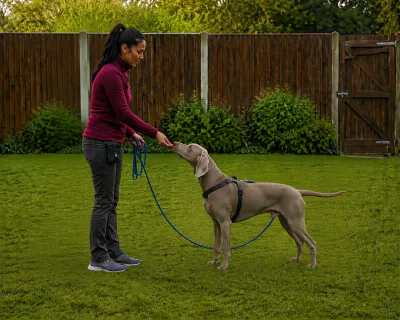
- Session length
- 3 to 5 minutes, once or twice a day
- Skill
- Impulse control
- Suits
- Any age
What you need
- A long line of five to ten metres (about sixteen to thirty three feet) attached to a well-fitted harness
- High value food rewards kept only for this exercise
- A secure, enclosed space such as a garden, enclosed field or empty hall
An emergency stop is a cue with one job: to freeze the dog in place immediately, regardless of what they are doing, because a moment’s hesitation matters near a road, close to livestock or in the second before another dog reaches yours. That single job is also why it takes patient, careful foundation work rather than a quick fix. A cue that only sometimes works in a real emergency is worse than no cue at all, because it invites false confidence.
Purpose
By the end of this lesson the dog should stop and hold still, close to you, on one cue, and begin to do the same after a few steps of movement on a long line in a secure space. That is a foundation, not a finished skill. Genuine reliability at distance, off lead and with real distractions present belongs to intermediate-level training, built over many further sessions in a wide range of places. Treat this lesson as laying the first, careful layer of something you will keep building for months before trusting it anywhere it might actually be needed for safety.
Prerequisites
- The U-turn cue already works reliably in a quiet setting, from the previous lesson, since both cues rely on the same calm, upbeat handling.
- The dog already holds still briefly on some cue, such as a sit or a wait used in recall practice, so the idea of stopping and staying put is not entirely new.
- Access to a secure, enclosed space where the dog cannot reach a road or another animal even if the cue fails completely.
Equipment
Use a long line of five to ten metres (about sixteen to thirty three feet) clipped to a well-fitted harness, so movement can be added safely once the stationary stage is solid. Reserve a genuinely high value food reward for this exercise alone, since an emergency stop needs to compete with whatever the dog would otherwise be doing, which is a higher bar than most everyday training. Work in an enclosed garden, secure field or an empty hall to begin with, somewhere a missed repetition carries no real risk.
Method
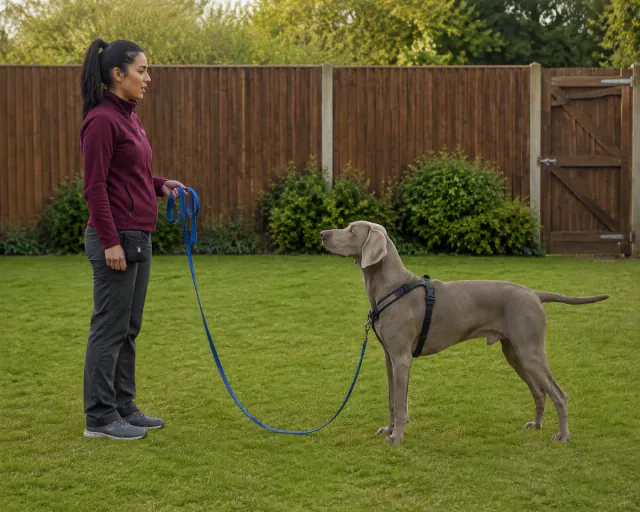
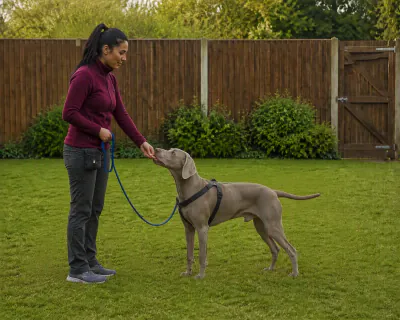
- Start with the dog standing or sitting close to you, no more than a metre (three feet) away, in a calm, familiar space.
- Choose a single, distinct word for this cue, different from any word already in use, and say it once in a clear, level voice.
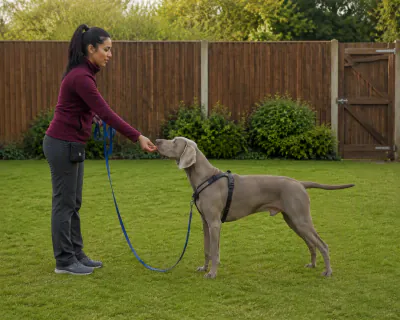
- The instant the dog is still after hearing the cue, even though they were already still to begin with, mark with a consistent word such as yes and reward generously. You are building the association between the word and stillness before you ever ask for a stop mid-movement.
- Repeat eight to ten times in a session, with the dog starting from a standing position each time so the stillness is genuinely being cued rather than simply continuing from a sit.
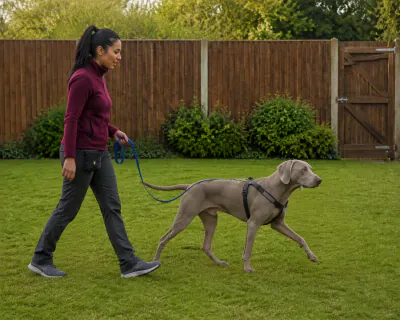
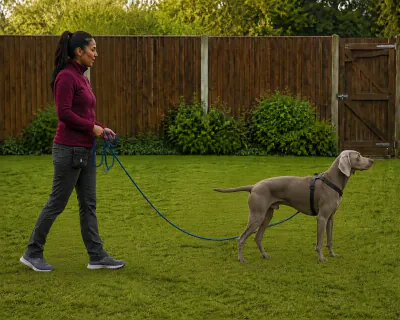
- Once the dog reliably freezes on the word from a standing start at close range, add a single step of movement. Walk the dog on the long line for one step, say the cue, and reward the moment all four feet stop.
- Extend duration first. Once one step is solid, ask for stillness for two or three seconds after the stop, rather than rewarding the instant the feet stop moving, before building to a few steps of movement before the cue.
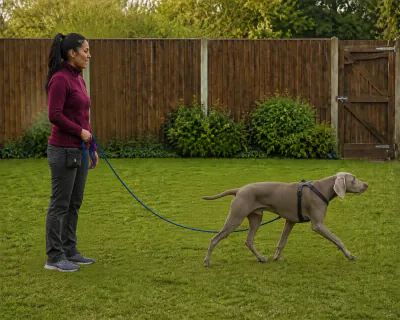
- Extend distance next, keeping the amount of movement modest. Let the dog range out to two or three metres (six to ten feet) on the long line, moving naturally, then say the cue once and reward a prompt stop, gathering slack calmly rather than reeling the dog in.
- Build distance gradually across many sessions, up to the full length of the long line, always in the same secure space, always rewarding heavily and immediately when the dog stops.
- Only once distance is solid on the long line in a familiar secure space should distraction be introduced, starting with something very mild such as a dropped object, and only ever in an enclosed area at this stage.
- Treat anything beyond this as intermediate work. A dog who reliably stops on a long line in an enclosed space with a mild distraction present has a genuine foundation, and that foundation needs substantial further proofing, ideally with guidance from a class or qualified trainer, before it is trusted off lead near real hazards.
Session length
Three to five minutes, once or twice a day, is enough. This exercise asks for a fast, precise response, and a tired or bored dog produces slower, less reliable stops, which teaches the opposite of what the cue needs to mean.
Progression criteria
Move on from the stationary stage when the dog freezes on one cue, from a standing start, nine times out of ten across three sessions. Move on from the single-step stage the same way before adding more movement. Count a repetition as failed if the dog needs the cue repeated, keeps moving for more than a stride, or turns to look at you rather than stopping outright. If you fall below nine out of ten, return to the previous, easier stage rather than pushing on. Once a stage is solid, raise difficulty in this order: duration of the stop, then distance from you when the cue is given, then distraction, one variable at a time.
Common mistakes
Testing the cue for the first time at real distance, off lead, or near an actual hazard is the most serious mistake possible with this lesson, since a single failure in that setting can be dangerous and also teaches the dog the cue can be ignored. Repeating the word when the dog does not stop immediately weakens it in the same way as any other cue, so say it once and manage the outcome with distance and the long line instead. Rewarding a slow, hesitant stop as though it were instant sets a low standard that will not hold up under real pressure later.
Troubleshooting
If the dog does not stop at all once movement is added, the jump from stationary to moving was too large, so go back to a single step and rebuild more gradually. If the dog stops but then immediately continues on their own, extend duration in very small increments, rewarding stillness of one extra second at a time. If reliability drops the moment you change location, treat the new space as a fresh start, beginning again from the stationary, close-range stage rather than assuming the skill will transfer automatically.
Safety and when to stop
Always practise this exercise in a secure, enclosed space at beginner level, never near a road, open water or livestock, since the cue is not yet proven and a failure in a genuinely dangerous setting has real consequences. If the dog seems fearful of the exercise itself, freezing with tucked tail and flattened ears rather than calm, attentive stillness, stop and reassess with a qualified behaviourist, since that response is not the relaxed stop you are aiming to build. Speak to your vet if the dog seems reluctant to move generally, since pain can affect willingness to walk, stop or change pace.
Next lesson
Continue with settle on cue, which takes the same idea of rewarding calm stillness and extends it into a longer, more relaxed behaviour.
Useful tool
The dog harness size helper is worth checking before this lesson, since a harness that shifts or rubs under the sudden movement of a long line stop can undermine the exercise and cause discomfort.