
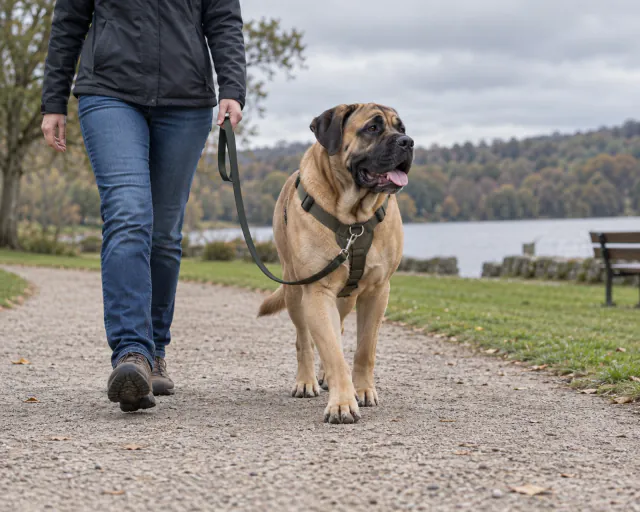
A small dog that pulls on the lead is an inconvenience. A large or powerful dog doing exactly the same thing can pull a person off their feet, drag them into a road, or become genuinely impossible to hold back at the moment it matters most. The behaviour is identical. The physical consequences are not, and that difference is the reason training and equipment decisions deserve more attention, not less, once a dog has real size or strength behind it.
None of this means every large dog is dangerous or that every powerful breed needs specialist handling. Plenty of large dogs are easy to manage because their early training was solid and consistent. But the margin for error is genuinely smaller, the physical stakes of a mistake are genuinely higher, and waiting to see whether a large puppy “grows out of” pulling, jumping or poor impulse control carries more risk than making the same bet with a dog that will always be light enough to hold back by hand.
Why size and strength change the calculus
A behaviour that is merely annoying in a small dog can be physically dangerous in a large one. A 10 kilogram (22 lb) dog that jumps up knocks a child over; a 40 kilogram (88 lb) dog that jumps up can injure an adult. A small dog that bolts after a squirrel gives a slight tug on the lead; a large, driven dog doing the same thing can dislocate a shoulder or pull a handler to the ground. This is not a claim that large dogs are inherently more badly behaved or more aggressive than small ones. It is a statement about consequences: the same underlying training gap produces a much more serious outcome once there is enough mass and muscle behind it. That is why early, thorough training matters more for these dogs, not because they are harder to train in principle, but because the cost of an undertrained large dog is higher for everyone nearby, including the dog itself if a bad outcome leads to rehoming or worse.
Equipment considerations specific to size and strength
A harness and lead that would comfortably hold a small dog may not be rated for the pulling force a large, driven dog can generate, so check that fastenings, stitching and clips are built for the size and strength of dog actually wearing them, not just sized to fit. A secure double-ended lead, or a harness with two attachment points, gives a handler a genuine mechanical advantage while a dog is still learning loose-lead walking, because it offers a second point of control rather than relying on a single connection taking all the force. See choosing the correct harness size for how to fit a harness correctly on a large-chested or deep-chested dog, where sizing mistakes are common.
Some professionals use a well-fitted head collar as one option for extra steering control on a powerful dog while lead skills are still developing, since it gives a handler more influence over where the dog’s head and attention are pointed. A head collar is not automatically the right choice for every strong dog, and it is not a substitute for training underneath it. It needs a careful, gradual introduction so the dog is comfortable wearing it, and it must never be used to jerk the dog or applied as a quick fix without that introduction period. Whether a head collar, a harness alone, or a different combination suits a specific dog is exactly the kind of decision worth reviewing with a competent trainer, covered in how to assess whether a dog trainer is competent, rather than deciding from a general rule about what every large dog needs.
When the handler is the limiting factor
A physically weaker handler paired with a very strong or highly driven dog is a genuine safety consideration in its own right, separate from anything about the dog’s temperament or training progress. This is not a training failure and it is not something to feel embarrassed about. It is a practical mismatch that calls for a different plan than a physically strong handler managing the same dog would need: earlier professional involvement, different equipment choices such as a double-ended lead or head collar while groundwork continues, and more conservative day-to-day management, such as avoiding busy times and places until control is more reliable. Being honest about this early, rather than assuming willpower or a stronger grip will be enough, prevents the situations where a dog gets loose, a handler gets hurt, or an incident with another person or dog occurs because physical control genuinely was not there in the moment it was needed.
Training priorities that matter most
Every dog benefits from good foundations, but a few skills carry higher stakes for a large or powerful dog and are worth prioritising early. Loose-lead walking reduces the chance of a serious pulling incident on ordinary walks. A reliable stop or wait cue, practised first at short range and low distraction before being built up gradually, gives a handler a way to halt the dog before a situation develops rather than after; beginner emergency stop foundations covers building this skill from the ground up. Calm greetings, both with people and other dogs, matter more for a large dog because an overexcited greeting from a big dog is far more likely to knock someone over or intimidate them than the same greeting from a small one. None of these skills are unique to large dogs, but the consequence of any of them being weak is measurably higher once real size and strength are involved, which is a reasonable basis for prioritising them earlier in a training plan.
Do not wait to see if it grows out of it
A young dog that pulls, jumps or mouths during play is common and often improves with consistent training regardless of eventual size. The risk with a large breed is different: by the time it becomes clear that a behaviour has not resolved on its own, the dog may already be strong enough that managing it safely is considerably harder than it would have been at twelve weeks old. Starting structured training early, well before a large puppy reaches its full strength, gives a much wider window to shape behaviour while mistakes are still physically manageable. This is a practical argument about timing and physical consequences, not a claim that large dogs are harder to train or need a fundamentally different method from smaller ones.
Seek professional support earlier for higher-stakes dogs
Early signs of reactivity, resource guarding or poor impulse control are worth taking seriously in any dog, but the case for involving a professional sooner is stronger for a large or powerful dog, again because of what is at stake if the behaviour is left to develop further. A resource-guarding incident that is startling but manageable in a small dog can cause a genuine injury in a large one. A reactive dog that lunges at other dogs is harder to physically hold back and redirect the bigger and stronger it becomes. None of this means every large dog with an early wobble is heading for a serious problem, and it does not mean every large dog needs a specialist behaviourist. It means the reasonable threshold for getting an individual professional assessment, rather than waiting to see how things develop, is lower for a dog where a bad outcome carries more physical risk. A competent trainer or behaviourist can also help judge which equipment and handling adjustments actually suit the dog and handler in front of them, which is a more reliable route than following generic advice aimed at large dogs as a category.