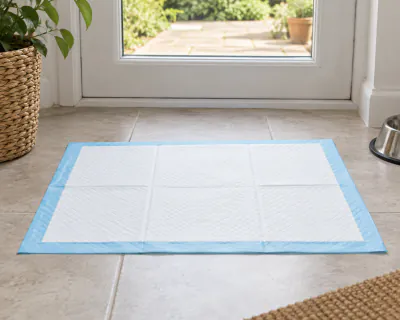
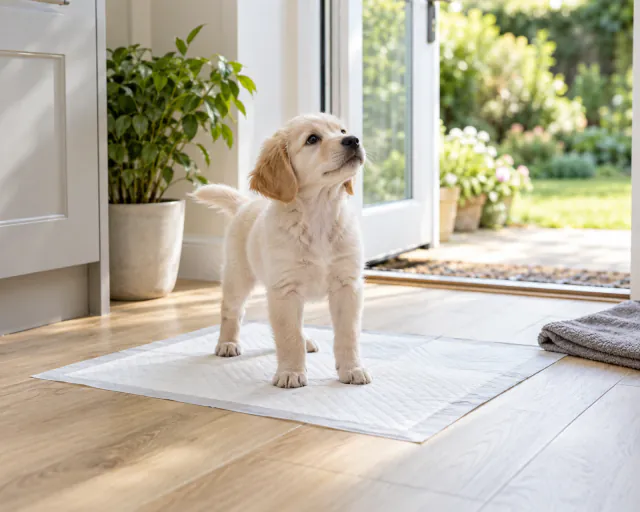
Start with the honest part, because it changes what you buy. A toilet pad is a containment measure, not a training method. Blue Cross puts it plainly in its puppy advice: leaving paper down “won’t teach your puppy where you would like them to go to the toilet”, though it does make the mess easier to clean up and stops the area becoming soiled. Dogs Trust goes further in the context of older dogs, warning that pads “may cause confusion” and that “they can encourage going to the toilet indoors and reduce the likelihood of your dog going outside instead”. The PDSA’s own toilet training advice is built entirely around getting the puppy outside: out every two to three hours during the day, first thing in the morning, shortly after each meal, with praise and a high-value reward when the puppy goes in the right place, and never a punishment for an accident indoors.
So the case for a pad is narrow and practical. Overnight, in a flat several floors up, during the days before a puppy’s vaccinations allow it outside, or for an older dog with a medical reason, a pad protects the floor while the real training happens outdoors. Bought for that job, it is useful. Bought as a substitute for taking the puppy out, it works against you.
How products are chosen
Canine Origin has not tested these pads hands-on. Each one was chosen from the maker’s published details and a UK listing, checked against the criteria below, and every specification on the product cards names the page it came from and the date it was read. The criteria are published pad dimensions, what the maker says the absorbent core and the backing are made of, whether there is an attractant, whether the pad has corner adhesive, and for washable pads the stated wash temperature and any stated number of washes. Absorbency is a particular problem in this category: not one maker or UK listing checked here publishes a capacity in millilitres, so the comparison below is on construction and size rather than on how much a pad holds.
How to choose a toilet pad
Size first. The pads here run from 45 x 30 cm up to 90 x 60 cm, and the common mistake is buying the smallest. A puppy that circles before squatting needs more room than the pad it is standing on, and a pad that is too small produces a puddle at the edge, which teaches nothing except that the floor is fine too. Buy larger than looks necessary and reduce later.
Then decide between disposable and washable. Disposable pads are convenient, produce daily waste and are the ones with attractants and adhesive corners. Washable pads cost more once, wash at a stated temperature and are worth it if the pad is a long-term arrangement, such as a crate or car liner, rather than a few weeks of puppyhood. If the pad is going in a crate, read our crate mats guide as well, because the two do different jobs and a wet pad under a dog is not bedding.
Finally, look at the backing. Every disposable pad here has a plastic film underneath, which is what stops the floor getting wet, and it is also what makes the pad slide on laminate unless it has corner adhesive or you put something under it.
What is actually inside a pad
Disposable pads are built in layers, and the makers describe them differently enough to be worth reading. Savic states a silica gel core that absorbs moisture and neutralises odours, a leak-proof polyethylene backing, and that the surface dries within thirty seconds so a puppy does not track wet paw prints away. The zooplus own-brand kooa pads use a bamboo fleece top layer over a cellulose core, with a PE foil backing and four corner stickers for fixing the pad to the floor.
Attractants are the other difference. Savic states a pheromone attractant intended to encourage faster training, and Simple Solution states a 3-in-1 attractant on its washable pad. Whether a given puppy responds is another matter, and no maker publishes evidence you could check. Treat an attractant as a possible small help rather than the reason to choose a pad.
Washable pads are simpler: a fabric top over an absorbent middle with a waterproof backing. The Trixie pad is polyester and cotton with a sealed rim, and its maker states washing at 60 degrees, which is the only published wash temperature among the washables here. Simple Solution’s UK listing states testing for up to 300 washes but neither its listing nor the maker’s page gives a temperature, which is a real gap.
Placement, and why it matters more than the pad
Put the pad in one place and leave it there. Dogs Trust’s advice for owners who do use pads is to always place them in the same spot, secure them so they do not slip, change them regularly, and make sure the dog still has outdoor access. Keep the pad well away from the bed and the food bowls, because a puppy will not willingly toilet next to either, and away from the route between the two.
If you are moving a puppy from pads to outdoors, move the pad gradually towards the door rather than removing it overnight, and take the puppy out on the schedule the PDSA describes regardless of whether the pad is there. Blue Cross suggests putting some soiled paper in the spot you want used, because the smell helps the puppy work out where to go. Our toilet training routine lesson sets out the full pattern, and the puppy daily routine guide shows where the toilet breaks sit in a day.
Safety and hygiene
Two things matter here. The first is chewing. A pad is a flat sheet of plastic film, fluff and gel, and puppies explore with their mouths; a shredded pad is a mess at best and a swallowing risk at worst. Do not leave a pad down with a puppy that is picking at it rather than using it, and never leave one in a crate with an unsupervised puppy that chews.
The second is hygiene. Change disposable pads often rather than letting them fill, wash your hands afterwards, and wash reusable pads at the temperature the maker states. None of the pages checked here says any of these pads is flushable, so treat them all as general waste. If a puppy that was making progress suddenly starts having accidents, or an older dog begins soiling indoors, that is a health question before it is a training one: Dogs Trust names urinary tract infections, bladder stones, kidney disease and canine cognitive dysfunction among the medical causes, and advises seeing a vet if accidents continue or have come on very suddenly. Our guide to routine health checks at home covers what is worth noting before that appointment.
When to stop using them, and questions to ask
Stop as soon as the puppy is reliably going outside and can hold on between trips, rather than keeping a pad down as insurance. Leaving one in place is the situation Dogs Trust describes, where the indoor option quietly competes with the outdoor one. For a puppy that is only using pads overnight, the pad usually goes when the dog can last the night, which arrives sooner than most owners expect.
Before buying, ask: is this pad bigger than my puppy’s turning circle, will it stay where I put it or do I need corner adhesive, am I buying for a few weeks or for a long-term crate liner, and can I wash this at a temperature the maker has actually published. Our guide to preparing your home for a new puppy covers where the pad sits alongside everything else in the first week.