
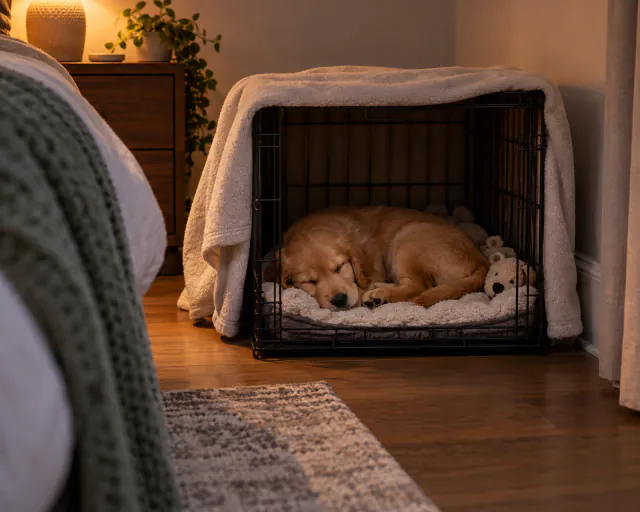
Sleep does more work in a young puppy’s development than almost anything else on a new owner’s list, yet it is usually the item that gets squeezed to make room for everything else. A puppy’s brain and body are growing at a rate they will never repeat, and a large part of that growth and the processing of everything newly learned each day happens while asleep, not while awake. A puppy who is not getting enough genuine rest is not simply a bit tired, they are missing something their development actually depends on.
This guide covers what typical sleep looks like at different young ages without pretending to a false level of precision, how to set up a sleeping space that actually helps, why night and day should feel different from the very start, and which sleep patterns are ordinary versus worth a call to the vet.
How much sleep is typical
Very young puppies sleep for a large proportion of each twenty four hours, considerably more than an adult dog, and that sleep is usually spread across many shorter bouts rather than one long stretch, particularly in the earliest weeks at home. As a puppy gets older across the following months, the total amount of sleep gradually decreases and it consolidates into longer, less frequent blocks. Rather than fixing on a specific number of hours as a target, which varies with age, breed and the individual puppy, the more useful measure is behaviour: a puppy who naps readily and easily several times through the day, and who is generally calm rather than wired between naps, is getting roughly what they need. A puppy who seems to fight sleep, or who only drops off from complete exhaustion after a period of frantic behaviour, is usually not getting enough rest during the day.
Setting up a space that actually helps
A good sleeping space is calm, enclosed enough to feel secure, and free from constant disturbance. A crate or pen with comfortable bedding, away from direct sun through a window, away from a radiator or draught, and positioned somewhere the puppy is not repeatedly woken by foot traffic, tends to work well. Cover part of an open-fronted crate with a light blanket if the puppy seems to settle better with less visual stimulation, provided ventilation stays adequate. The aim is a space that says clearly to the puppy that this is where rest happens, kept separate as far as possible from the busier spaces used for play and activity.
Make night and day feel different from the start
One of the most useful habits to establish early is a clear difference between how the household responds at night and how it responds during the day. Overnight, keep any necessary interaction deliberately boring: a brief, quiet toilet trip in low light with minimal talking, then straight back to bed, rather than the play, chat and attention a puppy might get for the same behaviour during the day. This teaches a puppy that night time is for sleeping and that waking up rarely leads to anything interesting, which speeds up the process of sleeping through longer stretches as they grow.
Normal sleep behaviour versus something to check
Twitching paws, soft whimpers, rapid eye movement under closed lids and the occasional muffled bark during sleep are all typical signs of a dreaming puppy and are not something to intervene in. Waking a puppy from this kind of sleep is usually unnecessary and can startle them.
What is worth watching for is different: a puppy who cannot settle at all despite clearly being tired, who seems distressed rather than simply unsettled when trying to sleep, who sleeps dramatically more than seems typical and is also lethargic, uninterested in food or slow to rouse, or whose sleep patterns change suddenly and significantly without an obvious cause such as a change in routine. Persistent, genuine distress around sleep, or excessive sleepiness paired with other signs of being unwell, are reasons to speak to a vet rather than working through it alone.
Where the crate or pen should live at first
Placing the sleeping space near the family, often in or close to a bedroom for the first weeks, is commonly recommended because it means the puppy is not sleeping somewhere totally isolated during a period when they are adjusting to life without littermates. Being able to hear breathing and movement nearby, without necessarily being touched or picked up, helps many puppies settle faster than being placed somewhere quiet and separate straight away. As the puppy grows in confidence over the following weeks and months, most households gradually move the sleeping space towards its longer-term location, whether that stays in a bedroom or moves elsewhere in the house, doing so in small steps rather than all at once.
How this fits into the wider day
Sleep does not sit apart from the rest of a puppy’s day, it underpins it. A puppy who sleeps well during the day is generally easier to settle at night, and a puppy who sleeps well at night copes better with training, socialising and normal household life during the day. How the sleep windows fit alongside meals, toileting and activity across a full day is covered in building a puppy’s daily routine.