Switching a dog’s food overnight, from one bag straight to another, is one of the more common causes of a sudden bout of loose stools or vomiting that otherwise seems to come from nowhere. A dog’s digestive system, and the bacterial population living in it, adjusts to whatever it processes regularly, and a sudden change in ingredients, fat content or fibre asks it to adapt faster than it comfortably can.
This guide covers the standard gradual approach to changing food, situations that call for a slower transition than usual, and the signs that mean a transition should be paused rather than pushed through.
The standard gradual approach
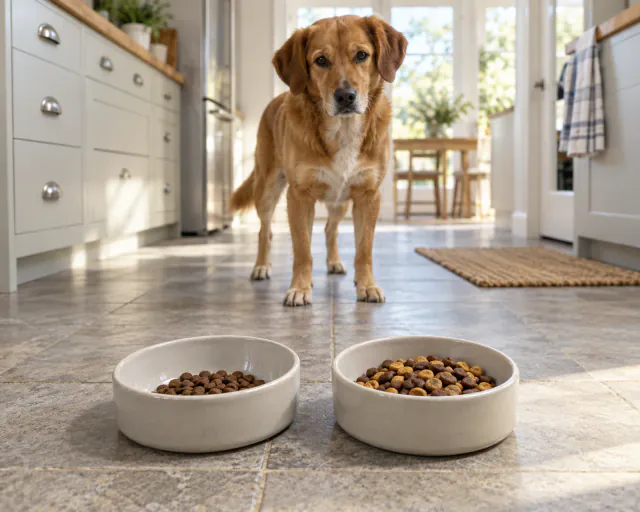
The widely used method is to mix the new food into the old food in gradually increasing proportions over roughly seven to ten days, rather than switching in one step. A typical pattern looks something like a quarter new food to three-quarters old food for the first two or three days, moving to half and half for the next two or three days, then three-quarters new to a quarter old for a couple more days, before finishing on the new food alone.
Exact proportions and timing are less important than the underlying idea: give the gut several days of overlap rather than an abrupt switch, and move through that overlap steadily rather than jumping straight to the new food after only a day or two. Adjust the pace within that broad approach based on how the individual dog’s digestion responds, rather than following a rigid day-by-day schedule regardless of what you observe.
Why abrupt changes cause problems
A sudden change in the mix of protein, fat and fibre reaching the gut can outpace how quickly its resident bacteria and digestive processes adjust, and loose stools, mild vomiting or reduced appetite for a day or two are common results of a food changed too quickly. This is not usually a sign that the new food disagrees with the dog specifically, and it often resolves on its own if the diet is reverted or the transition slowed down.
It also means that switching foods to try to solve an existing digestive problem is not straightforward to judge, since introducing the change itself can produce short-term symptoms that look similar to the ones a change was meant to fix. Where a dog has an existing or suspected digestive issue, involving a vet before choosing and introducing a new diet avoids this confusion and ensures any change is appropriate for what is actually going on.
Dogs that usually need a slower transition
Some dogs benefit from stretching the gradual approach out longer than the standard week to ten days. Dogs with a history of sensitive digestion, dogs recovering from a recent bout of gastrointestinal illness, puppies, and senior dogs commonly do better with a slower changeover, sometimes extending the whole process to two weeks or introducing the new food in smaller initial proportions than the typical starting split.
This is a general tendency rather than a fixed rule for every dog in these groups. Some puppies and seniors transition food without any issue on a standard timeline, and the safest approach for a dog with a known sensitivity is to ask a vet what transition pace they would recommend for that specific dog, rather than assuming a slower pace is automatically required.
When a faster change might be advised
There are situations where a vet advises a quicker transition than the standard gradual approach, typically for a specific clinical reason, such as needing a dog on a particular diet promptly to manage an acute condition. This kind of faster change is a deliberate clinical decision made with knowledge of the individual dog’s situation, not a general shortcut, and it is not something to attempt independently on the assumption that a healthy dog will simply cope. Outside specific veterinary direction, the gradual approach remains the safer default for the great majority of food changes.
What to watch for during a transition
Mild, brief loose stools during a transition are relatively common and often settle as the mix shifts further toward the new food. What is not normal, and needs a pause, is vomiting that repeats or is severe, diarrhoea that continues for more than a day or two, blood in the stool or vomit, a dog that seems lethargic, off its food entirely, or otherwise unwell rather than simply having slightly looser motions.
If any of these appear, the sensible response is to stop advancing the transition, hold at the current mix or step back toward the old food, and contact a vet, particularly if symptoms are more than mild or do not settle quickly. Pushing on with the schedule regardless of how the dog is actually responding defeats the purpose of a gradual approach in the first place.
Keep the old food’s packaging until the switch is complete
Hold onto the packaging, or at least note down the full product name and any batch information printed on it, from the previous food until the transition is finished and the dog has settled comfortably onto the new diet. If a reaction does occur partway through, having the exact identity of both foods on hand makes it far easier for a vet to work out what might be responsible, and to advise on next steps, rather than trying to reconstruct from memory what was being fed a week or two earlier.
The same principle applies across life stages
Moving a dog from a puppy diet to an adult diet, or from an adult diet to a senior diet, uses the same gradual mixing principle as switching between two ordinary adult diets. These transitions are sometimes treated as more significant because they mark a change in life stage, but the digestive system does not distinguish a life-stage change from any other change in ingredients, so the same steady week-to-ten-day overlap applies. Timing a life-stage food change to coincide with other changes, such as a house move or a new routine, is worth avoiding where possible, since it becomes harder to tell which change is responsible if the dog shows any signs of an upset stomach.